
Leon Trotsky's Toilets, Sinks,
Tub and Hot Water Heater
Leon Trotsky
Лев
Троцкий
Leon Trotsky was a prominent figure of the Communist Revolution, arrested and exiled into Siberia twice during Tsarist days. He founded the newspaper Pravda. He was in western Europe when World War I broke out and was deported to the U.S. He returned to Russia after the February Revolution of 1917 overthrew Tsar Nicholas II. By the end of 1917 he was second only to Lenin in the leadership of the Bolshevik Party. But after Lenin's death in 1924, Stalin portrayed Trotsky as an enemy of the party and sent him into exile. He ended up in Mexico City, where he lived in a very nice home that you can tour today. And, of course, I photographed Trotsky's toilet. And his hot-water heater, sink, and tub.
He was born Lev Davidovich Bronshtein or Лев Давидович Бронштейн in Yanivka, Ukraine, in 1879. He changed his name during Czarist days to Leon Trotsky, derived from a German term for "defiance".
Lenin probably would have named Trotsky as his successor, but Lenin's stroke prevented that. Trotsky was a party theorist, and seems to have been closer to the original intent of Marx than any other prominent Soviet figure.
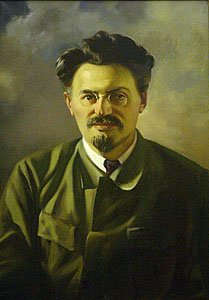
Official Soviet portrait of Leon Trotsky.
Trotsky's father, a well-to-do farmer, sent him to Odessa for schooling in 1888 at the age of nine. Odessa was a cosmopolitan port city, very atypical of the Russian Empire. The atmosphere of Odessa led Trotsky to an international outlook.
In 1896, when he was just sixteen, Trotsky became involved in revolutionary activities after moving from Odessa to Nikolayev. He was initially a народник or narodnik, a populist revolutionary. He was introduced to Marxism, which he initially opposed but then gradually came to adopt.
Trotsky helped to organize the South Russian Workers' Union in Nikolayev in early 1897. Two hundred members of this union, including Trotsky, were arrested in January 1898. Trotsky was imprisoned for two years waiting for his trial. During this time the Russian Social Democratic Labor Party was formed, Trotsky became a member, he married fellow Marxist Aleksandra Sokolovskaya, and he studied philosophy. He finally got his trial in 1900, at which he and his wife were sentenced to four years of exile in the Irkutsk region of Siberia.
Leon and Aleksandra had two daughters in Siberia, but they soon separated and divorced. Meanwhile the party was splitting. One side argued that the party should concentrate on improving the lives of industrial workers. The other, which Trotsky sided with, said that the most important thing was forming a well-organized and disciplined revolutionary party to overthrow the monarchy.
Trotsky managed to escape his exile in Siberia during the summer of 1902. He moved to London to join the editors of Искра or Iskra, the newspaper of the monarchy-overthrowing faction. Trotsky took the pen name Перо or Pero ("feather" or "pen"), becoming one of the paper's leading editors along with Vladimir Lenin, Georgi Plekhanov and Julius Martov. Trotsky met Natalia Ivanovna Sedova in late 1902. She soon became his lover, and they married in 1903.
No one should ever claim that left-wing politics are simple. They split and squabble in a fractal fashion. The existing six editors of Iskra were equally split between Plekhanov's "Old Guard" and Lenin and Martov's "New Guard". Lenin expected Trotsky to side with his "New Guard" and give it a majority. So, Plekhanov opposed making Trotsky a full member of the editorial board.
In 1903, Iskra convened the party's 2nd Congress in London. Soon after that the pro-Iskra group split into two factions. Lenin's Bolsheviks wanted a smaller but highly organized party, while Martov's Mensheviks wanted a larger and less organized one. In case you aren't confused yet, the name bolshevik refers to larger size while menshevik refers to smaller size — the opposite of those factions' desired party sizes! But the idea was that большевик or bolshevik referred to the "majority" and меньшевик or menshevik referred to the "minority". Meanwhile most of the Iskra editors (the majority!), including Trotsky, sided with the mensheviki.
Trotsky gave up on this confusing mess in September 1904 as the Mensheviks insisted on an alliance with Russian liberals and opposed reconciliation with Lenin and his Bolsheviks. Trotsky described himself as a "non-factional social democrat" from 1904 until 1917, during which he spent most of his time trying to reconcile the various factions within the party. In his spare time he was developing his theory of Permanent Revolution.
In January 1905 a group of unarmed peaceful demonstrators were marching through Sankt-Peterburg to deliver a petition to Tsar Nicholas II. The petition called for improved working conditions, a reduction of the working day to eight hours, and increased wages, along with an end to the Russo-Japanese War and the introduction of a universal right to vote. They were approaching the Winter Palace from several directions when they were gunned down by the Imperial Guard in the Bloody Sunday massacre.
Maybe about 1,000 people were killed — the Tsar said just 96, anti-Tsarist sources said over 4,000 — and disorder and looting broke out. This led to the Revolution of 1905, which in turn led to the 1917 Revolution.
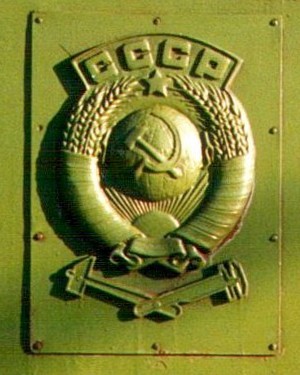
The State Emblem of the Soviet Union on an older Russian passenger train. A hammer and sickle, a red star, and two sheaves of wheat wrapped in a ribbon with "Workers of the world, unite!" in the official languages of the Soviet Union. 15 of them, one for each republic. СССР is "SSSR" spelled with Cyrillic letters: Союз Советских Социалистических Республик or Soyuz Sovietskikh Sotsialisticheskikh Respublik, meaning Union of Soviet Socialist Republics.
Trotsky returned to Russia the month after Bloody Sunday, in February, initially writing pamphlets for an underground press in Kiev but soon moving to Sankt-Peterburg. He worked there with both Bolsheviks and Mensheviks. However, the Mensheviks were infiltrated by a secret police agent, forcing Trotsky to flee to rural Finland until a national strike in October 1905 allowed him to return.
The Mensheviks had come up with the same idea Trotsky had, a Soviet (or "Council") of Workers, an elected non-party revolutionary organization. The Sankt-Peterburg Soviet was up and running by the time Trotsky returned from Finland. Trotsky joined and was elected Vice-Chairman under yet another pseudonym, "Yanovsky". The chairman was arrested in November, and Trotsky took his place.
On December 2, 1905, the Sankt-Peterburg Soviet issued a proclamation criticizing the Tsarist government, and it was promptly surrounded the next day by troops loyal to the Tsar's government. Trotsky and other leaders of the Soviet were tried in 1906 on charges of supporting armed rebellion. Trotsky delivered what are considered some of his best speeches at his trial, but he was convicted and sentenced to deportation and exile in Obdorsk, Siberia.
On the way to Siberia in January 1907, Trotsky once again escaped and made his way to London. He arrived in time to attend the 5th Congress of the RSDLP. In October he moved to Vienna for seven years, where he participated in both the Austrian Social Democratic Party and the German Social Democratic Party.
In October 1908 Trotsky founded Правда or Pravda, meaning "Truth". Pravda became a party-financed "central organ" in 1910, and Trotsky kept publishing it until April 1912. The very same month, the Sankt-Peterburg Bolsheviks started a new labor-oriented newspaper and also called it Pravda, greatly upsetting Trotsky. He sent a letter to the Mensheviks denouncing the newspaper-title-stealing Bolsheviks in general and Lenin in particular. Unfortunately, the police intercepted the letter and kept a copy in their archive. The letter was found in the archive in 1924, soon after Lenin's death, and it was used to portray Trotsky as an enemy of Lenin.
Trotsky continued to write articles for radical Russian and Ukrainian papers, including Kievskaya Mysl, which in 1912 sent him as their correspondent to cover the two Balkan Wars.
World War I broke out in late July of 1914. This pitted Austria-Hungary against the Russian Empire, and so within a week Trotsky had to flee to neutral Switzerland to avoid arrest in Vienna as a Russian. Once there he worked with the Swiss Socialist Party and quickly cranked out an anti-war book, The War and the International.
He moved on to France in November 1914 as a war correspondent for the Kievskaya Mysl. In January 1915 he began editing Наше Слово or Nashe Slovo, "Our Word".
At the end of March the French deported Trotsky to Spain because of his anti-war activities. The Spanish didn't want him either, although they let him stay until Christmas of 1916 when they deported him to the United States.
Trotsky in New York
Trotsky arrived in New York on January 13, 1917. He was there for not quite three months. He lived in the Bronx, at 1522 Vyse Avenue, but he worked for Новый Міръ or Novy Mir, "New World" in English, where he worked alongside Nikolai Bukharin and Alexandra Kollontai. Bukharin went on to be a member of the Politboro and Central Committee of the Soviet Union, and editor in chief of Pravda (the post-revolution Soviet one), Bolshevik, Izvestia, and the Great Soviet Encyclopedia. Then he opposed a number of Stalin's policies, and fell victim to the "Moscow Trials" and purges of the late 1930s.

Amazon 1640090037
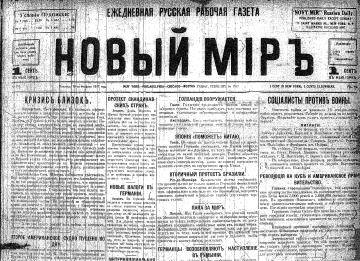
Notice the spelling, the pre-revolutionary Міръ instead of the sleek revolutionary Мир. Trotsky also wrote articles that were translated into Yiddish for publication in Der Forverts, "The Forward", a Yiddish radical publication.
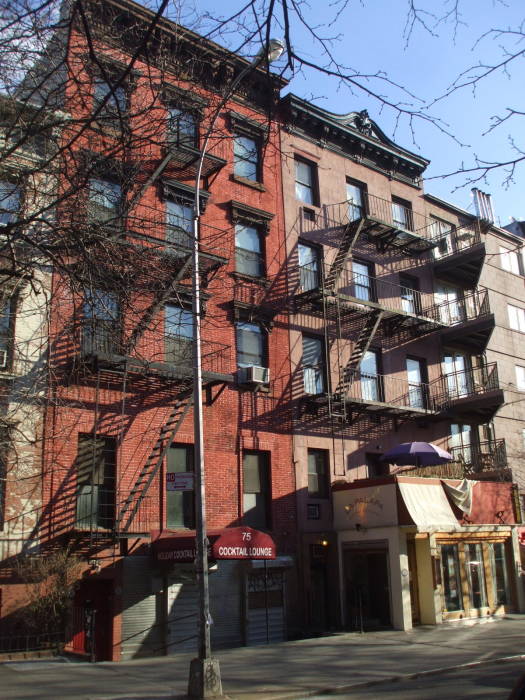
Novy Mir was published at #77 St Marks Place in what today is called the East Village.
Today, #77 St Marks Place is the home of La Palapa, a nice Mexican restaurant. #77 is the lighter colored building at right in the picture, the yellow and red extension is the entry to La Palapa.

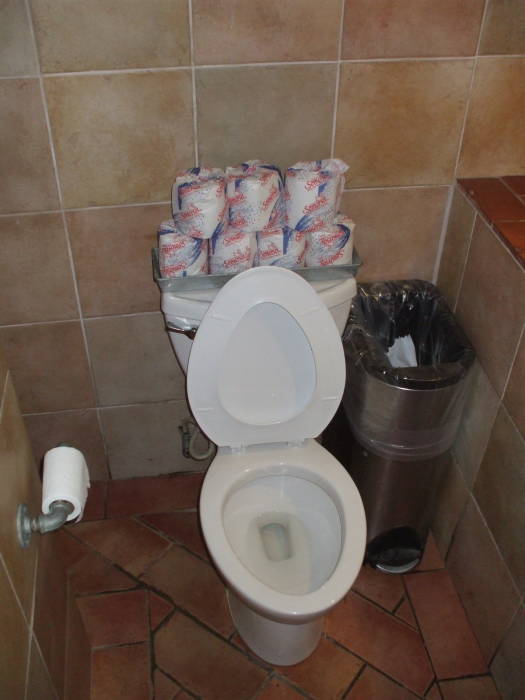
Here we see the restaurant's toilet. Renovations have definitely happened since the days when Trotsky and Bukharin worked here writing and publishing Novy Mir.
So yes, unlike those above and below at Trotsky's home in Mexico City, this is just "site of" plumbing.
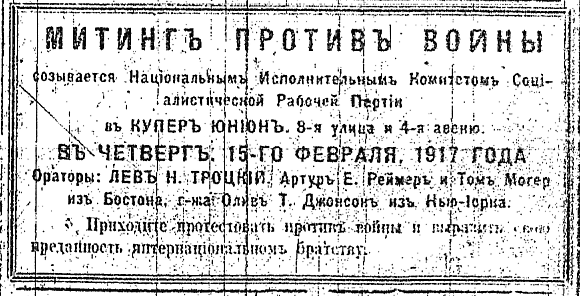
This is an announcement in Novy Mir of a meeting of a group opposing the war. It's to be at Cooper Union, at 8th Street and 4th Avenue, on the 15th of February, 1917. The first "orator" or speaker, listed in all capitals, is Lev N. Trotsky.
Amazon
ASIN: 1931859450
Trotsky Returns to Russia
The February Revolution of 1917 overthrew Tsar Nicholas II, and Trotsky left New York by ship on March 27th. He reached Russian on May 4th, joining the Mezhraiontsy regional social democratic organization in Sankt-Peterburg, also known as Petrograd around this time. He was elected a member of the first All-Russian Central Executive Committee (ВЦИК or VTsIK) at the First Congress of Soviets in June.
Trotsky was arrested, again, after an unsuccessful Bolshevik uprising in August. He was held for 40 days and then released. The Bolsheviks gained the majority in the Petrograd Soviet, and Trotsky was elected its chairman on October 8th.
By the end of 1917 Trotsky was clearly second only to Lenin in the Bolshevik Party.
Stalin wrote a summary of Trotsky's role in the events of 1917, published in Pravda and included in Stalin's 1934 book The October Revolution (but cut out of Stalin's Works of 1949):
All practical work in connection with the organization of the uprising was done under the immediate direction of Comrade Trotsky, the President of the Petrograd Soviet. It can be stated with certainty that the Party is indebted primarily and principally to Comrade Trotsky for the rapid going over of the garrison to the side of the Soviet and the efficient manner in which the work of the Military Revolutionary Committee was organized.
The Bronx Home News was more straightforward with their headline:
BRONX MAN LEADS RUSSIAN REVOLUTION
Trotsky became the People's Commissar for Foreign Affairs. He resigned that position on March 13th, 1918 to become People's Commissar of Army and Navy Affairs and the chairman of the Supreme Military Council. The position of commander-in-chief was abolished, granting Trotsky full control of the Red Army subject only to the oversight of the Communist Party leadership.
On and on.... Criticism of Trotsky's military leadership in 1919, Trotsky was put in charge of national railroads in 1920, meddling with the trade union system in 1921, and then Lenin's health began to deteriorate.
Lenin had three strokes between May 26th, 1922 and March 10th, 1923. These caused paralysis and loss of speech. Lenin died on January 21st, 1924. Stalin, Zinoviev and Kamenev formed a troika to make certain that Trotsky would not succeed Lenin, despite his official public position as second only to Lenin.
Trotsky in Exile
Trotsky lost his positions and political power in 1925. He was expelled from the Central Committee in October, 1927.
Trotsky was exiled to Alma Ata in Kazakhstan on January 31st, 1928. Just over a year later in February 1929 he was expelled from the USSR to Turkey. He and his wife and son lived on the island of Büyükada near İstanbul, Turkey for four years.
French Prime Minister Édouard Daladier offered Trotsky asylum in France in 1933. He lived there in Royan and Barbizon, but was told in 1935 that he was no longer welcome in France. He lived near Oslo, Norway for two years, at which point he was put under house arrest. Norwegian officials arranged his transfer to Mexico by cargo ship.
Trotsky in Mexico
The Mexican president Lázaro Cárdenas welcomed Trotsky when his cargo ship docked at Tampico, and arranged for a special train to carry him to Mexico City.
Trotsky initially lived at the home of the painter Diego Rivera and his wife Frida Kahlo. Trotsky had an affair with Kahlo, which led unsurprisingly to Rivera kicking Trotsky out of his house. Trotsky moved in May 1939 to a house a few blocks away on Avenida Viena.
Today you can tour his home in Mexico City. It's very swanky, click here to see my pictures. The communist leaders may have been for collectivism and "from each according to his abilities, to each according to their needs", but this is a very nice home for Mexico City in the 1930s.
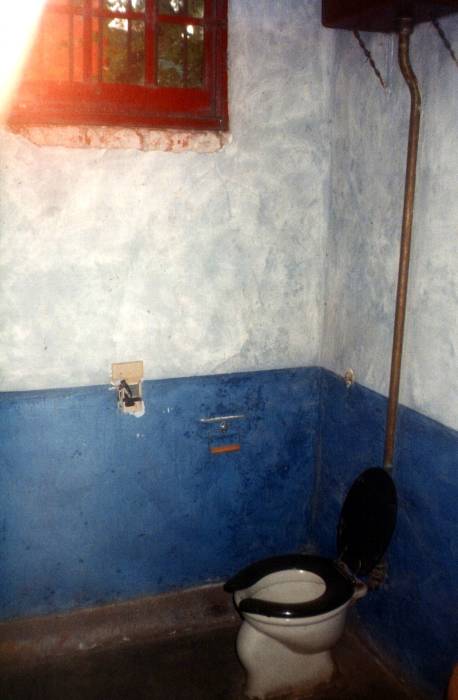
Leon Trotsky's toilet at his home at Avenida Viena in Mexico City, where he lived in 1939 and 1940. Notice how high the water tank is mounted on the wall. This would have had a powerful flush!
Meanwhile, in 1936 the first "show trial" was staged in Moscow. Trotsky, Zinoviev, Kamenev, and over a dozen others confessed to having joined Trotsky in a plot to kill Stalin and other Soviet leaders. They were all found guilty and sentenced to death, the sentence being passed on Trotsky in absentia.
A second "show trial" in 1937 of seventeen others connected Trotsky to more supposed conspiracies and crimes. Trotsky was now under a death sentence.
In May of 1940 a group organized by NKVD deputy director Pavel Sudoplatov and led by GPU agent Iosif Grigulevich, the Mexican painter David Alfary Siqueros, and Vittorio Vidale launched an assassination attempt. The group disguised themselves as police officers and overpowered Trotsky's guards. They set up machine guns in the inner courtyard of the home and began firing. Everyone inside hid underneath bedroom furniture as the attackers fired into the various rooms of the house. I don't know if that was the source of the damage next to the toilet in the pictures above. Trotsky's grandson was shot in the foot, and Robert Sheldon Harte, one of Trotsky's assistant and bodyguards, was abducted and later killed. The other guards eventually repelled the attack.
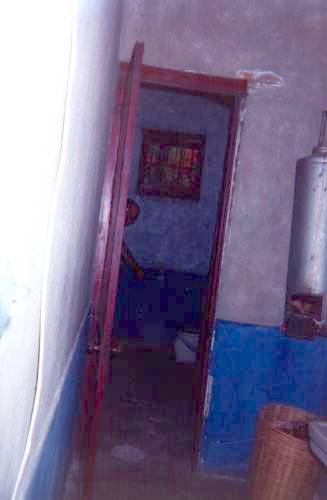
Leon Trotsky's bathroom sink, hot water heater and toilet. Hey, these are my pages and sometimes I include other plumbing of interest like Jim Morrison's bidet or Robert F Kennedy's home water fluoridation system.
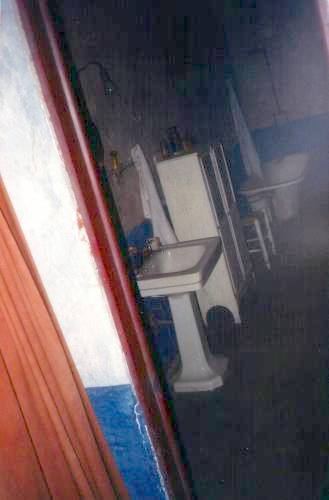
Leon Trotsky's bathroom sink and bathtub.
Ramón Mercader, a Spanish-born NKVD agent of Stalin's, was living in Mexico City with a Canadian passport. He had gone through a series of identities including "Jacques Mornard", a Belgian; "Frank Jacson", a Canadian; and "Jacson Mornard", who may have been Belgo-Canadian for all I know. He had managed to become the lover of Sylvia Ageloff, Trotsky's personal secretary, living with her on and off over a period of two years and gaining access and trust within the Trotsky household.
Leonid Eitingon, a GPU agent who had operated in Spain, headed the second attack. Mercader, as either Frank Jacson or Jacson Mornard, started meeting with Trotsky in the guise of a sympathizer.
On August 20, 1940, Mercader showed up at Trotsky's house with a mountaineering ice axe hidden under his coat. Why an ice axe? Because you can casually walk around Mexico City carrying an ice axe and no one will notice? That can't be it. Because Mercader was an expert with ice axes? That doesn't seem to have been the case, either.
Eitingon and Mercader's mother, Caridad, were waiting outside behind the wheels of two getaway cars. Nothing like joining forces with your mother in an assassination.
Mercader went into Trotsky's study and asked him to read something that he had written. While Trotsky was reading, Mercader pulled the ice axe out from under his raincoat and hit Trotsky in the back of the head. Perhaps due to Mercader's lack of experience swinging ice axes, the blow did not kill Trotsky immediately.
There was a struggle. Trotsky's bodyguards nearly killed Mercader but Trotsky told them not to, saying that the assassin should be made to answer questions. Trotsky was taken to the hospital, where he died the next day from blood loss and shock. The getaway drivers had gotten away, and both fled the country.
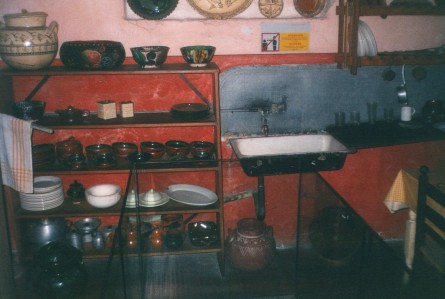
Leon Trotsky's kitchen sink at Avenida Viena in Mexico City.
"When we are victorious on a world scale, I think we shall use gold for the purpose of building public lavatories in the streets of some of the largest cities in the world."
— Vladimir Ilych Lenin
Mercader was convicted of murder and spent twenty years in prison in Mexico. He and his mother were awarded the Order of Lenin in absentia by Stalin. Mercader was released from prison in 1960 and moved first to Havana, Cuba, and then moved on to the Soviet Union in 1961. He was then awarded the USSR's highest decoration, Hero of the Soviet Union.
If you're really into Leon Trotsky ephemera, and you would like to also see pictures of his typewriter, his kitchen, his rabbit hutches, his sombrero, and lots more at his Mexico City home, then see my page with more pictures from there.
If you are keenly interested in Communist Toilets in general, then be sure to see the toilets of the People's Republic of China.
As for the Trotsky family, his great-granddaughter Nora Volkow is head of the U.S. National Institute on Drug Abuse. She grew up in the Trotsky house in Mexico City.