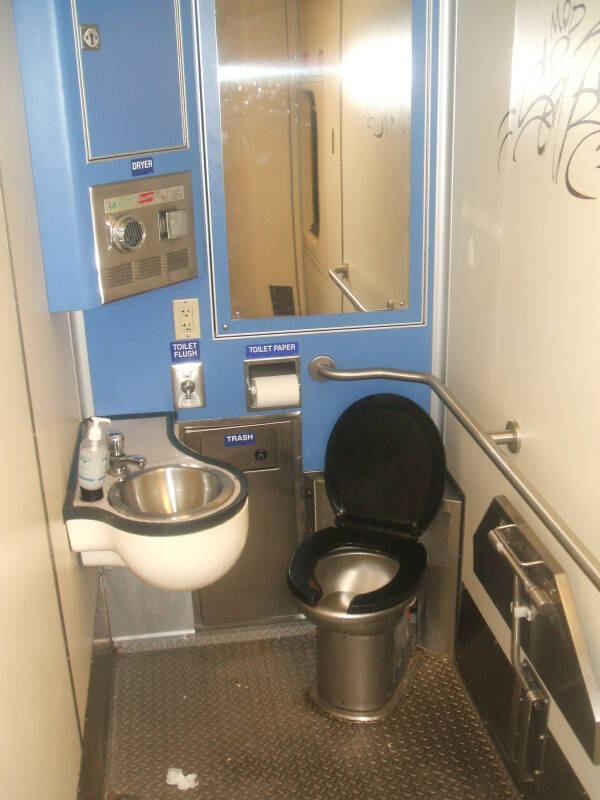
Toilets on Trains
Train Toilets
Passenger trains usually have toilets, and the on-board lavatory takes many forms. The simplest train toilets are those called Drop Chute Toilets or Hopper Toilets. The term "Drop Chute Toilet" is obviously descriptive: the toilet bowl opens into a vertical open-bottomed chute or tube about 4-5" or 10-12 cm in diameter dropping the waste onto the tracks beside one of the rails. The term "Hopper Toilet", on the other hand, could be confusing. It sounds as if there might be a hopper or storage tank to catch the waste, but there isn't. The toilet dumps directly onto the track just like a hopper car used to transport grain.
This page shows toilets on board trains. Toilets in train stations are shown on the corresponding national pages.
You often find a flapper in the drop chute, limiting the air flow outside flushing times, but some times you can simply look down the tube and see the tracks rushing past. The lower opening of the drop chute should be shaped in such a way as to draw air down the chute by means of the Bernoulli Effect, much like an upside-down chimney. This pulls air into the lavatory through the door vents, and then down and out through the toilet, reducing odor within the car. This usually works just fine as it's simple technology. But as I discovered and describe below, it can go horribly wrong.
The first drawing is from U.S. Patent 1,166,192 A, showing that in 1915 people were working on this problem. This design still drops the waste onto the tracks, the patent describes a method for the brakeman or other train staff to disable the flushing mechanism while the train is passing through a city. But once the flushing is re-enabled, it simply dumps waste onto the tracks.
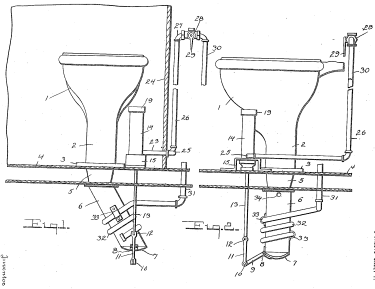
As long as the brakeman remembers to disable and re-enable the flushing, at least the waste is kept out of the cities. But this development just controls where the waste is simply dumped onto the tracks.
People have been working on improvements on the simple drop chute design. For example, US Patent 1,325,310 from 1918 describes a train toilet design with a holding tank. The holding tank, partially filled with water and visible below the floor in this diagram, collects waste from the toilet. When the train reaches a speed of 40 miles per hour, the electrical solenoid (number 18 in this diagram) energizes and pulls the stopper (#10) loose, allowing the tank to drain onto the tracks.
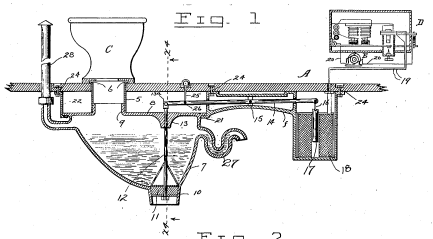
Well, that's a start. The control has been automated, and the waste has been diluted and at least partially liquified.
It has taken railway toilets a long time to move toward holding tanks, and inventors are still working on the problem. China, for example, recently issued a patent for a toilet liquid sewage collection box for trains. As that patent describes the current situation in China, most train sewage is "directly discharged onto the railway roadbed".
Luckily, train toilet holding tanks aren't nearly as much of a chore to empty as marine sanitation devices on boats. A yacht's head can sometimes be dumped offshore. Some of the nicest, most expensive toilets have been inside of the bathroom of a Prestige Yacht for sale and are similar to the ultra-low-flow toilets meant to reduce water use.
When were the First Toilets Installed in Trains?
Late 1880s Train ToiletsThat's a good question! The above patent drawings are from the U.S. in the 1910s. Another page describes toilets in overnight trains in the U.S. in the late 1880s.
Queen Victoria's 1869 train car and toiletQueen Victoria was the first British monarch to travel by rail, and her personal railway carriage included a nice toilet. The rail carriage is at the National Railway Museum in York, the Daily Mail has several pictures. Now, was the pictured toilet in the original 1869 design, or was it added when the car was modified in 1895?
There were railway-like systems with wagons hauled by animals and people all the way back in the 6th century in Corinth, Greece. There were horse-powered wagonways in the 16th century in Germany. But what we think of as a railway arrived after the development of the steam engine in Britain in the early 1800s. The Stockton and Darlington Railway in northeastern England was the first to carry passengers, in 1825.
Early passenger trains wouldn't have traveled far enough to need toilets on board. The Liverpool and Manchester Railway opened in 1830, it was the first public inter-city railway.
Sleeping cars for longer inter-city routes first appeared in the U.S. on the Cumberland Valley Railroad in the spring of 1839, running between Chambersburg and Harrisburg, Pennsylvania.
So, I would guess that the first one appeared in the 1830s, possibly as late as 1839. Do you have more information? If so, please let me know.
What's the Current Train Toilet Situation?
The simple drop chute design is slowly being replaced with holding tanks, usually featuring the familiar bright blue chemical solution. Some nations (e.g., the U.S. since around 1990) now use nothing but holding tank systems, others still have nothing but drop chute toilets, while many nations use a mixture.
A March 2014 article "Mind The Crap: The Continuing Problem of Poo on the Tracks" in The Londonist reported that all UK rolling stock built in 1996 has holding tanks, but older cars that dump the waste directly onto the tracks, including while in stations, were still in service. London's King's Cross, Liverpool Street, and Paddington stations are all served by trains with the older cars, and while passengers are urged not to use the toilets while in stations, it still happens. The track workers' union was calling for train companies to add containment systems, but while the government and the Rail Delivery Group is investing in new rolling stock it was estimated that complete fleet upgrades would take several more years.
The holding tank design obviously provides the opportunity for a cleaner solution for the stations and areas along the rail lines. However, it requires that the holding tank be emptied periodically. The down side is that the holding tank can fill, possibly backing up into the lavatory compartment, and often causing the train crew to lock the lavatory shut. That's a better solution until you can't get to it because it has made its mess inside the train instead of on the tracks.
The latest generation of rail passenger cars, like the French TGV, the Belgian Thalys, and Amtrak's Acela in the U.S., use lavatory units much like those found on passenger aircraft.
Traditional Train Toilet Songs
Well, there's pretty much just one train toilet song, although there are some variations. It's Humoresque, often known by its first line, Passengers Will Please Refrain. It's by the Canadian-born folk singer Oscar Brand, who hosted a weekly folk music shown on WNYC radio in New York City for 70 years.
Belgium
The Belgian Thalys trains are similar to the French TGV, and connect Belgium with France and the Netherlands.
It's great service. Both Thalys and TGV trains run at 300 kph with a very smooth ride, connecting Brussels and Paris in about 80 minutes with a train leaving every 30 to 90 minutes.
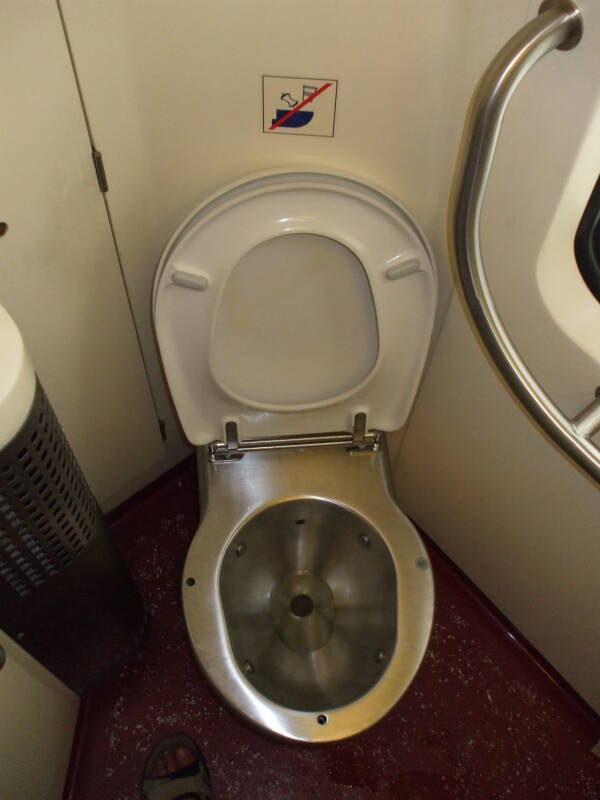
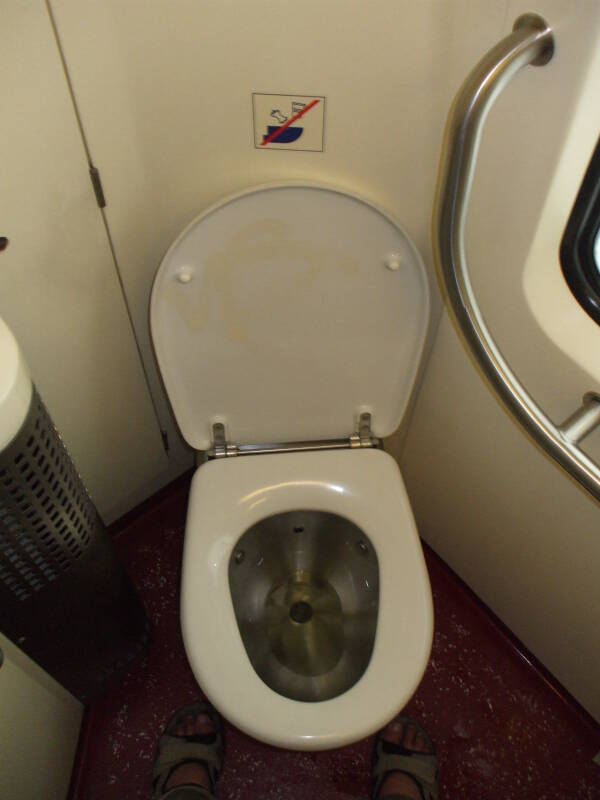
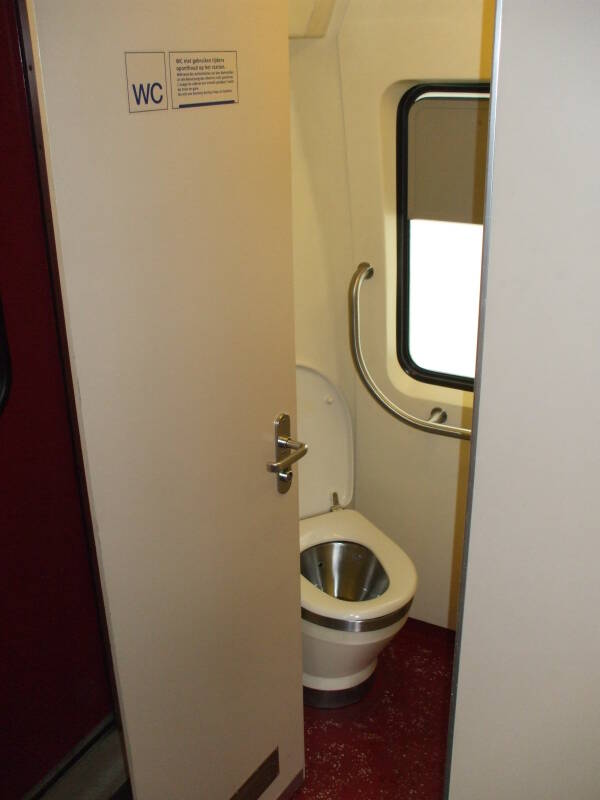
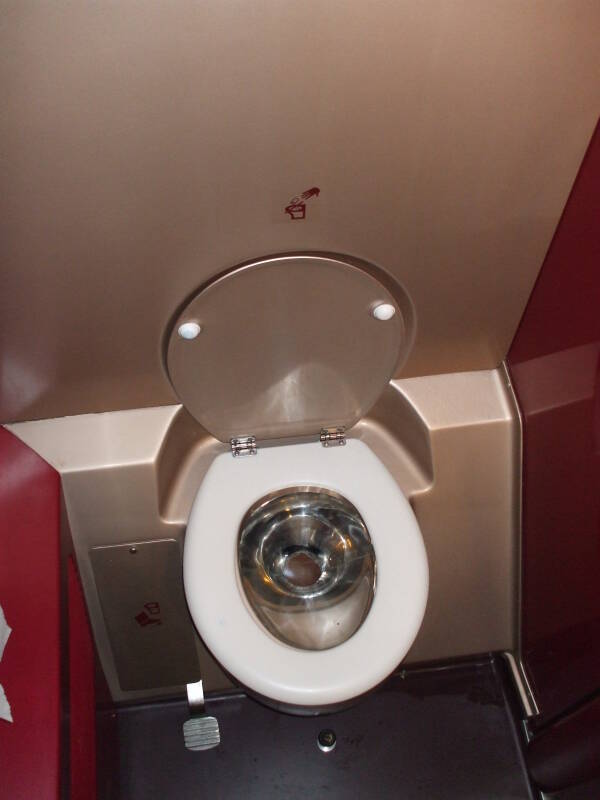
As you can see here, the Thalys lavatories feature toilets with stainless steel bodies connected to a holding tank.
The opening at the bottom of the bowl is sometimes rather small, as seen above. However, these toilets use vacuum flushing, eliminating almost all of the waste with a minimal use of the blue chemical solution. They're similar to current aircraft toilet designs.
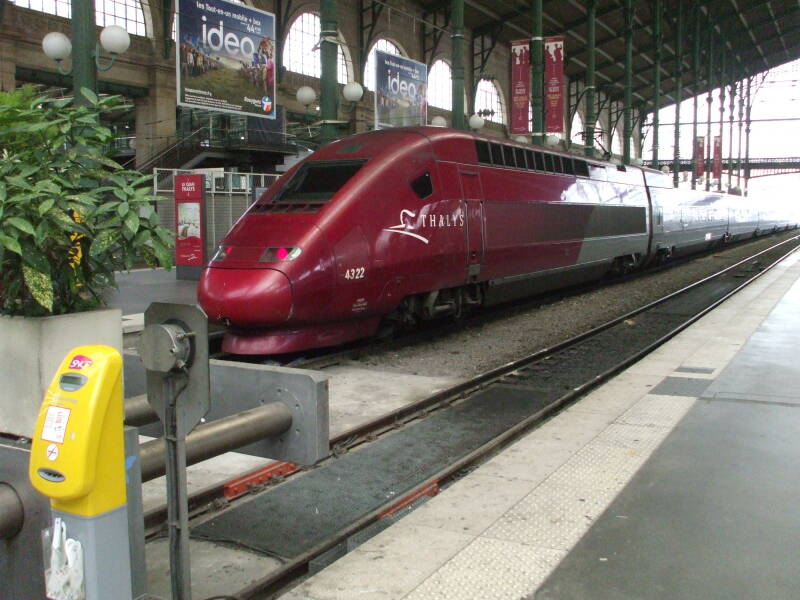
The Thalys trains arrive and leave Paris at the Gare du Nord station, seen here.
As in many countries, you are expected to be responsible for your own travel detaills in French and Belgian rail systems. Make sure that you validate your ticket before going out on the platform to your train. Put the end of the ticket into the yellow box seen here. That prints a date and time stamp on it, showing that you are committing yourself to starting your rail journey.
If you get on the train with an unvalidated ticket, it will appear to the conductor that you are trying to run a scam in which you buy one ticket and make multiple trips.
Validate your ticket!
The obvious end point in Belgium is the Brussels Midi Station. It uses a very similar ticket system, just a different design and color for the ticket validation devices.
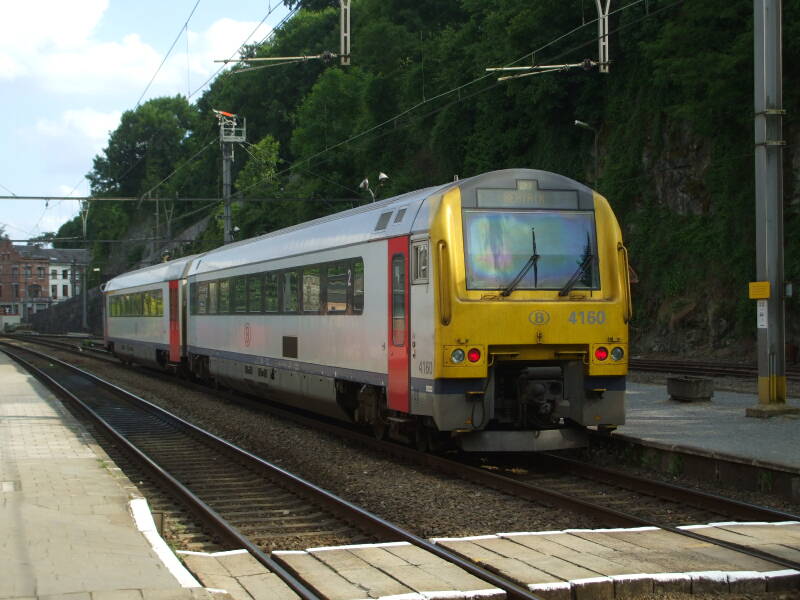
Of course, not all Belgian trains are luxurious high-speed ones.
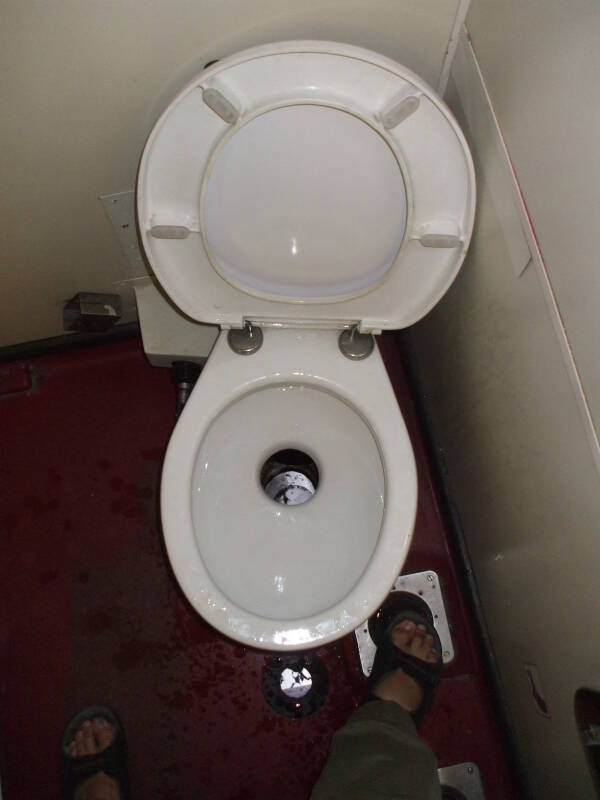
Below is a regional train in Dinant, in the northwestern Ardennes Forest, and its toilet.
It has the standard foot-operated flapper valve opening directly onto the track. With my foot on the flush button, we see light through the waste pipe.
Click here for pictures from Namur and Dinant.
Click here for several pages with pictures and descriptions from around Bastogne and the Battle of the Bulge.
Bulgaria
This is on board the overnight train from Thessaloniki, Greece, to Sofia.
Seat down, seat up.
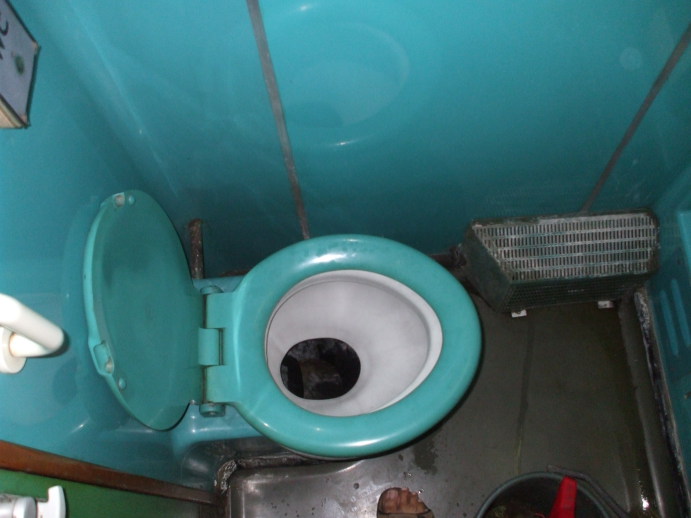
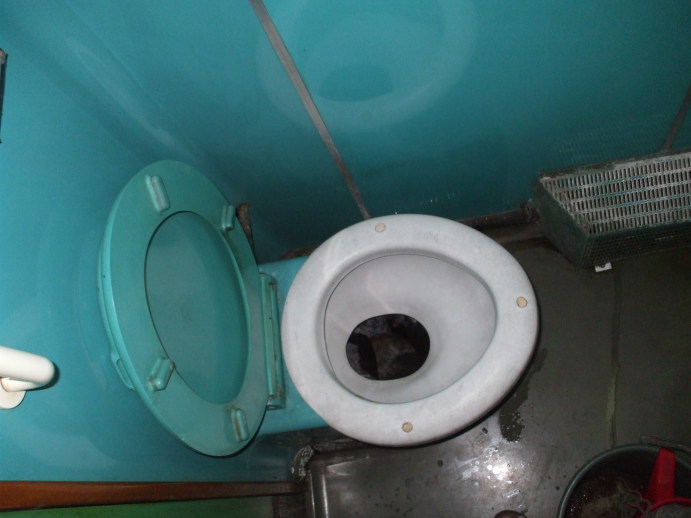
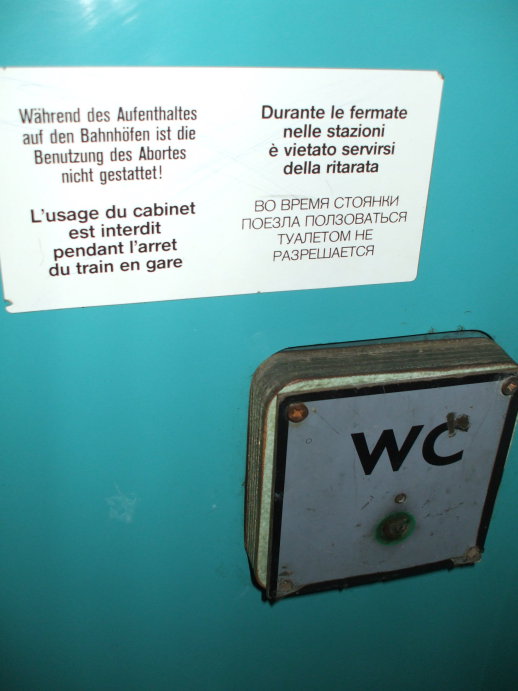
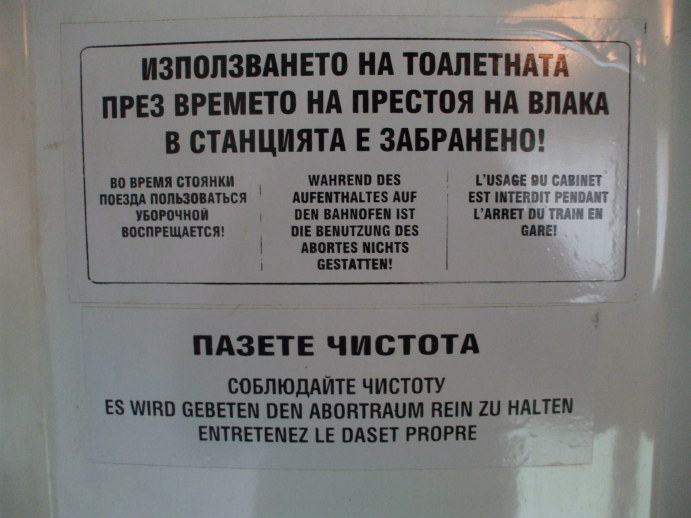
It's just the standard straight drop onto the tracks, so you are warned in several languages not to use it in the station, as seen below.
This train leaves Thessaloniki at 0030, spends about 0300-0350 crossing the border, and arrives in Sofia at 0805.
The sleeper compartments are very nice.
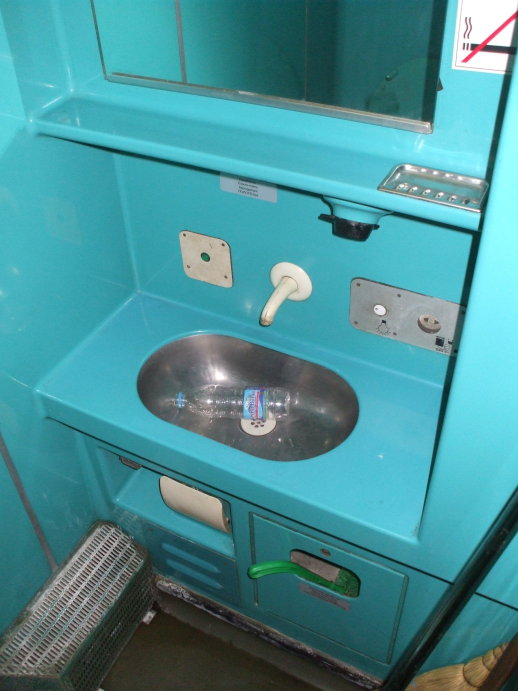
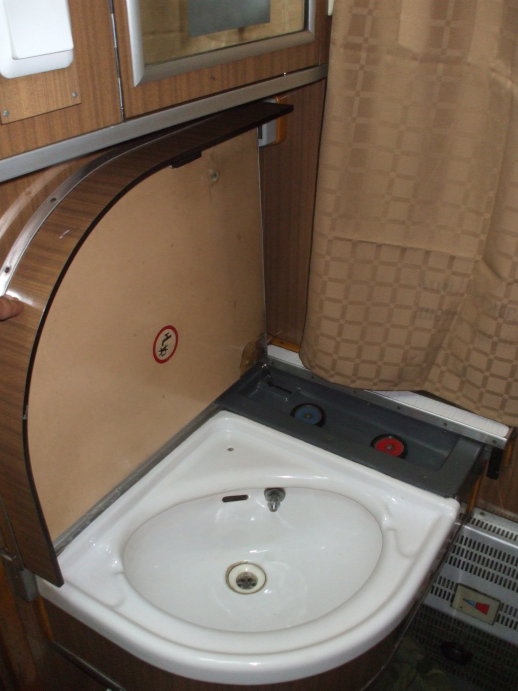
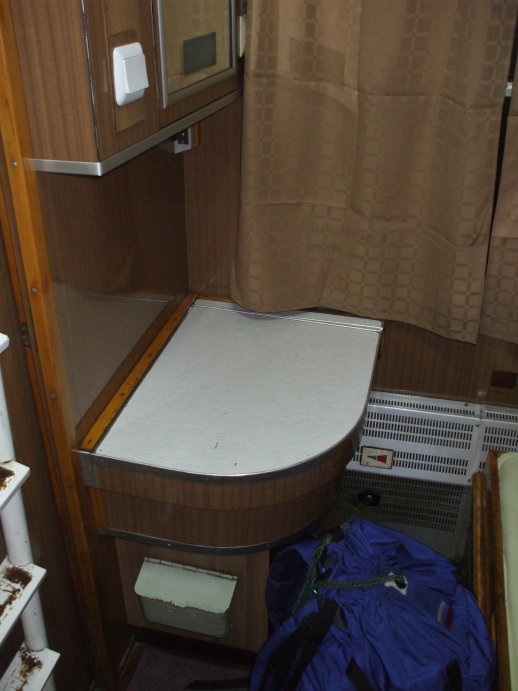
And to be complete, here is the sink in the compartment.
Closed, it's a desk.
Open, its about to suddenly slam shut.
Well, the intent is that open, it's a sink. With non-potable water, as it warns.
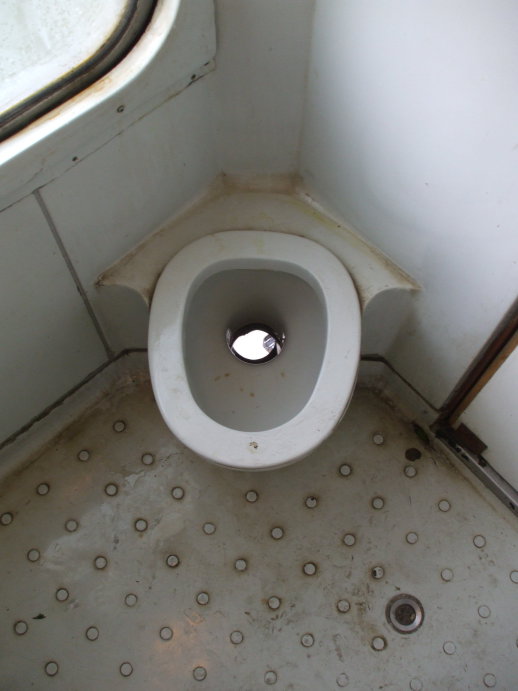
This toilet is on board the train from Sofia to Varna, by way of Gorna Oryahovitsa.
I took the second picture to better capture the view straight out the bottom of the pipe. This is why you aren't supposed to use these when the train is in the station.
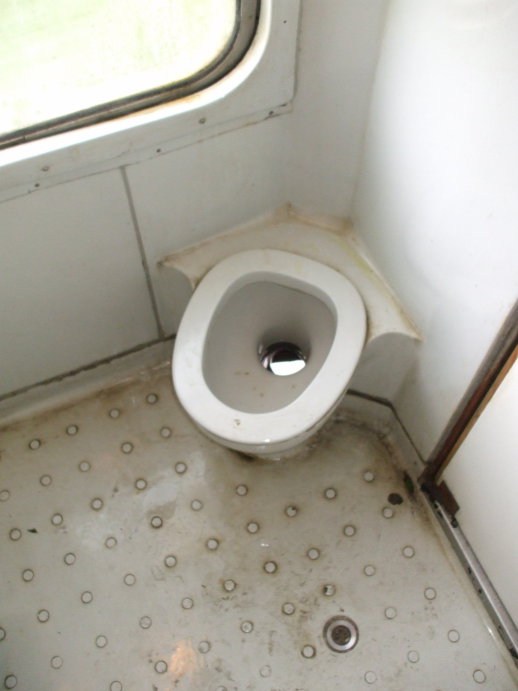
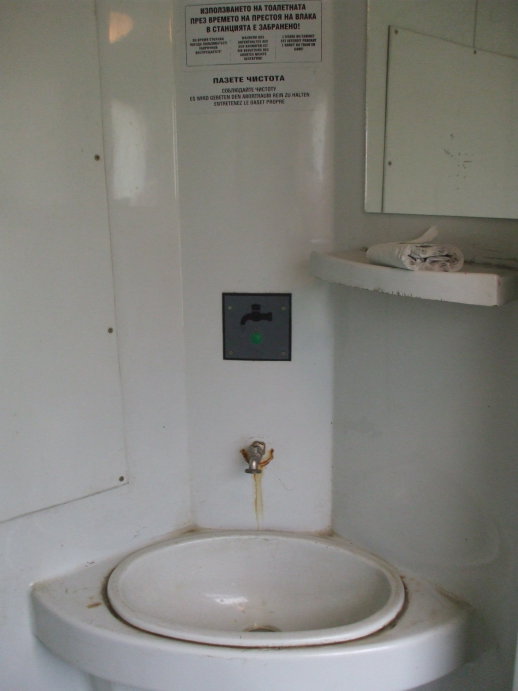
This sign above the sink tells you to refrain from using the toilet when the train is in the station. It's in Bulgarian (of course!) plus Russian, German, and French. It also asks you to clean up after yourself.
The Bosfor Ekspresi is a Turkish train that runs from İstanbul to Bucharest, Romania. It leaves İstanbul with a sleeper car, a couchette car, and a coach car.
In Gorna Oryahovitsa, in central Bulgaria, it merges with a train out of Sofia. The train from Sofia is based on one that originated in Thessaloniki, Greece, and left its sleeper cars back in Sofia. The Bulgarian coaches and the Turkish sleeper and couchette are combined and pulled north toward Bucharest by a Bulgarian locomotive. Before crossing the Danube River into Romania, the Bulgarian locomotive is replaced by a Romanian one.
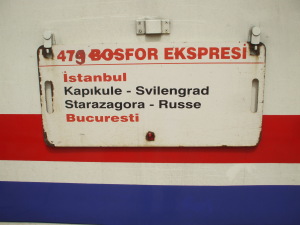
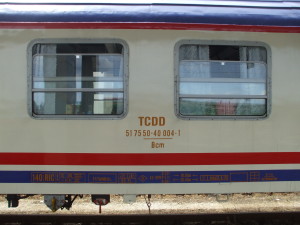
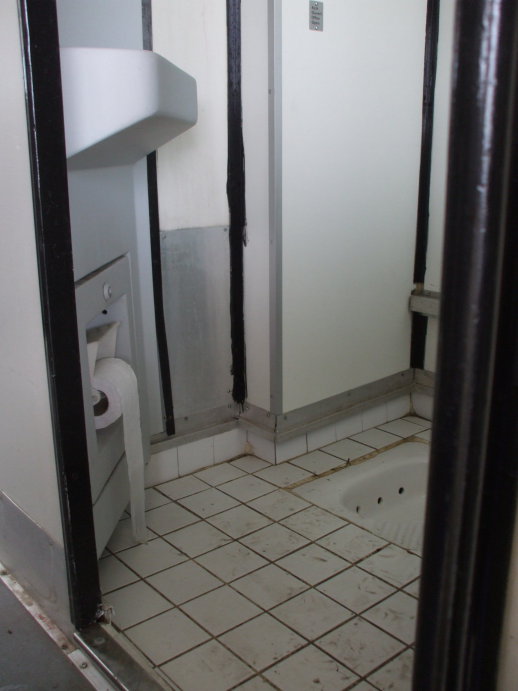
So, is this a Turkish train, a Bulgarian train, or a Romanian train? Yes!
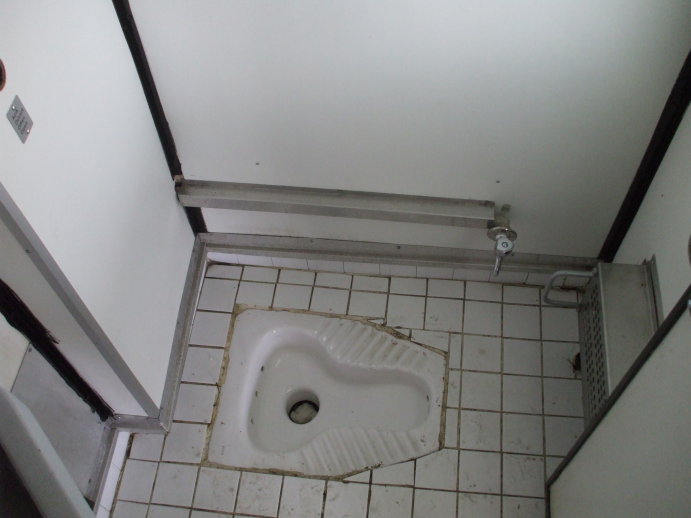
The sleeper and couchette are definitely Turkish as they're owned by TCDD, the Turkish national rail company. And, its toilet at the end of the couchette car is in the Turkish style.
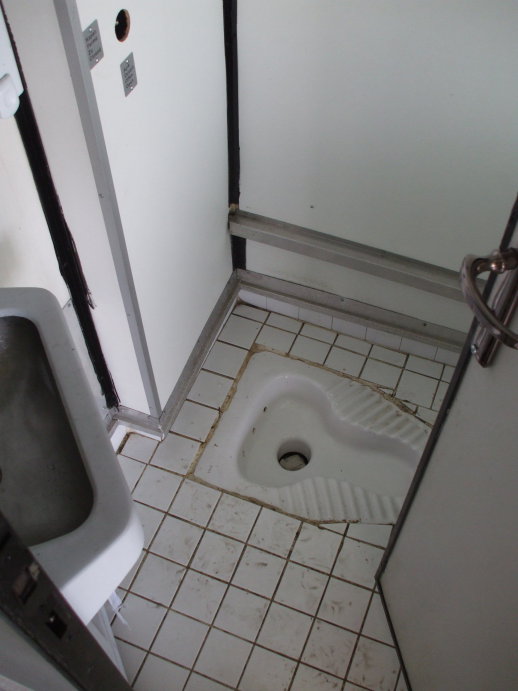
If you get on at Veliko Târnovo, you take a temporary seat in the coach. You're herded out onto the platform at Gorna Oryahovitsa as the Turkish coach is pulled off the train to wait to be connected to the next Bosfor Ekspresi bound back to İstanbul.
You're then told by the Bulgarian conductor to sit in an empty seat in the couchette car, as it will be an hour or so before the joining train arrives from Sofia. That gives the Turkish conductor plenty of time to try to scam you into paying a couchette supplement as, according to him, there will be no coaches arriving. Ignore him, it's a scam, and a rather clumsily attempted one at that.
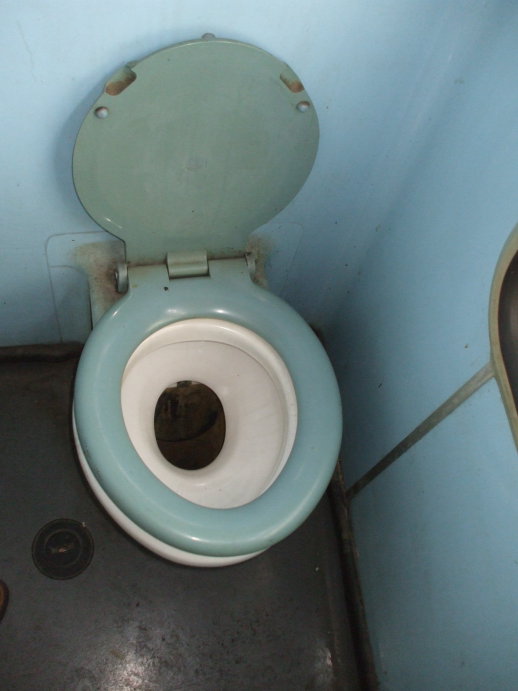
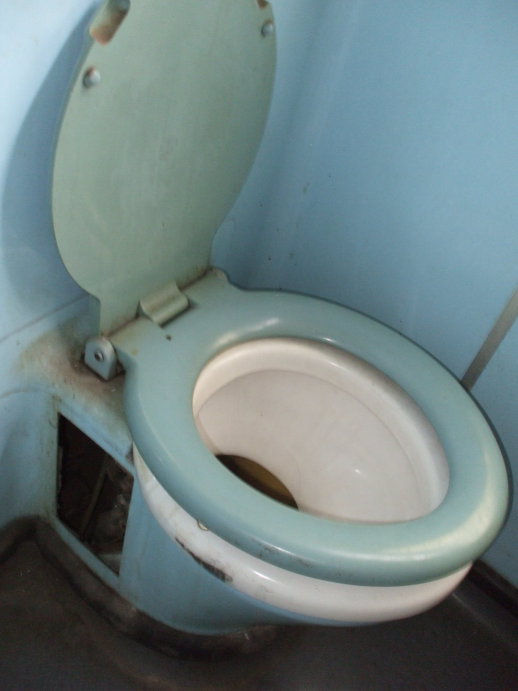
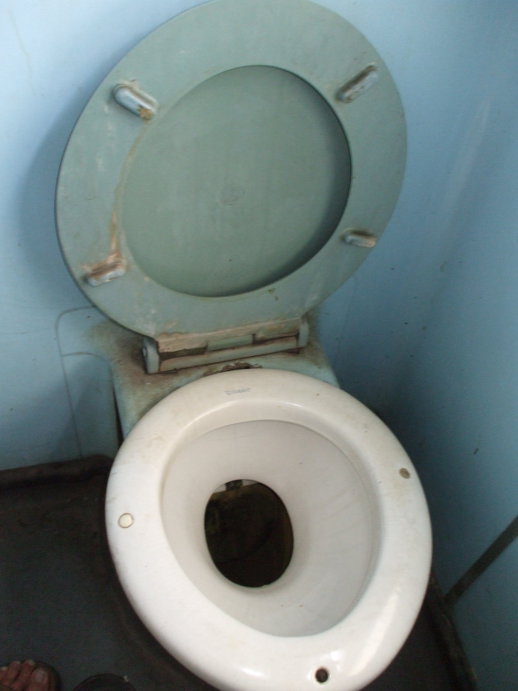
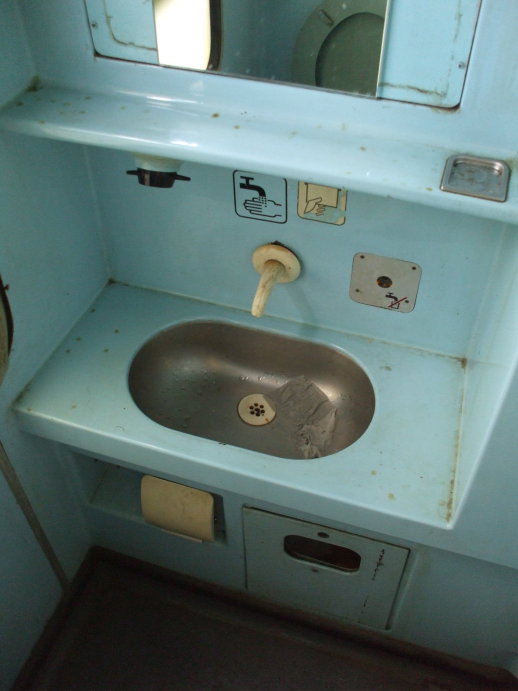
Eventually the train from Sofia arrives and the two trains are merged. Then you find a Bulgarian owned coach with your assigned seat. And, the typically blue Bulgarian train toilet.
Chilean Train Toilets
Chile's passenger train service is limited to the main line south from Santiago through the central valley as far as Chéllan, plus a narrow-gauge line from Talca over to Constitución on the coast.
Main-line train from Talca to Santiago
I'm at the station in Talca, preparing to board the train running north to Santiago.
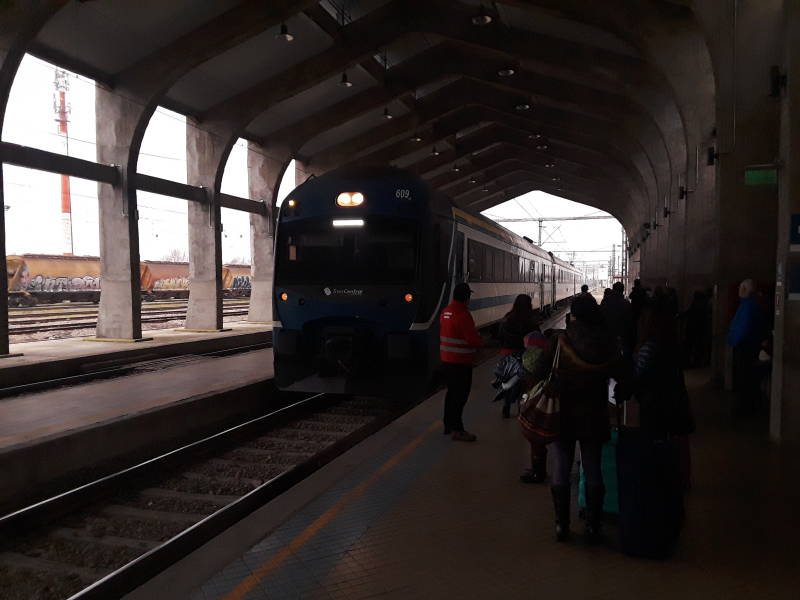
Orderly, comfortable, here we go!
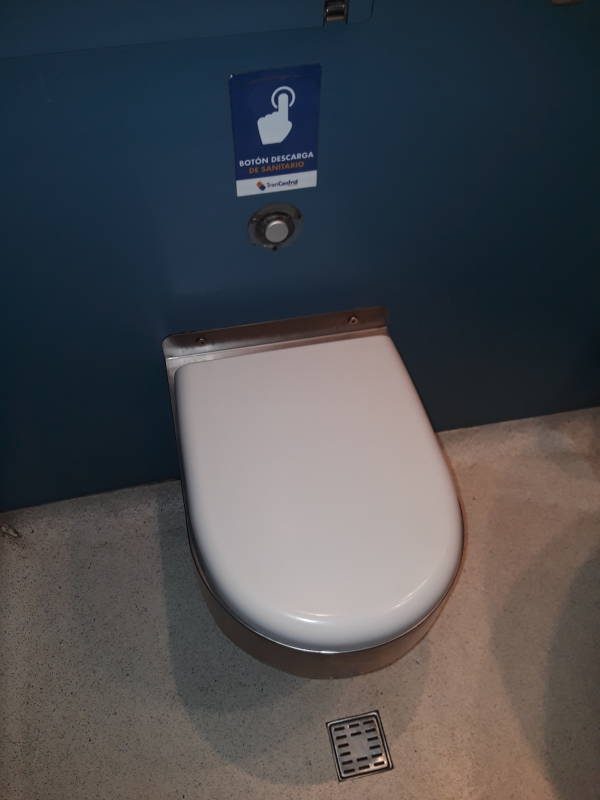
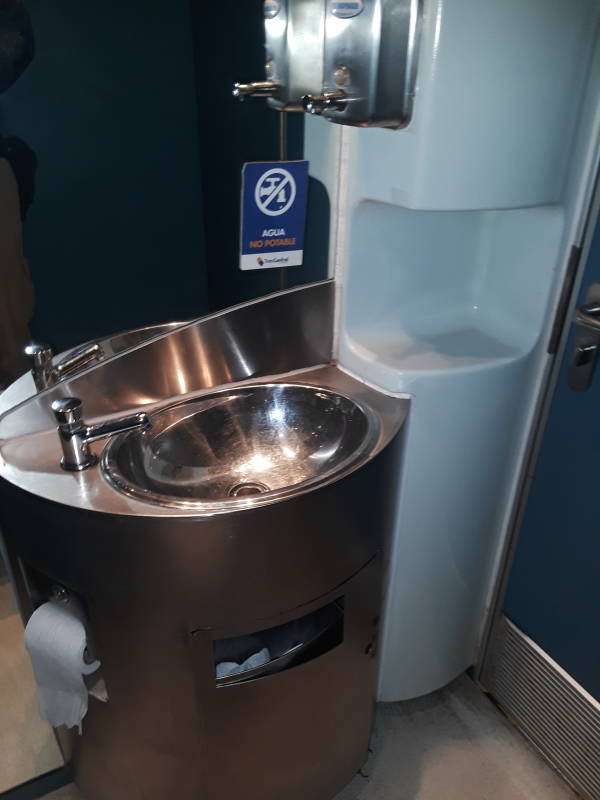
Buscarril narrow-gauge train from Talca to Constitución
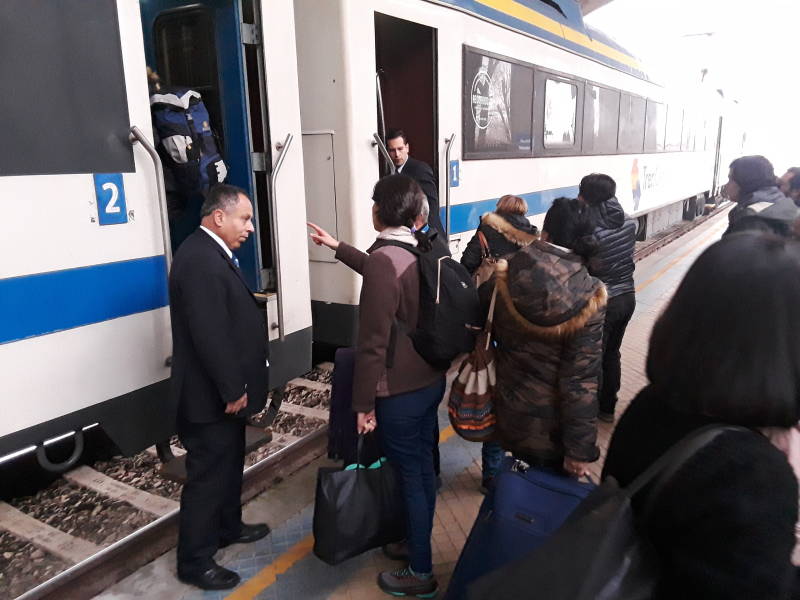
The Buscarril looks like a mashup of a bus and a train. It runs on the narrow-gauge line from Talca to the coast and Constitución. There's a long stop midway in each direction, at Gonzalez Bastias.
The train remains in service as it's the only practical transporation for people in small settlements along the line. There are many potential stops other than the mid-way break, letting people off where they have asked the conductor to stop, and picking up people who are standing at the stop and flagging down the train.
It's just over three hours each way. You can leave Talca at 0740 and arrive in Constitución at 1052. Returning, you leave Constitución at 1545 and get back into Talca at 1857.
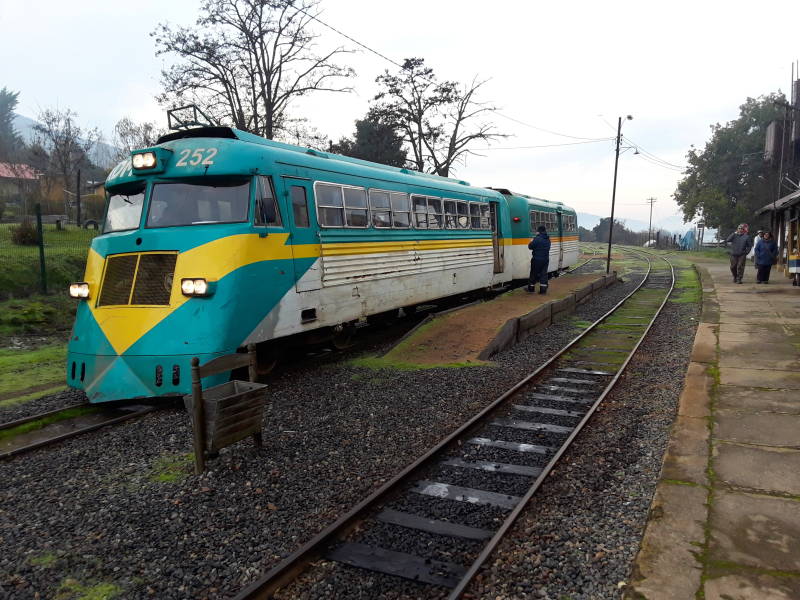
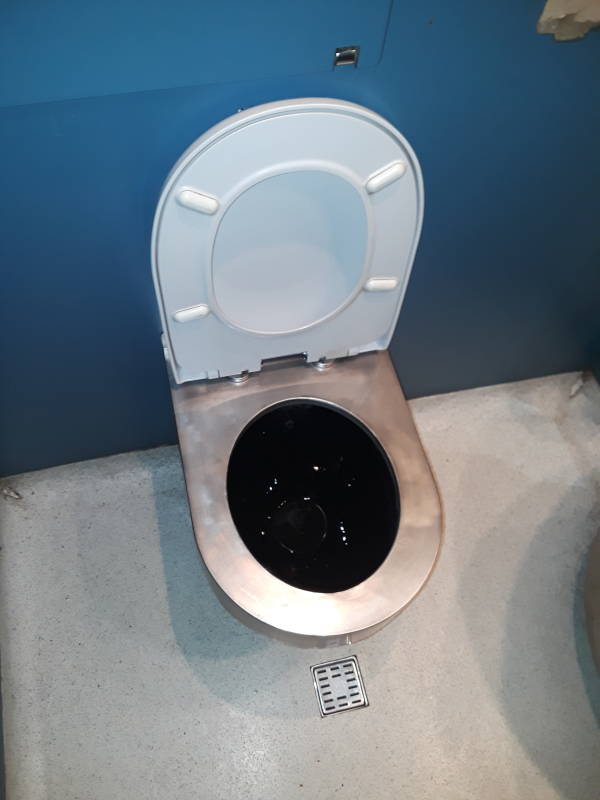
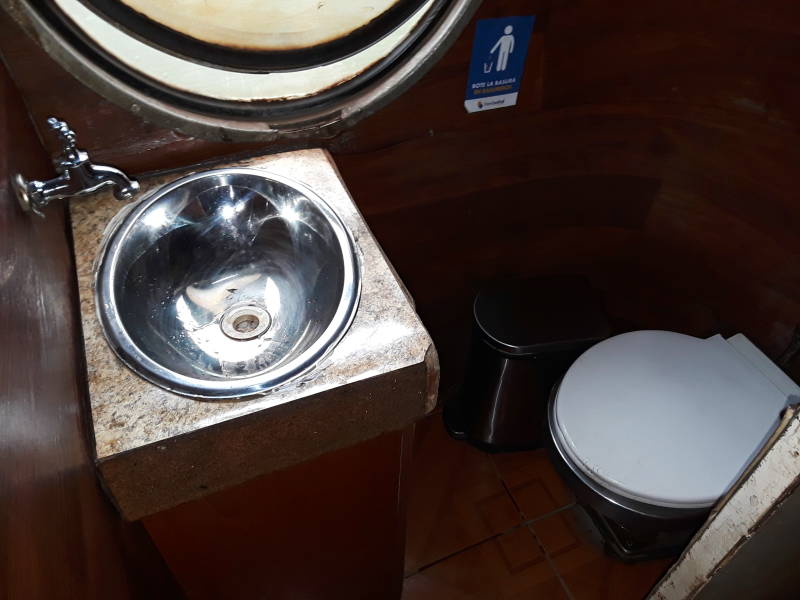
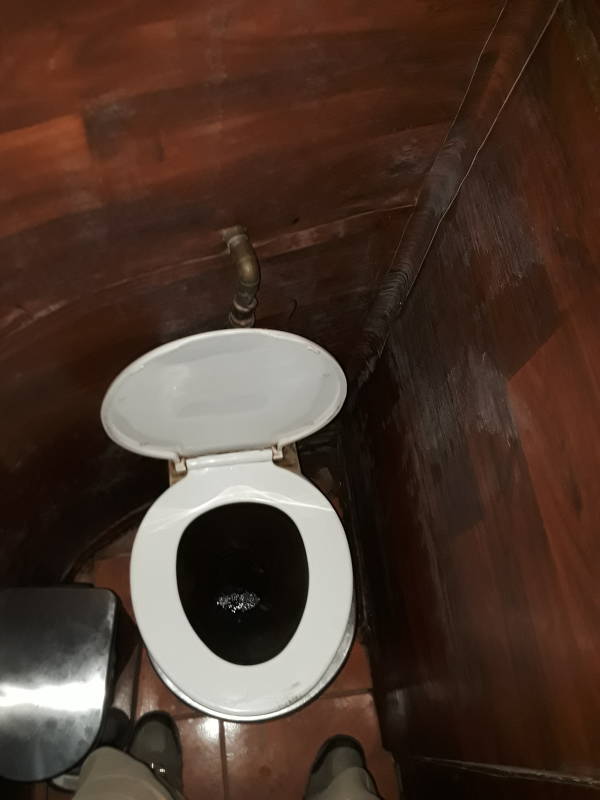
The lavatory is in a small compartment in the rounded rear corner of the engine car.
Czech Republic
The City Night Line passenger train provides great service north and west from Prague through Berlin, Köln, and Amsterdam.
The City Night Line includes the common couchette overnight accommodation, but it also has luxury first-class sleeper compartments.
This is the nicest overnight train I have ever ridden!
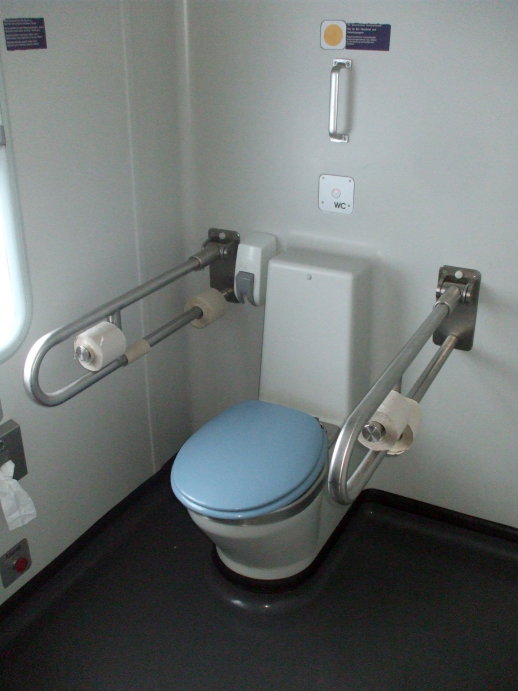
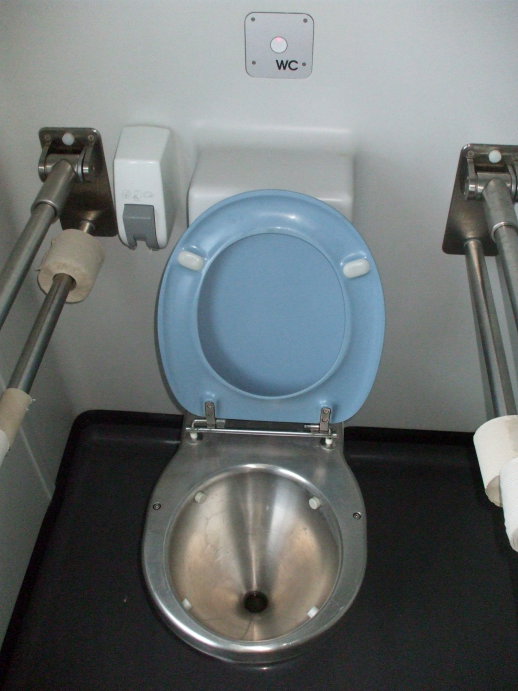
The gymnastic style toilet seen above is in the spacious handicap accessible lavatory in a couchette car on board the City Night Line train.
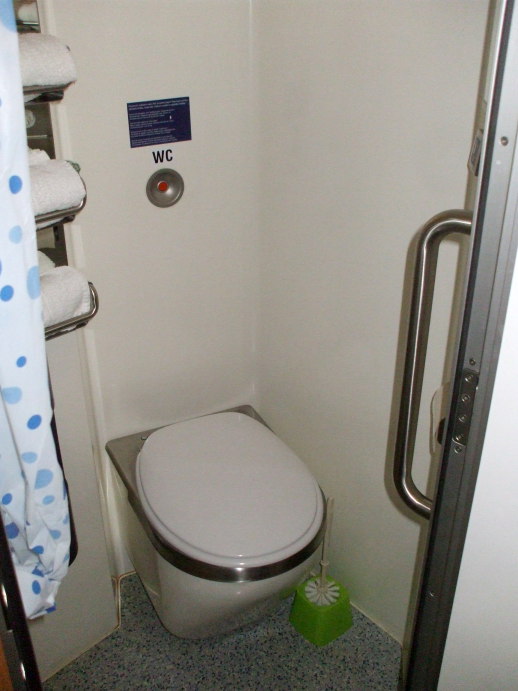
The luxury First Class sleeper compartments on the City Night Line train have their own compact but private toilet and shower!
It is not as cramped as you might expect — there is no need to stand straddling the toilet as you shower. The private lavatory is oval in shape, with the toilet at one side and a sink and shower area at the other.
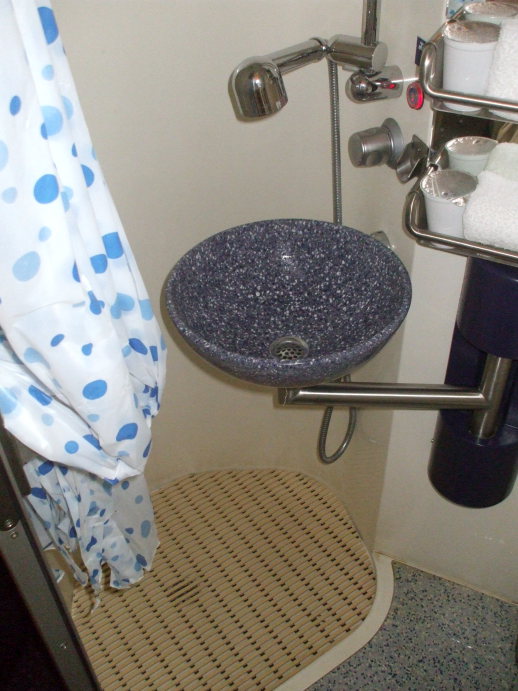
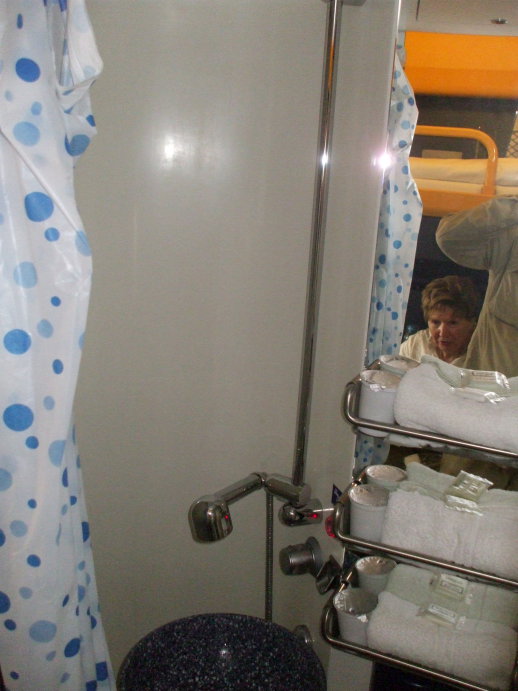
This washroom is on board a EuroCity train running from Budapest to Prague.
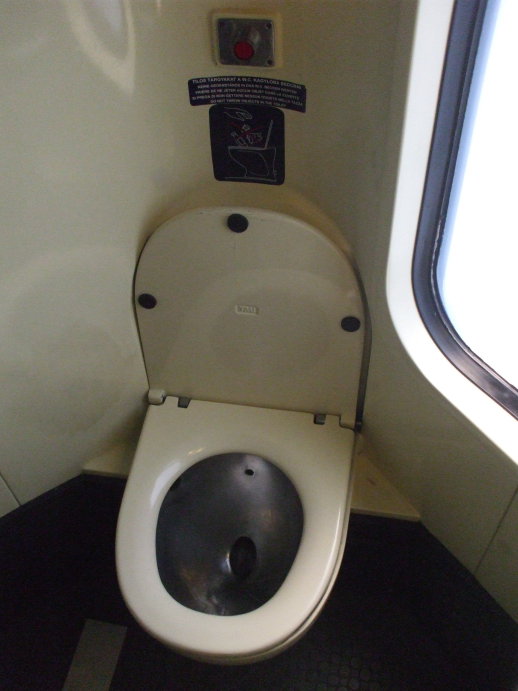
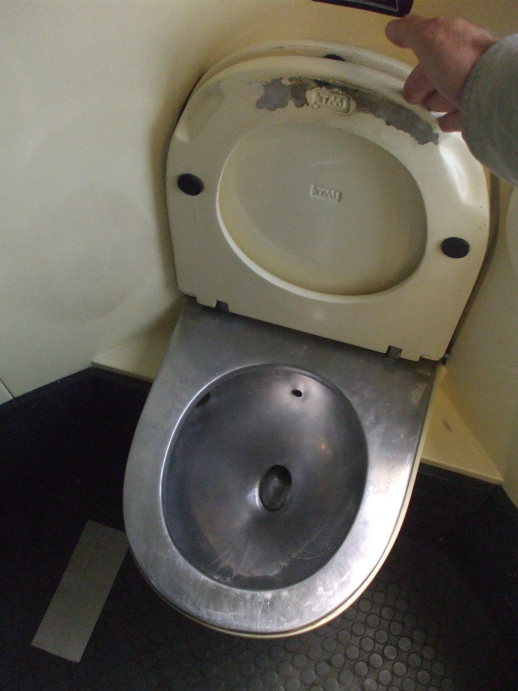
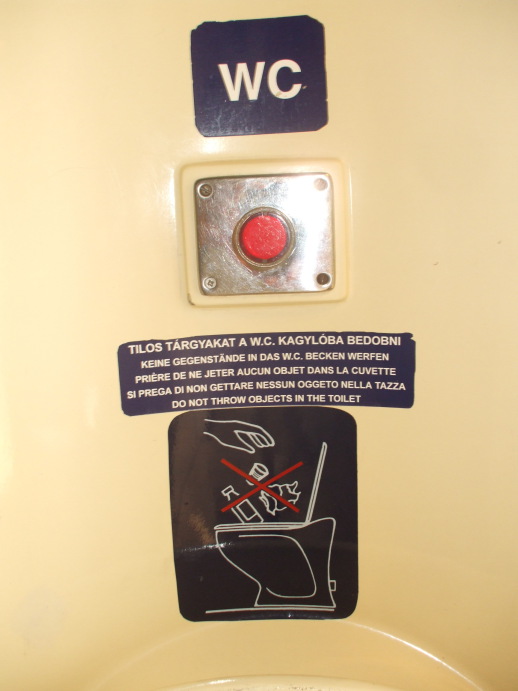
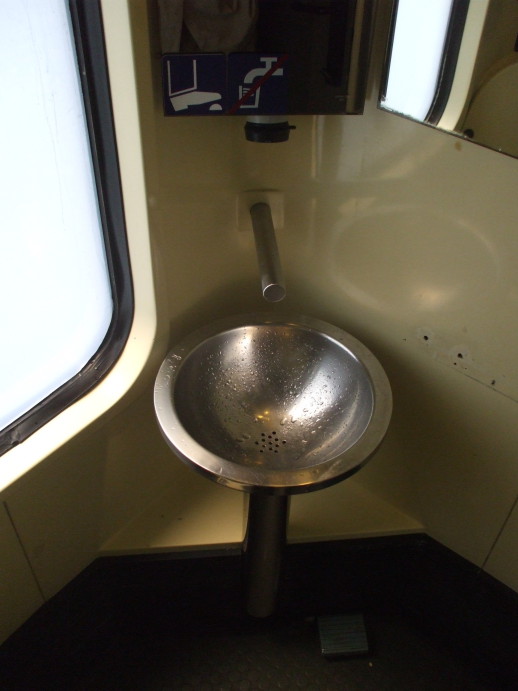
Egypt
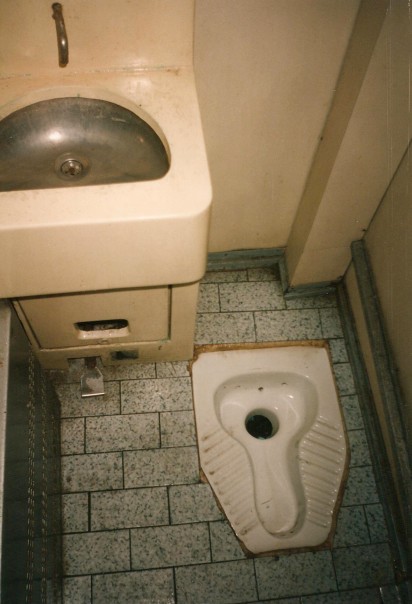
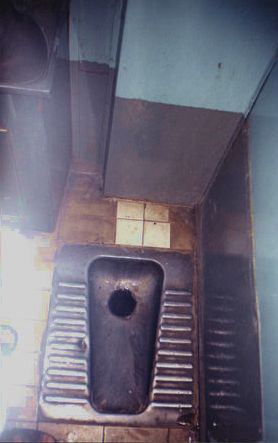
This squat toilet is found on board the Egyptian passenger train on the Aswan-Luxor-Cairo route paralleling the Nile.
Although this was an express train, and thus far superior to local service, there was something dreadfully wrong here.
No Egyptian train toilet is supposed to be this clean!
France
This Toilette a Grande Vitesse or High Speed Toilet is found on board the TGV or Train a Grande Vitesse, the High Speed Train running through France.
Before leaving my seat, my GPS had synced up and was indicating a speed of 305 km/hour.
The second toilet, with a lighted green flush button, is on an newer RER regional train in France, running between Marseille and Béziers. It's stainless steel, vacuum flushed, with a holding tank.
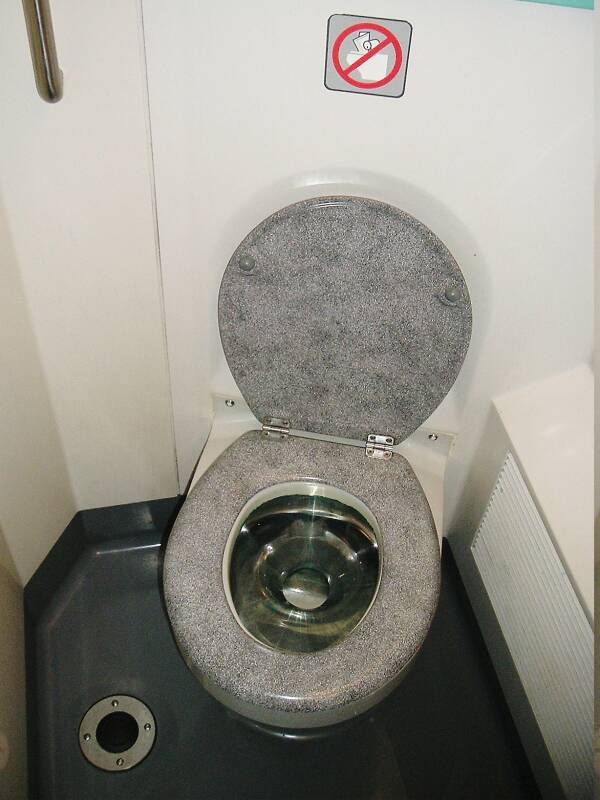
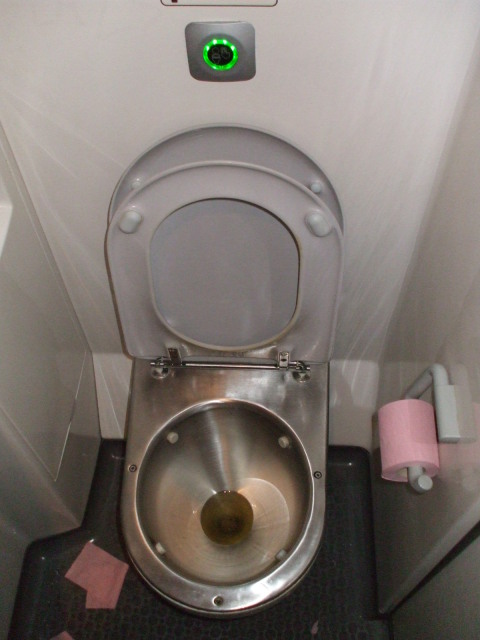
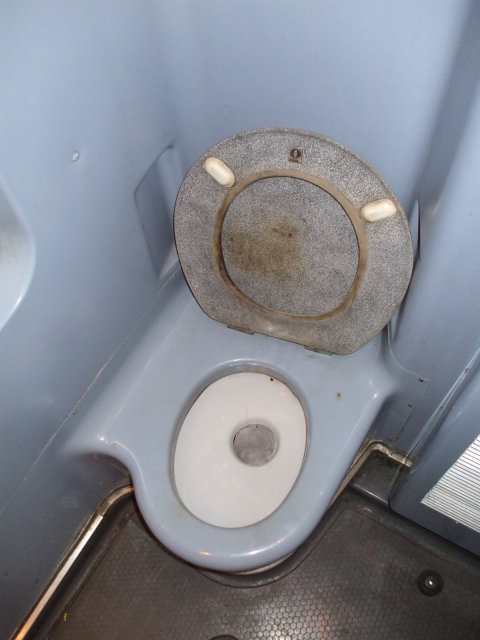
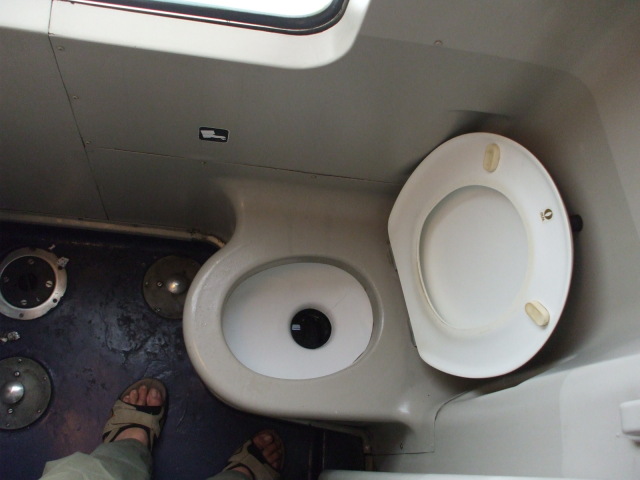
These are on older regional trains in southern France, the first running between Toulouse and Avignon and the second between Nice and Marseille
Old-style train toilets like these have no holding tank. Their flapper valve opens into a 10cm diameter pipe dropping straight onto the tracks.
Greece
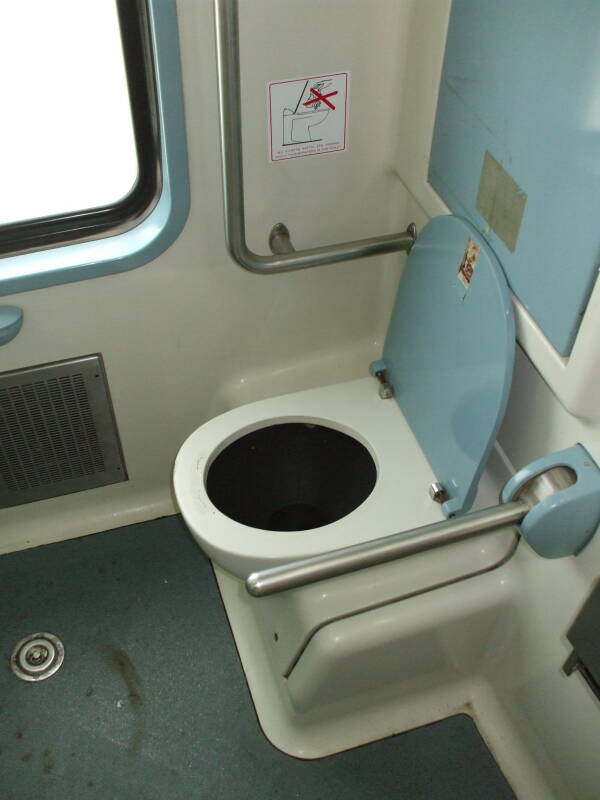
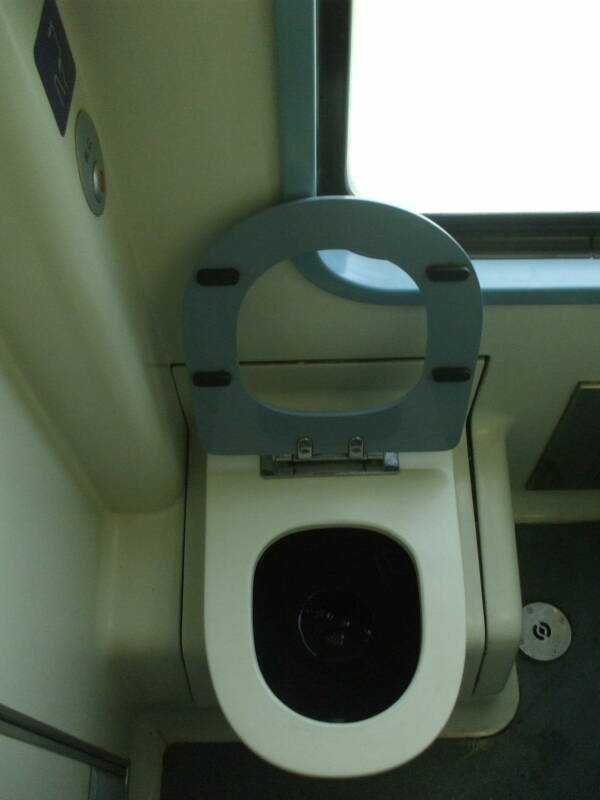
This is a handicap-accessible toilet on board a relatively new train running from Athens to the Kalambaka station at Meteora.
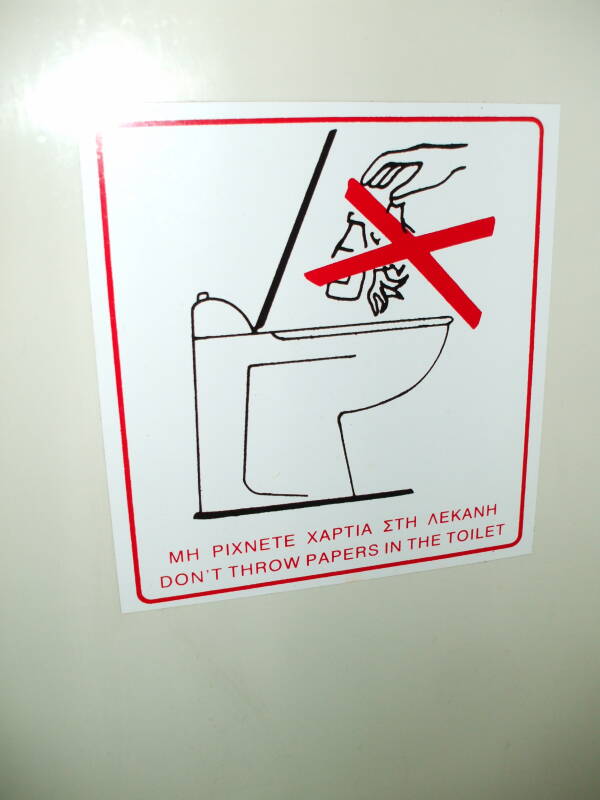
As the sign says:
ΜΗ ΡΙΧΝΕΤΕ ΧΑΡΤΙΑ ΣΤΗ ΛΕΚΑΝΗ
MI RIKHNETE KHARTIA STI LEKANI
DON'T THROW PAPERS IN THE TOILET
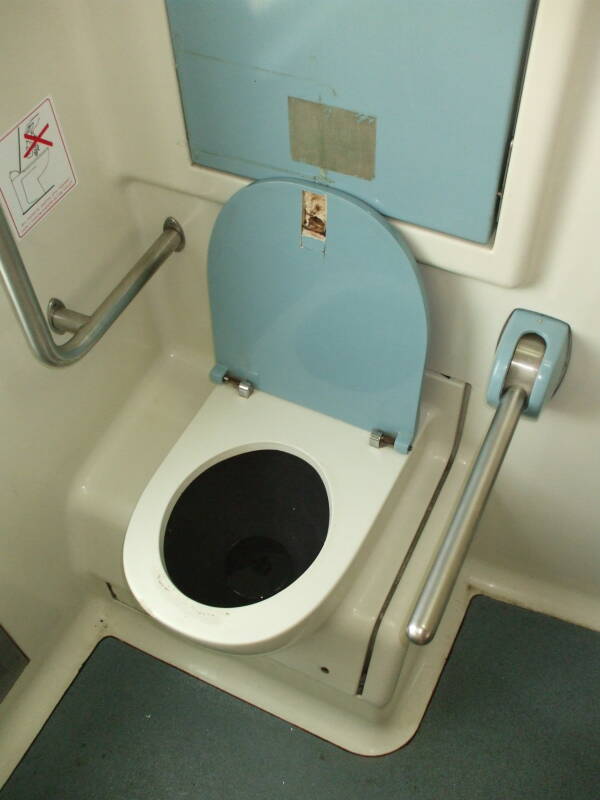
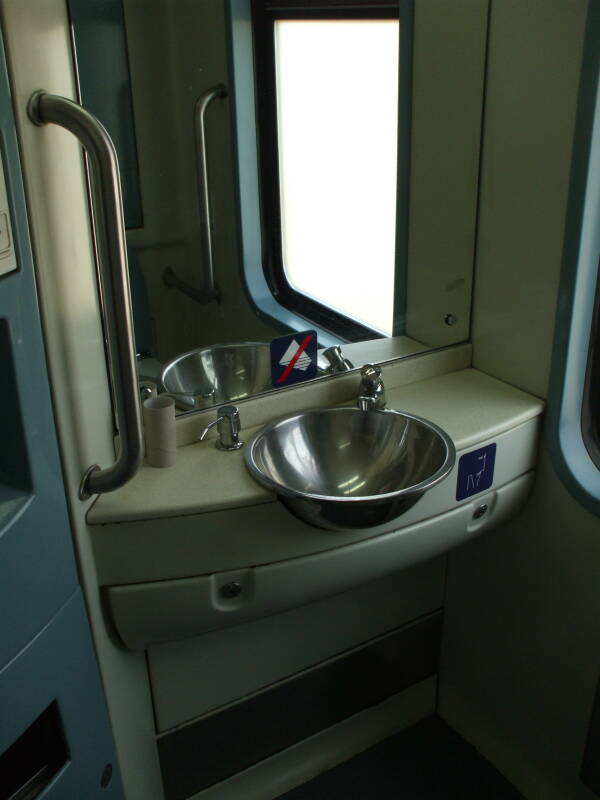
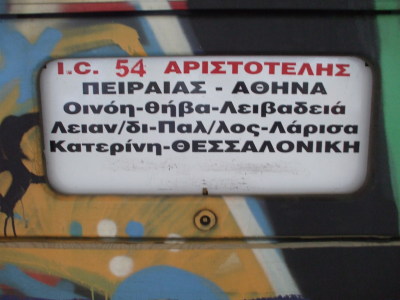
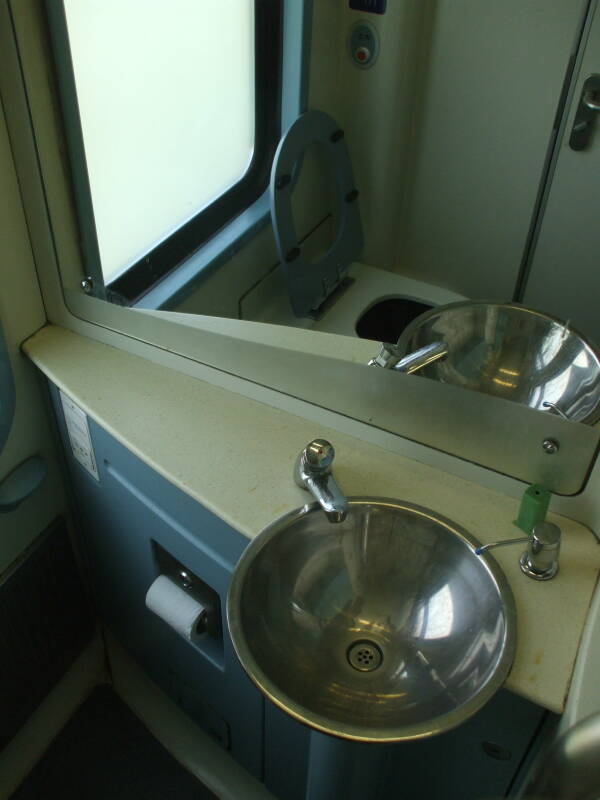
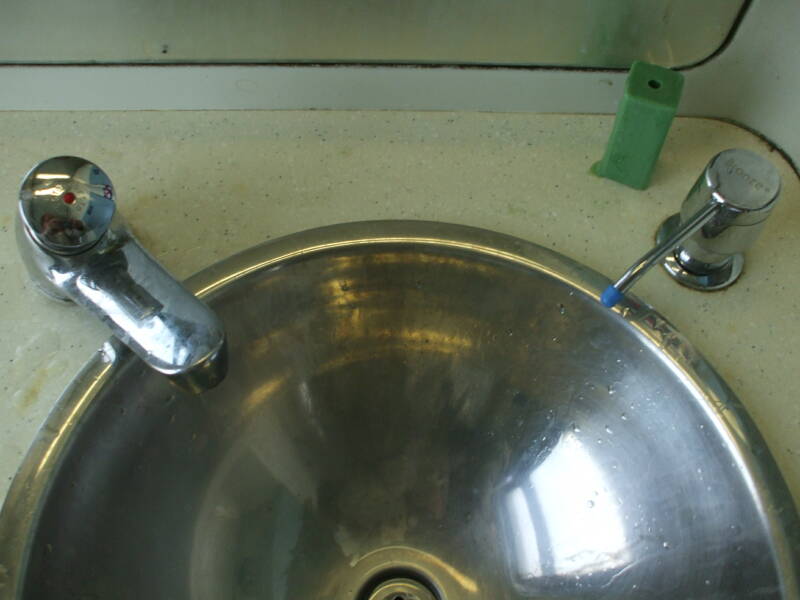
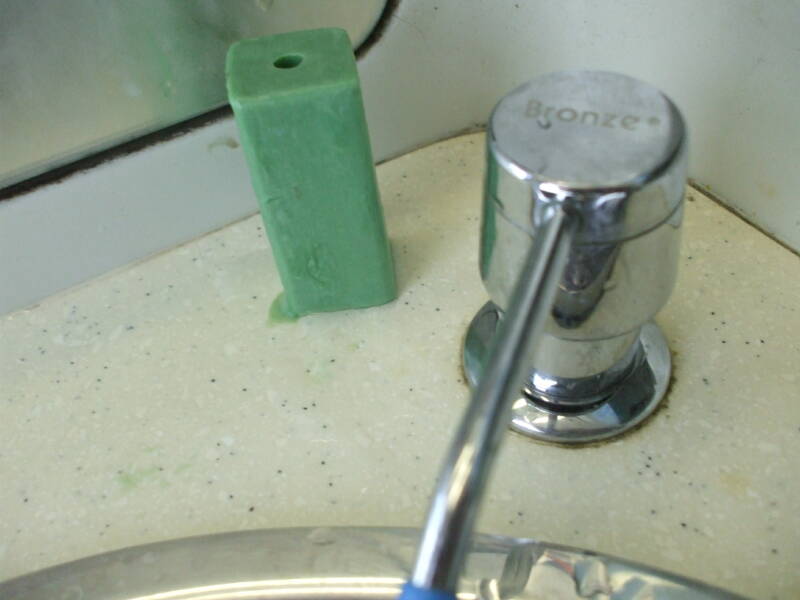
This is a toilet on board Inter-City train number 54, the Αριστοτελης, the Aristotelis (or Aristotle), running from Athens to Thessaloniki. Greek passenger trains aren't painted in a camouflage or Pop Art scheme, but many are almost completely covered with graffiti.
Also see the toilets at train stations in Athens, Kalambaka, Korinthos, and Thessaloniki.
Hungary
See the EuroCity train running between Budapest and Prague, above.
Italy
Italy has a good train system, see my travel pages for pictures and details on Italian train travel.
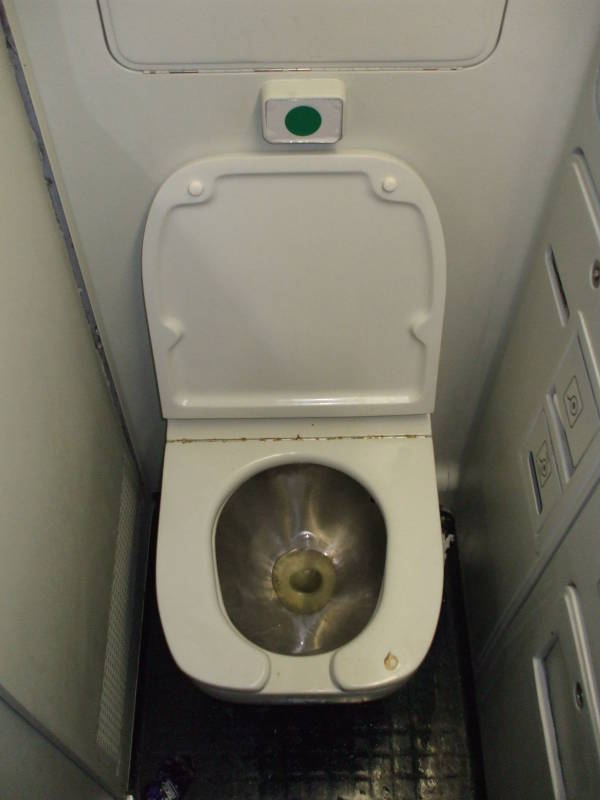
This toilet on board an inter-city train between Firenze and Pisa is modern, clean, and it has a holding tank.

Below are simpler toilets on board a regional train running along the coast from La Spezia through the beautiful Cinque Terre coastal region.
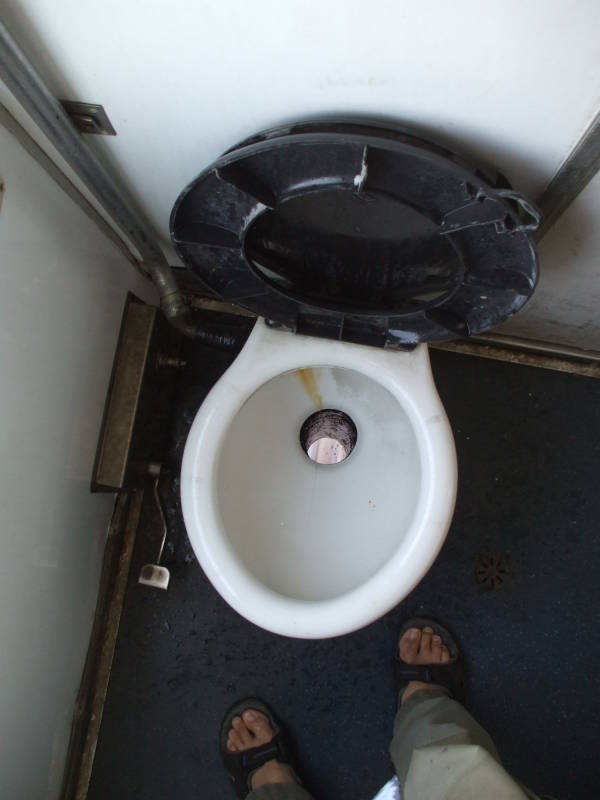
There's no holding tank, just a simple drop right onto the tracks, but it's reasonably functional.
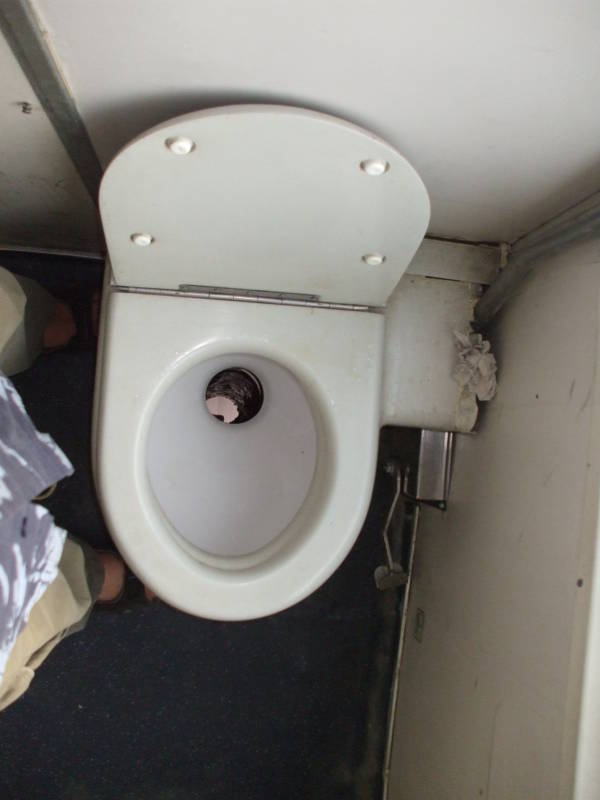
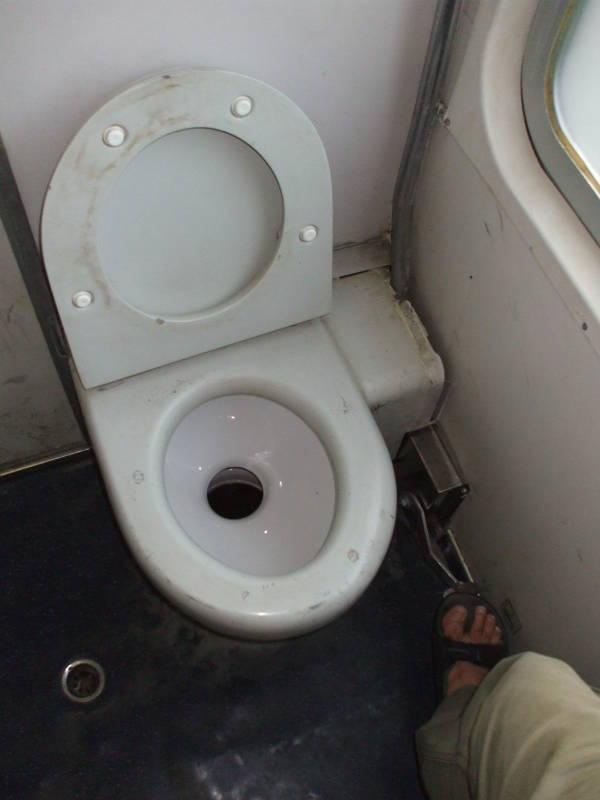
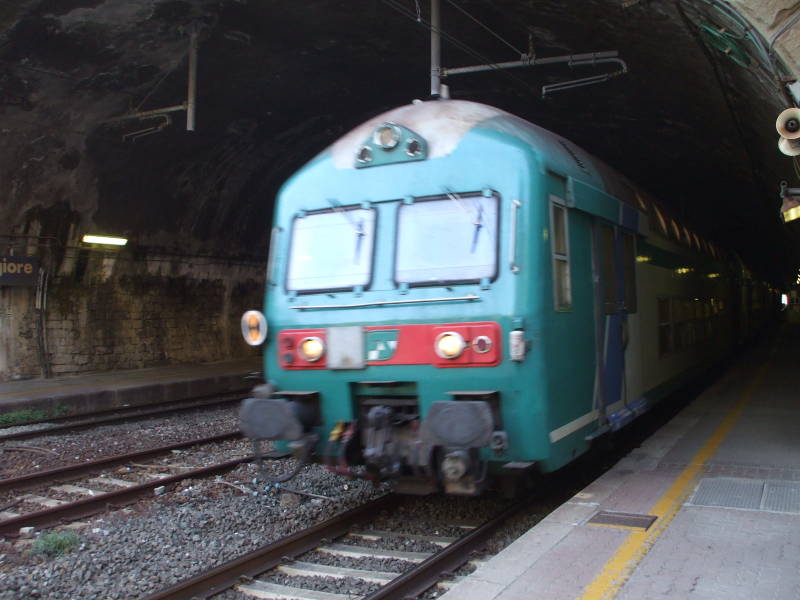

This is the worst train toilet I have ever encountered, on a regional Italian train out of Firenze.
It looks ordinary — a simple drop straight onto the track, much like the one just above. The slightly different seat design appears to be the only difference. Oh, if only that had been true....
I took this picture before using the toilet, and I was the first person to use it after the train had been sitting in the station for quite a while. So, things were reasonably clean. The drain pipe had dried, a crucial aspect of what was to come.
The problem is that the drain pipe seems to be directional. It is supposed to draw air down the pipe like a chimney, pulling waste and air down the toilet, out of the compartment, and onto the tracks.
The problem was that this one was forcing air up the pipe, with an effect that you can probably imagine but might prefer not to.
Full speed operation forced a very brisk air flow up the pipe. The result was a high-speed urine fountain. Closing the seat and lid just slightly changed the direction of flow — rather than spraying straight up, it now came out horizontally about knee high. The high air speed made for very fine droplets that more easily stayed airborne.
By the time we got into the next city, the interior of the toilet compartment had been coated in a fine mist of urine. It was a fairly long trip, people had had to use it and recharge the fountain.
train
toilets
Japan
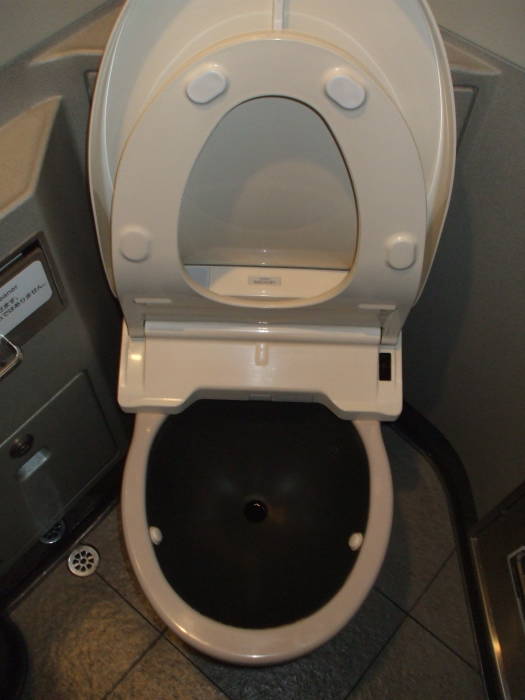
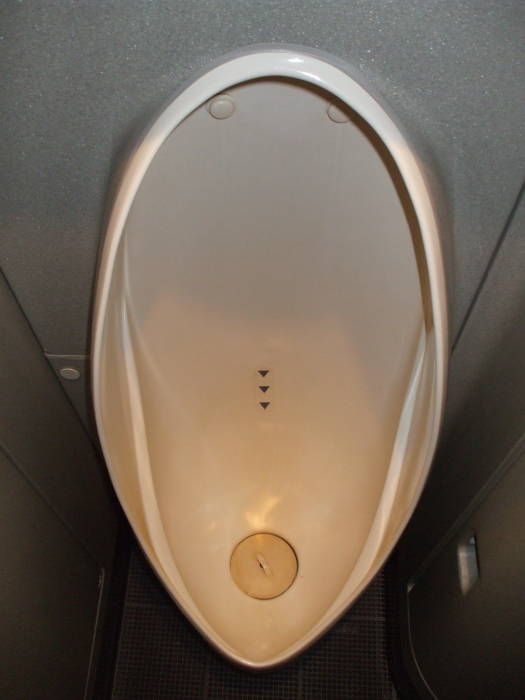
Japan's Shinkansen bullet trains have toilets much like those found on airliners. They also have urinals, the only ones I have ever seen on trains.
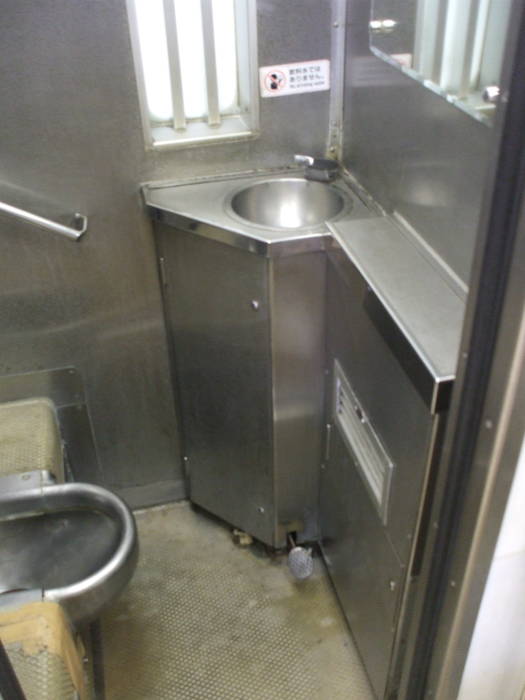
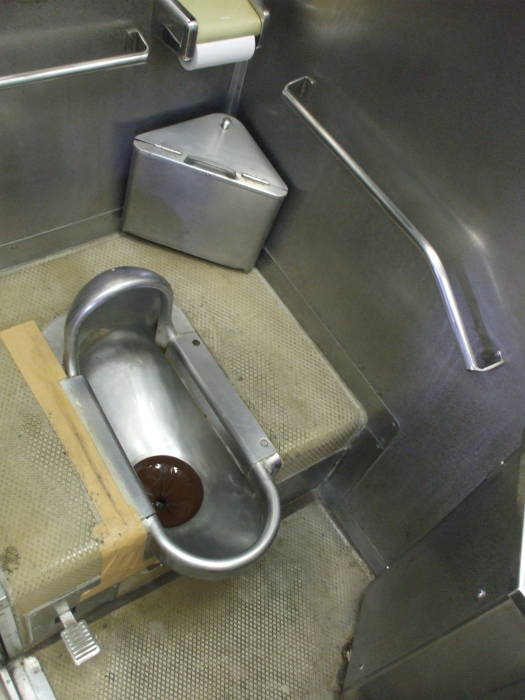
Local trains like the Tobu Railway connecting to Nikko may have a squat toilet on board.
Latvia
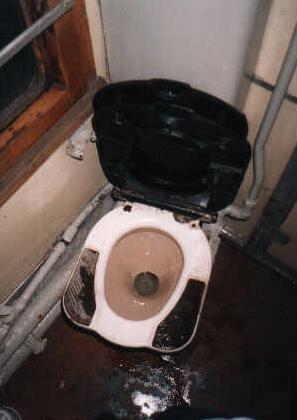
This Latvian passenger car on the Riga—Tallinn line was built in Russia, back in the days of the Soviet Union.
Notice the footpads. Most Soviet rail cars were built to all-USSR standards, hence this feature for Central Asian use. Lower the seat and it's a raised throne. In the configuration shown, it's an elevated squatter.
The tricky part is staying perched up there as the train sways through erratic Soviet-era rail joints, especially on the largely unmaintained Russian rail lines.
The exposed plumbing may provide adequate hand grips for those trying these advanced techniques, although someone in our group working at the hospital in Sankt-Peterburg was sent flying, with semi-disastrous results, during just such an attempt.
Also see the Russian train toilet, as both this car and that one were built in the Soviet Union.
Netherlands
The Dutch national railway Nederlandse Spoorwegen announced in September 2011 that their toiletless "Sprinter" trains would be supplied with plastic bags for use only in emergencies when the train is stopped and the passengers (and their bladders) cannot be evacuated. These bags, kept out of sight in the conductor's compartment, have a cup-shaped plastic top and contain a highly absorbent material that captures urine and results in a gel-like material.
People's Republic of China
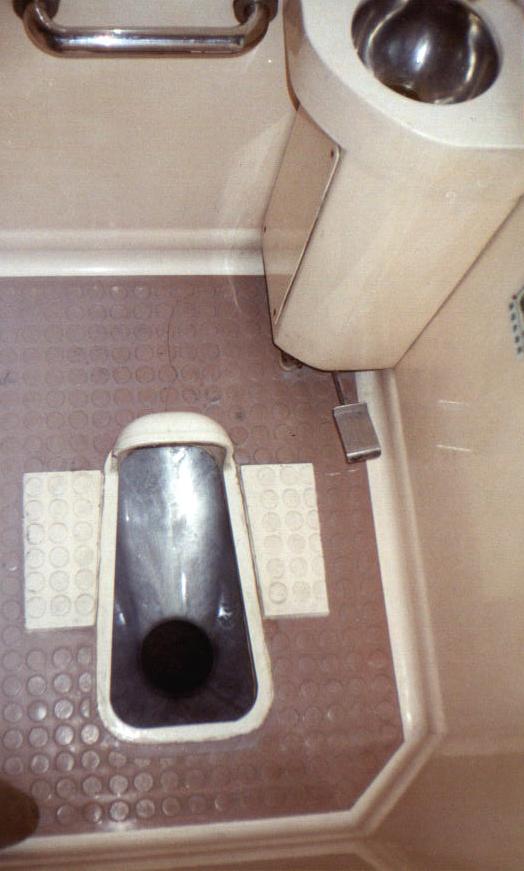
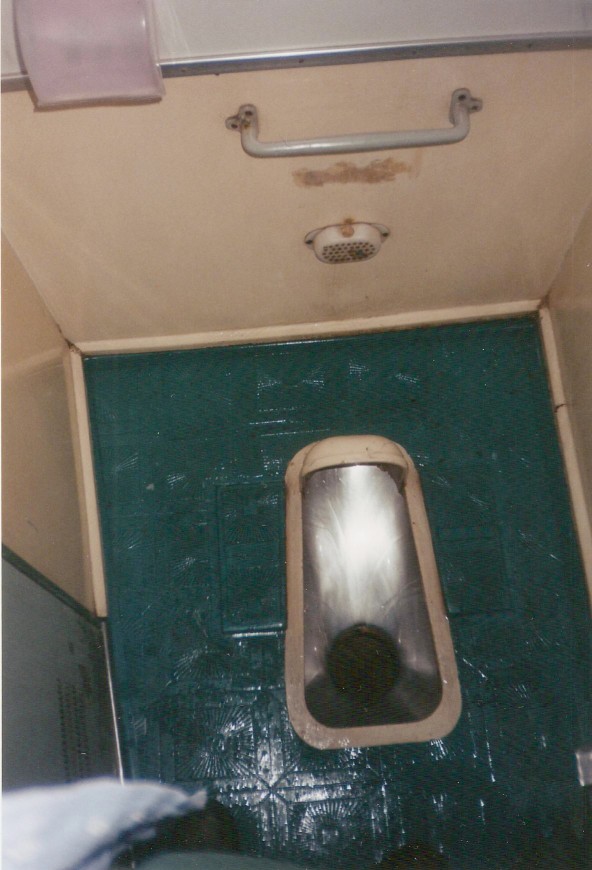
These Chinese train toilets are surprisingly non-nasty, but they are from elite trains frequented by decadent Capitalist Roaders.
The first one is from the express train linking Hong Kong and Guangzhou, China.
The similarly designed second one (minus the theoretically non-slip foot pads) is from an overnight sleeper from Guangzhou to Guilin. This is in the "soft sleeper" car.
Yes, in the allegedly classless socialist wonderland, trains have classes!
Note the handy two-handed handle, necessary for use when traversing those irregular tracks!
Romania
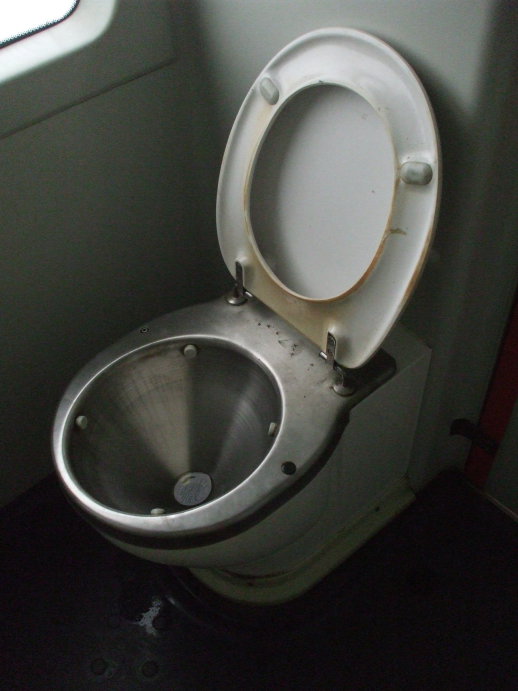
This stainless steel toilet is on board a train running north from Bucharest to Suceava.
Below instructions on how to flush it, in Romanian, French, German, and Italian.
This system seems similar to what you find on airliners. There are four downward pointing jets around the rim of the bowl, each spraying a fan of blue cleanser at least 120° wide. After they spray, the trapdoor at the bottom opens to a powerful vacuum.
With the holding tank system, there is no rule against using it in the station.
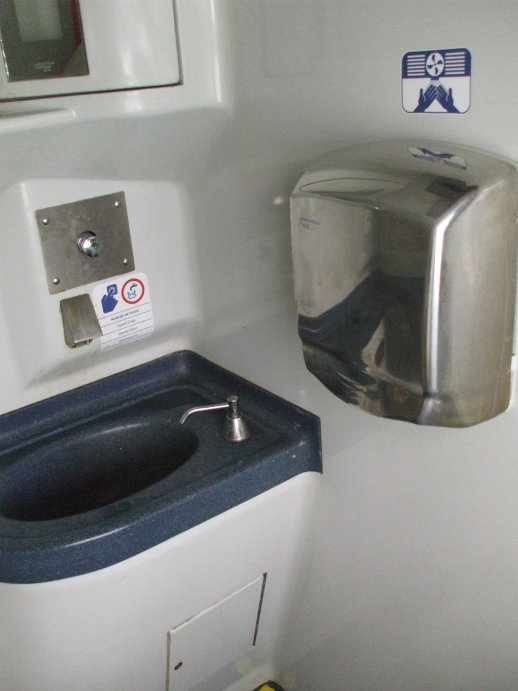
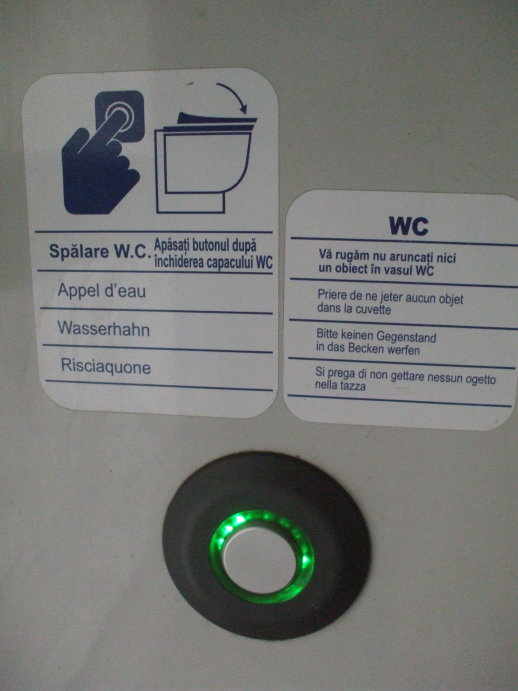
The toilets on board the EuroNight 472 passenger train from Bucharest, Romania to Budapest, Hungary, are located at the ends of the car. Some are entered from the end of the corridor, as seen at left, others from the noisy space next to the entry door at the very end of the car.
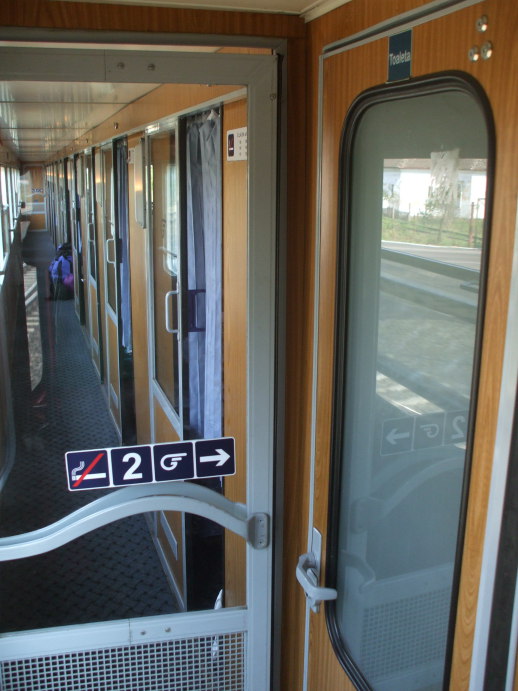
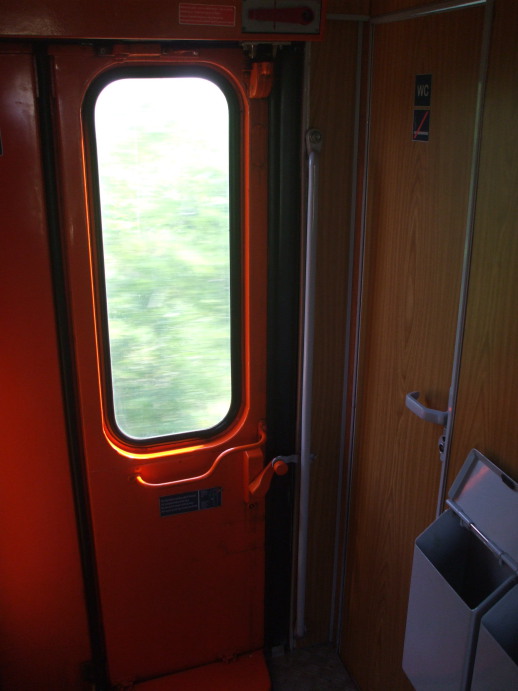
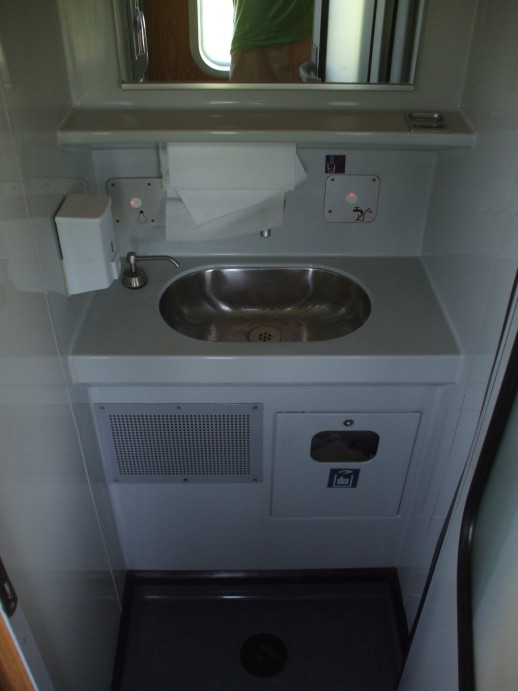
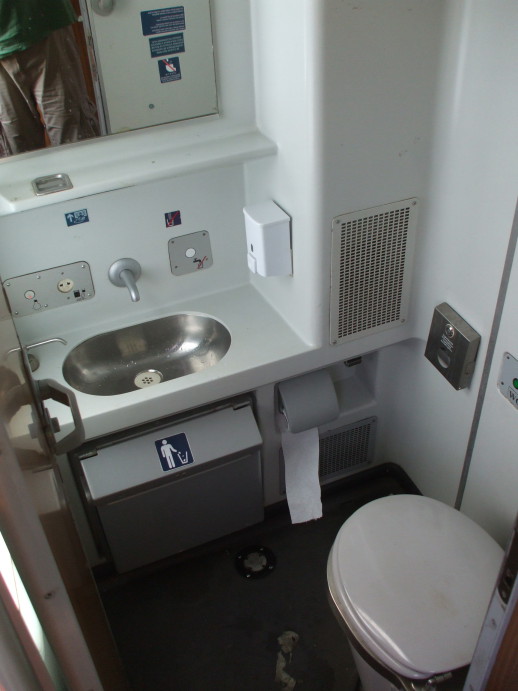
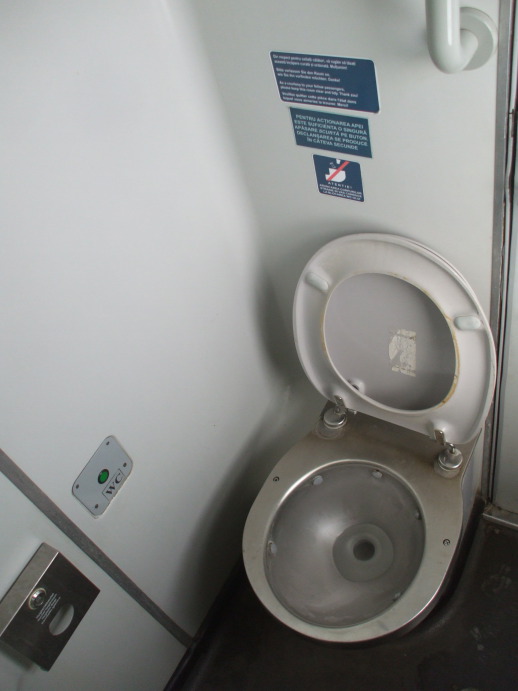
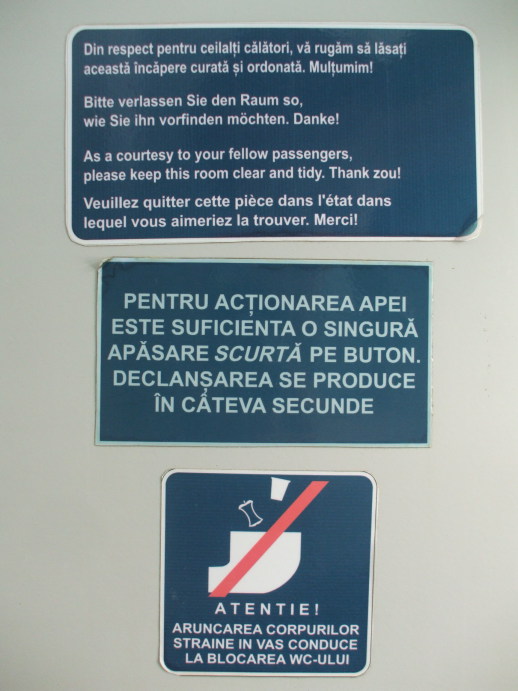
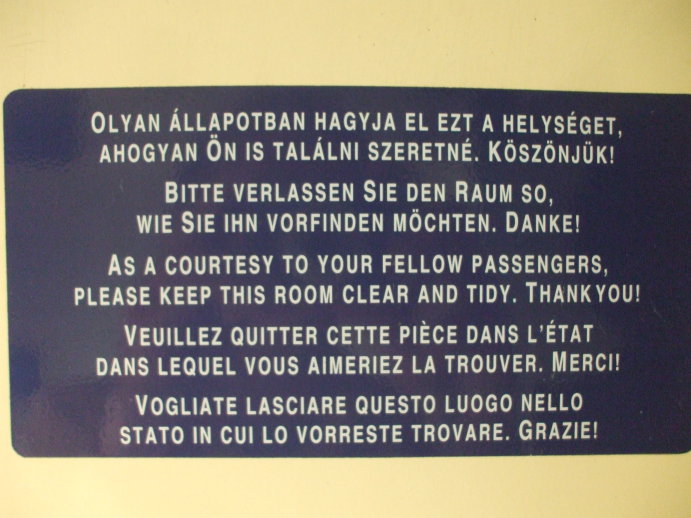
The Romanian cars have signs in Romanian, German, English, and French:
Din respect pentru ceilaţi călători, vă rugăm să lăsaţi această încăpere curată ordonată. Mulţumim!
Bitte verlassen Sie den Raum so, wie Sie ihn vorfinden möchten. Danke!
As a courtesy to your fellow passengers, please keep this room clear and tidy. Thank zou!
Veuillez quitter cette pièce dan l'état dan lequel vous aimeriez la trouver. Merci!
PENTRU ACŢIONAREA APEI ESTE SUFICIENTA O SINGURĂ APĂSARE SCURTĂ PE BUTON. DECLANŞAREA SE PRODUCE ÎN CĂTEVA SECUNDE
ATENTIE!
ARUNCAREA CORPURILOR
STRAINE IN VAS CONDUCE
LA BLOCAREA WC-ULUI
Russia
This is the toilet compartment at the end of a Russian passenger car on the Moscow—Sankt Peterburg line.
Many Russian train toilets have weak or broken springs on the trapdoor at the base of the bowl, providing a view of the tracks rushing past underneath and a refreshing breeze.
No TP, just a wire brush in a small bucket....
Also see the Latvian train toilet, as both this car and that one were built in the Soviet Union.
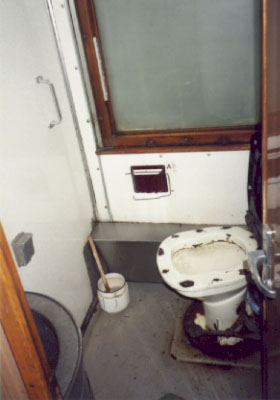
Turkey
This is the lavatory on board the Turkish 1st-class yataklı vagon, or sleeper car, on the Pamukkale Ekspresi between İstanbul and Denizli.
Note the distinctively Turkish (and somewhat intrusive) thin copper line providing water in lieu of any disposable dry abrasive. It's controlled by the valve immediately to the user's right, thus leaving the left hand free for, uh, the sort of activity that means left-handed eaters are viewed with horror in the Middle East.
This image is from the late 1990's, see the three below for more recent Turkish train toilet developments.
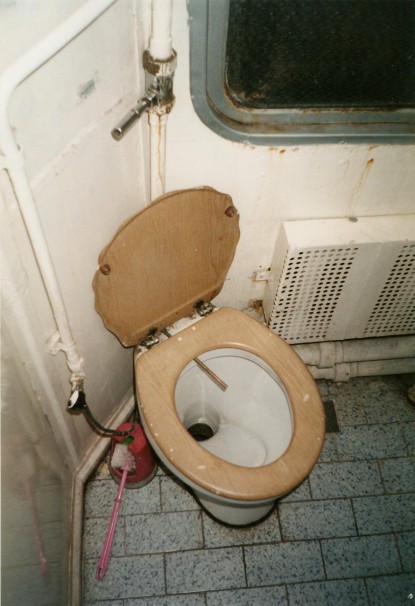
Now we're on board the Pamukkale Ekspresi in 2004 — Turkish toilet science had changed significantly in the past four years! The toilet itself is largely unchanged.
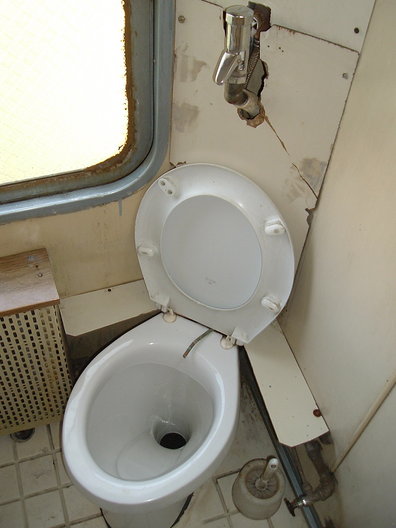
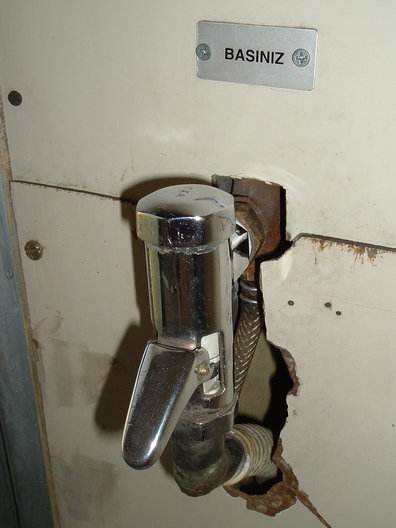
This was the strange thing in 2004 — Turkish toilets, even on board the Pamukkale Ekspresi, were largely equipped with toilet paper! OK, fine, a dumpy hotel that calls itself an Otel and doesn't really cater to foreign visitors was still uncontaminated by TP, but changes were underway.
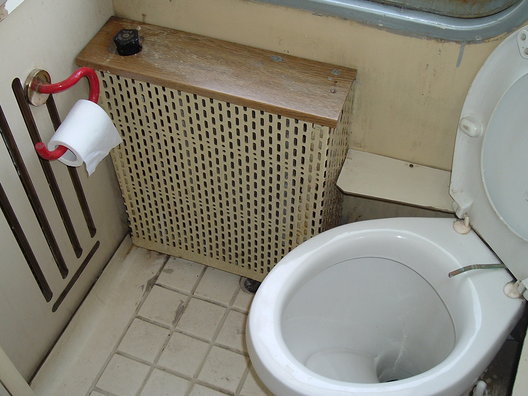
This squat toilet is also on board the Pamukkale Ekspresi overnight train between İstanbul and Denizli, but this is in a second-class coach car. And, back in 2000 or so. The toilet compartment was built largely from stainless steel.
The second toilet, a raised commode seat, is from the İzmir Ekspresi overnight train between Ankara and İzmir. It's a somewhat downscale overnight train as Turkish trains go, but it's still a nice way to travel.
Note the great similarity between this toilet and the one from the Pammukale Ekspresi above. Basically the same cars, the first-class yataklı vagon or sleeping car.
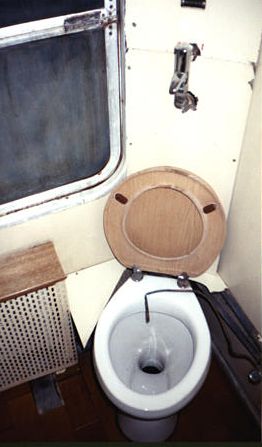
This is the toilet in the fabulous Ankara Ekspresi overnight train running between İstanbul and Ankara.
The first-class yataklı vagon (sleeping car) was the nicest overnight train I had ridden anywhere until I saw the Czech City Night train.
Brand-new high-tech sleeping compartments, comfortable beds, these clean toilets, and even a shower at one end of the car! The service is fantastic — each compartment has a refrigerator with a bottle of mineral water and a box of juice, plus a candy bar, for each passenger. A very nice ride for about US$ 35.
Also see the Bosfor Ekspresi toilet shown above in the section on Bulgaria.
United Kingdom
|
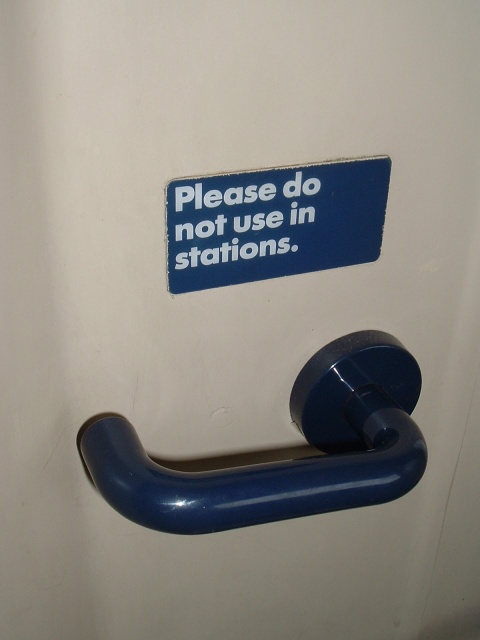
Please do not use in stations |
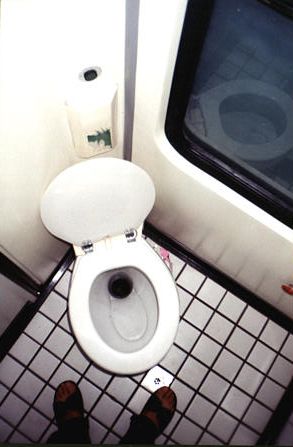
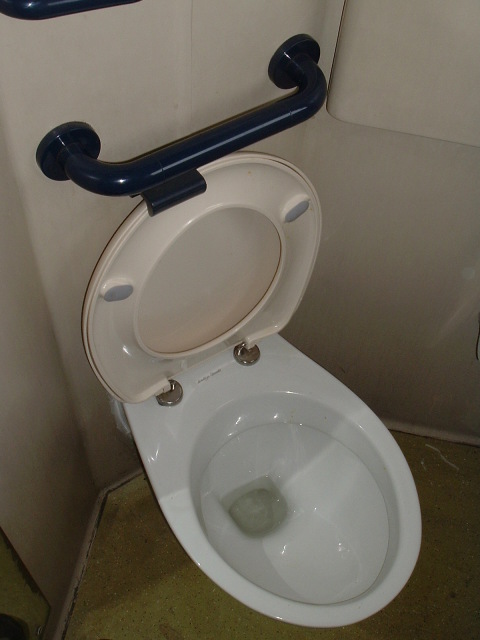
This handrail-equipped train toilet is on board the Great Northern Railway train between London and Edinburgh, UK. Although it's a very nice and modern train, they still give the traditional advice regarding train toilets.
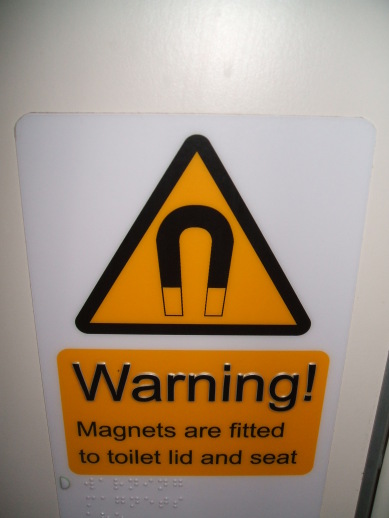
Magnets! MAGNETS!! LOOK OUT!!!
Some of the UK railways put magnets in their train toilet seats and lids.
They provide rather ominous warnings about it.
See the Toilet Sign page for more toilet signs.
U.S.A.
During the 1970s the U.S. federal government nationalized most all passenger rail service in the United States, forming Amtrak. The resulting trains are nice inside, and along the East Coast they keep to useful schedules. Toward the center of country, however, coverage is sketchy.
These are the toilets one board The Cardinal, which links Chicago and New York via Cincinnati and Washington, loosely approximating a three-times-weekly schedule, and Chicago and Indianapolis on the other four days. At least the stainless toilets are fairly nice!
They're the classic holding tank design, which means that the tank can fill and the lavatory be closed en route on the 26-hour trip between New York and Chicago.
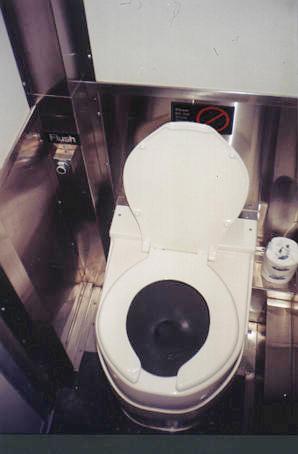
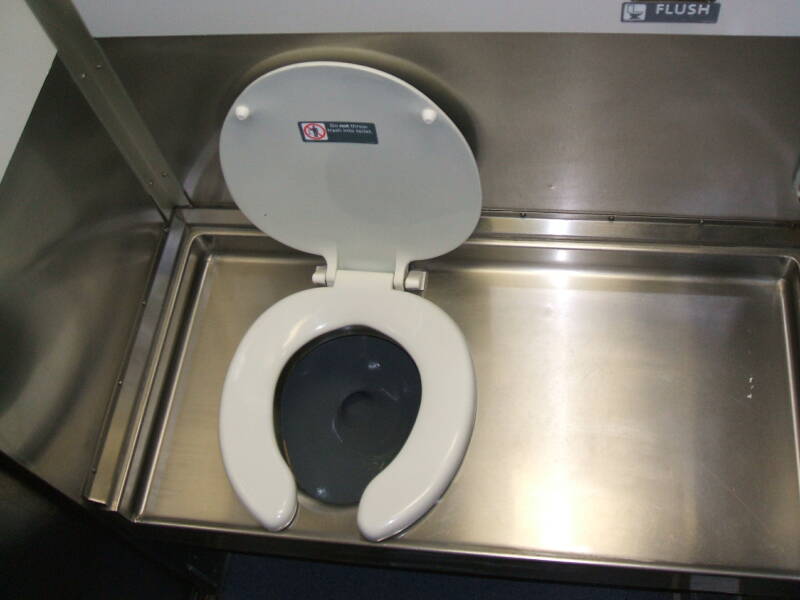
This toilet is on board one of Amtrak's high-speed Acela trains running between Boston and Washington DC.
As you can see, it's very similar to the vacuum flushing aircraft toilet design.
Unfortunately, these systems require electrical power. That means that the toilets don't work when the train loses power.
An Acela run from New York to Boston in November 2018 was stopped for six hours soon after leaving New York's Penn Station. The electrical power lines had been damaged. Train #2230 sat for 6 hours with no lights, no ventilation, and no toilets.
Staff opened doors for ventilation. After an hour, the train staff fashioned a field-expedient toilet out of a cardboard box lined with plastic.
That right — on the American rail system, sometimes people poop into cardboard boxes. Well, at least they had boxes, I suppose it could have been worse.
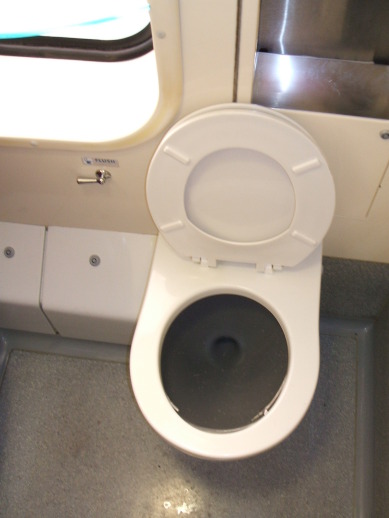
Here's a wheelchair-accessible toilet on board an Amtrak Acela train from New York to Washington:
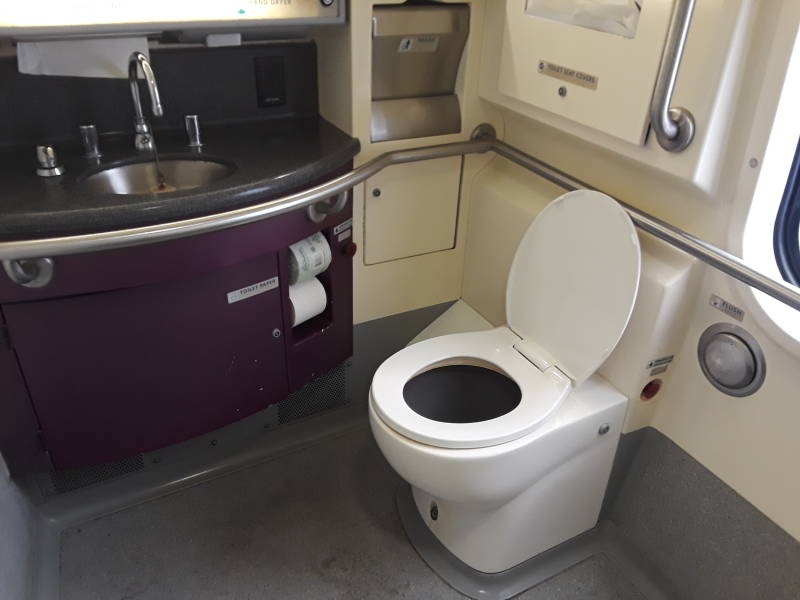
This stainless steel toilet suite is on board a MARC (Maryland Rail Commuter Service) train between Washington and Baltimore.
These commuter trains run about once an hour between Washington and Baltimore during the week, with limited service over the weekend.