British Toilets
British Toilets
Britain is enormously influential given its relatively small size. The home of a worldwide empire until recently, the island nation has been the source of literature (and now film) that has influenced cultures around the world. Its scientists and engineers have discovered and developed iron bridges, railroads, electrical and electromagnetic principals behind today's machinery and electronics, antibiotics, and the structure of DNA and treatments based on it. But before all that, many modern plumbing developments happened in Britain. Let's see what remains of British lavatorial heritage, and what a visitor will encounter today.
British toilets can be surprisingly mysterious, especially regarding their flushing mechanism. I received an e-mail from Alistair MacDonald, a Wall Street Journal reporter, asking:
I am a reporter at the Wall Street Journal writing a story about a best toilet competition in the UK. It seems they take their toilets very seriously over here. Given you have written about toilets around the world, I was wondering how British toilets rated compared with other nations and if they had any particular idiosyncrasies?
My response to him included:
There are a few things that I have found peculiar to Britain, or at least much more common there. (disclaimer: I've never been to Wales, but otherwise I've been places from Skara Brae to Glastonbury, both pictured on my pages)
One is the wall mounted tank up by the ceiling, providing a somewhat violent flushing action. It does what it needs to, but in the process it can dampen the surroundings. You lean over to pull the chain and then quickly jump back. Some of them seem to date from the Victorian era, but it was probably the thick multiple coats of paint in some low-budget hostels near the Earls Court Tube station that gave me that impression. Not bad, just different.
The second is the flushing mechanism when it's mounted just above and behind the bowl. The handle tends to be an enormous paddle (at least it seems that way given my habit of dealing with tiny chromed flippers), and you have to use just the right angular velocity to get it to really flush. My first several flushes on each visit to Britain tend to be misfires until I get the rhythm back again. I have pulled the lid off a tank to see what is so very different, only to encounter what looks very familiar. Hmmm. Next time, I need to take a picture of the inside of a British toilet tank... Not bad, but it is humbling to be unable to do something that would seem to be so obvious as flushing a toilet (and then after a few days, wondering why I had any trouble when I first arrived).
The third is the impressive confidence exhibited by the tank being enclosed within the wall. The handle is all that's visible, and the bowl itself may look fairly old, suggesting that the tank and flush mechanism have needed no attention since the Great War. Maybe there is some cabal of plumbers and carpenters guaranteeing extended hourly billing opportunities for each other, or maybe the toilets really are that reliable. Impressive, if a bit mystifying.
The fourth would be the labeling as "Gents" and "Ladies" as opposed to "Men" and "Women" (which aren't even in the expected possessive form, unless you interpret it more as a command than an announcment). Or the stylized "Trousered Humanoid" and "Aproned Humanoid" outlines. Anyway, "Gents" and "Ladies" is more cultured, or so I choose to believe.
The fifth would be a non-toilet plumbing issue, the tiny sinks with separated faucets so you have choices of Icy and Boiling and no way to get your hands below either. But again see my frequent reference point of cheap hostels in old buildings.
Finally, if one wanted to see toilets through history, Britain seems to be a good place to go (once you get past the myth that Thomas Crapper invented flush toilets). Examples are easily found from Neolithic times through Roman Britannia, the Middle Ages, and the 19th century.
That's all that occurs to me right now. If you're looking for attribution (or blame), and it would provide any helpful clarification, I do have a Ph.D. from Purdue University. However, it isn't in any lavatorial or scatalogical field. One finds fame or fortune where one can.
The siphon action makes it surprisingly difficult to flush a British toilet.
Even if you flush this one just right and get the siphonic torrent flowing on the first attempt, you are starting over afresh on the next one.
Good luck!
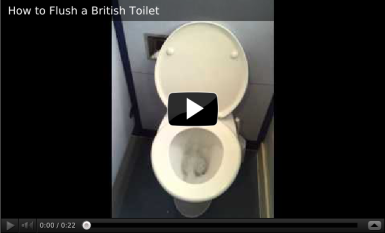
An instructional video is available to show you that it is possible to get one of these to flush on the first attempt.
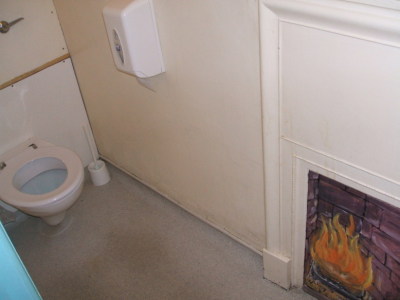
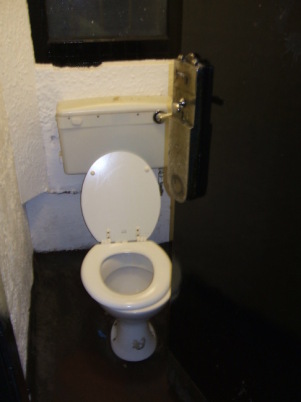
Here are two of the toilets at the Castle Rock Hostel in Edinburgh, Scotland.
Notice how the tank and flushing mechanism are embedded in the wall.
Also see the Trompe l'œil Toilet Page, where one of these fixtures is featured in detail.
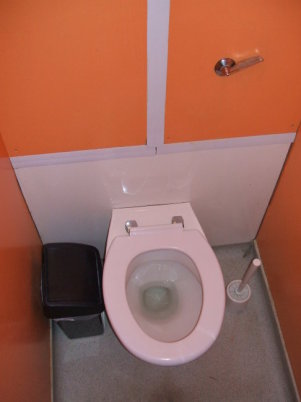
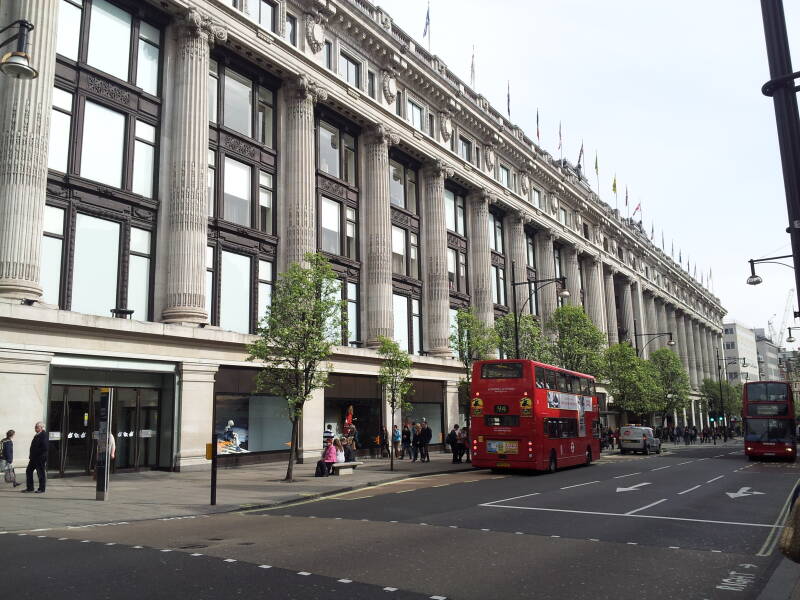
Selfridges, Oxford Street is the second largest retail premises in the UK and was named the world's best department store in 2010 and 2012.
Built by the American retailer Harry Gordon Selfridge and opened in 1909, it had several architectural innovations. It was an early example of a steel frame building and compliant with a number of new fire regulations.
Selfridge pioneered several retail concepts that still dominate the economy. He promoted the idea of shopping for pleasure rather than purely out of necessity. The store incorporated a number of restaurants with modest prices but elegant atmosphere, a library, and the first public toilets and washrooms for women. All this made for a pleasant experience that brought shoppers into the store and keep them there.
These are the ruins of Glastonbury Abbey in Somerset, in south-western England. The abbey church is in the distance, in the foreground you can see the toilets used by the monks from the late 1100s into the 1200s.
A monastery was founded here in the 7th century AD. The town was seized by the invading Saxons in 658, although they allowed the British abbot to remain in control of the abbey.
Saint Dunstan was the prominent abbot of Glastonbury in the 10th century. He enlarged the abbey church and built new cloisters before becoming the Archbishop of Canterbury in 960.
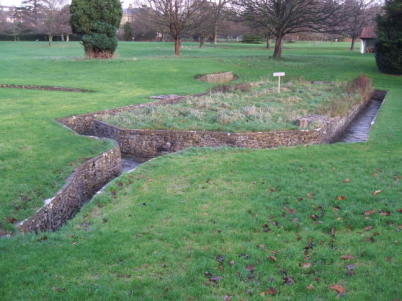
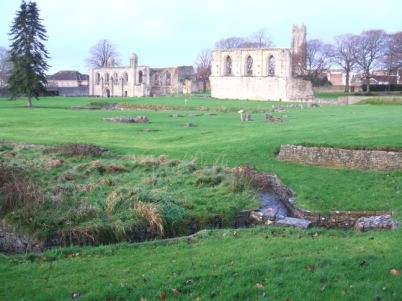
A huge fire in 1184 destroyed the abbey. It was rebuilt in just a few years, but by 1191 the reconstruction had the abbey under severe financial pressure. The abboy directed the monks to dig in a specific spot in the cemetery, where they just happened to discover the remains of what obviously (to them) were Arthur and Guinevere. Around that same time the legend appeared of how Joseph of Arimathea visited the location in 63 AD.
See about these monastic toilets in detail on the Arthurian Toilet Page.
The Saint Andrew Cathedral Priory in Scotland includes these majestic ruins of some medieval monastic toilets.
The Church of Saint Regulus was built here in the 900s, commemorating the legendary arrival of that saint bearing the relics of Saint Andrew. There was an abbot here by 747, in the monastic complex founded on a former Pictish stronghold.
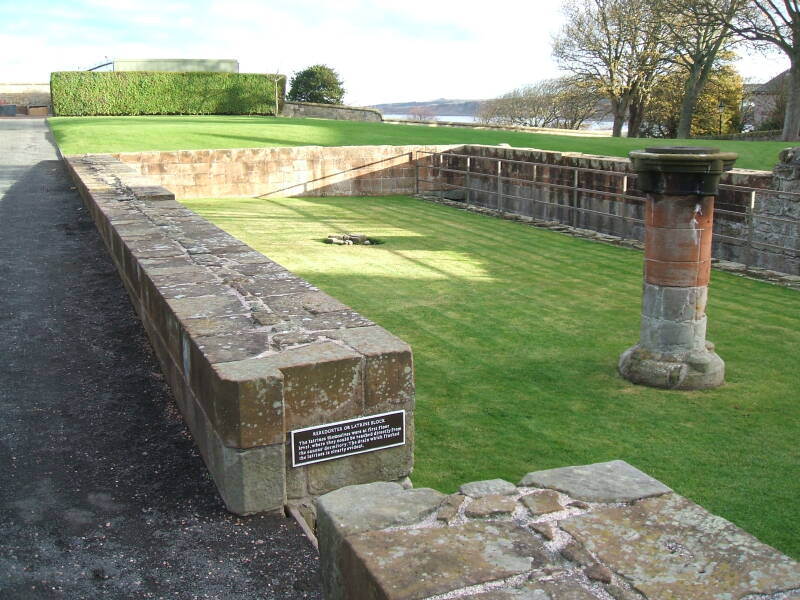
An Augustinian priory was built in the 1100s. Franciscans and Dominican monks held property in the town by the late 1400s and possibly as late as 1518. The cathedral and monastery fell into disuse during the Restoration and the cathedral was stripped of its altar and images in 1559.
Read about these in detail on the Medieval Ecclesiastical Scottish Toilet Page
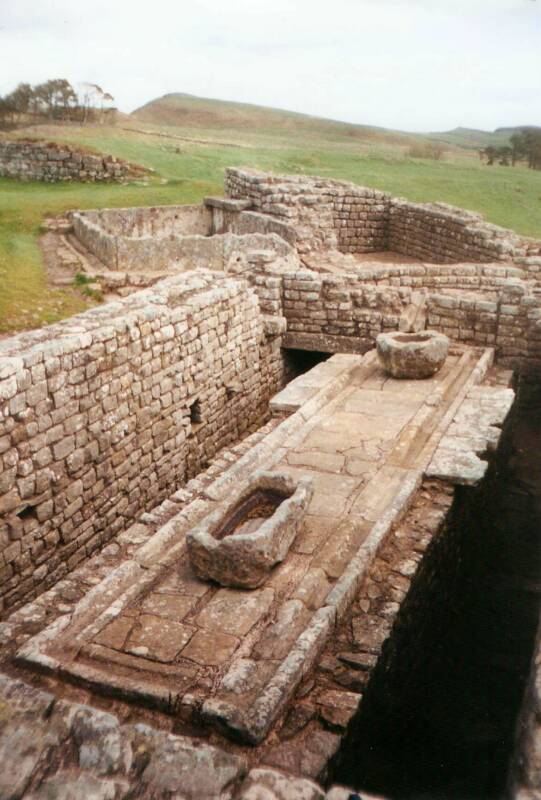
These are the Roman toilets at Vercovicium Fort, a part of Hadrian's Wall, in Northumberland in northern England.
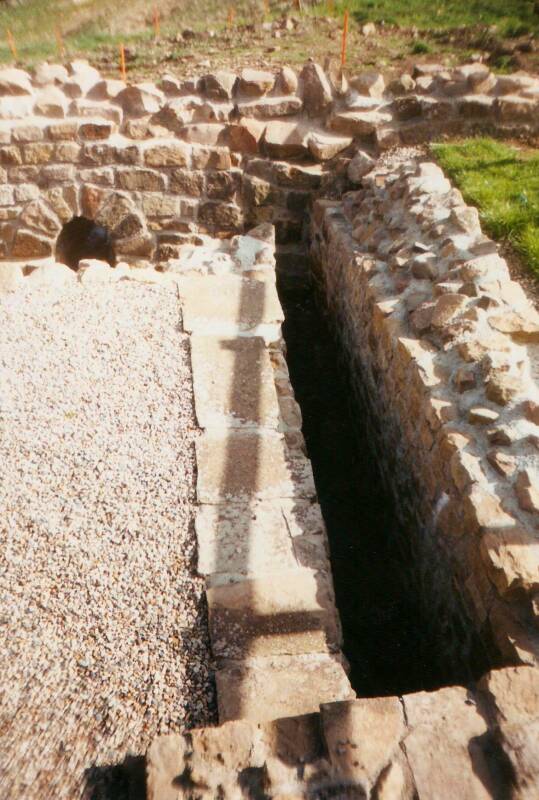
Below are the Roman toilets at Vindolanda Fort, also near Hadrian's Wall.
See these in detail on the Imperial Roman (Britannia) Toilet Page.
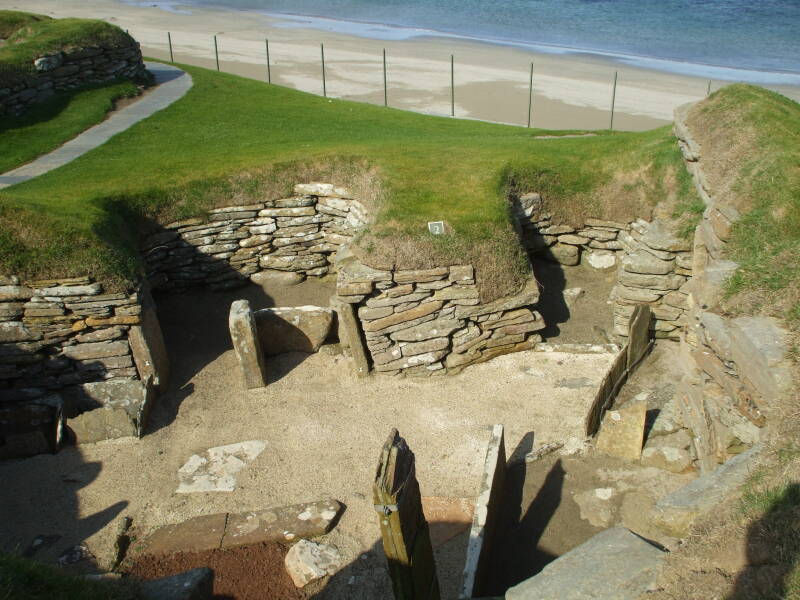
The Neolithic settlement of Skara Brae includes what are believed to be toilets attached to each of the eight interconnected dwellings.
Skara Brae is in the Orkney Islands, off the north coast of Scotland. It was inhabited in the period 3100-2500 BC and is Europe's most complete Neolithic settlement. It was buried by drifting sand and wasn't discovered until 1850.
See the Neolithic Toilets page for details.
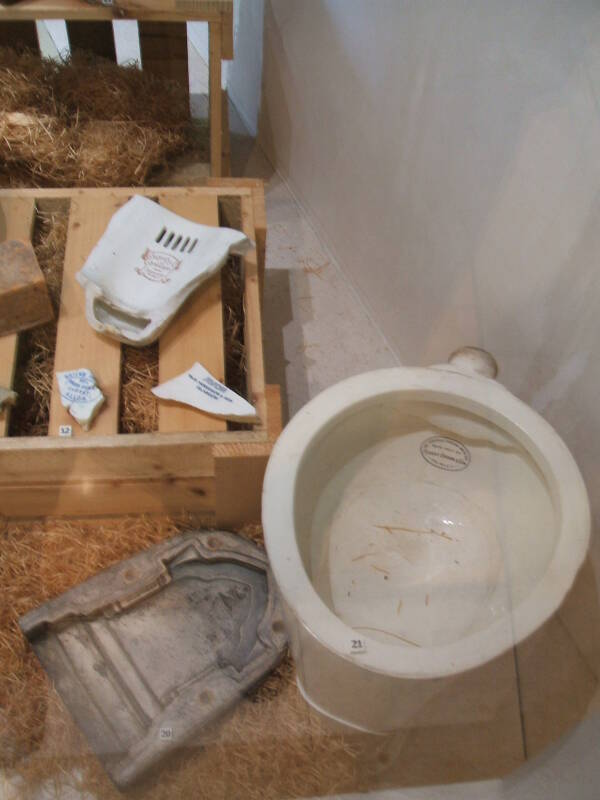
The National Museum in Edinburgh, Scotland has some 19th-century Scottish industrial samples in the form of toilets.
See about these in detail on the 19th-Century Scottish Toilet Page.
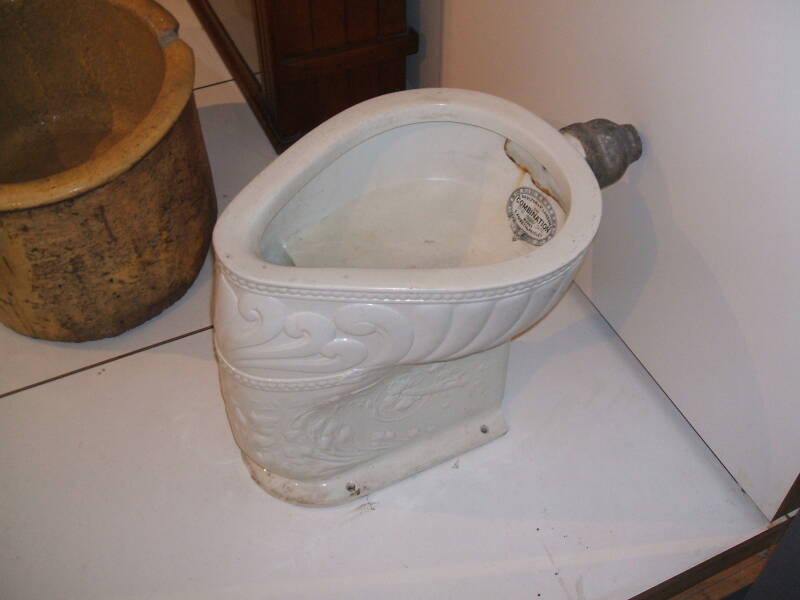
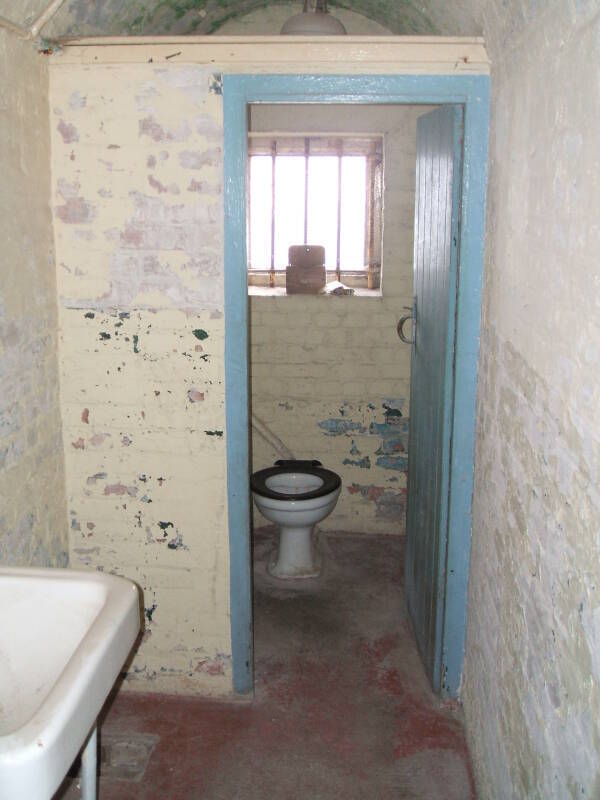
This toilet is in the formerly secret UK government bunkers tunneled into the cliffs above Dover.
Some of the tunnels date from the Napoleanic Wars, but they were greatly expanded during World War II. The UK anti-aircraft operations were controlled from here — radar and other data was gathered and interceptors were dispatched from here. See my page with many pictures from there.
Also see the Loos with Views page.
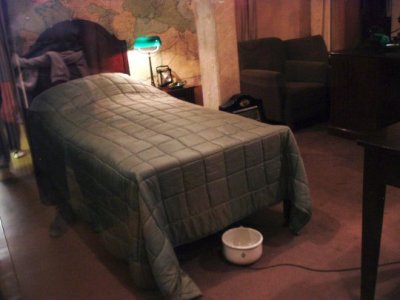
This is Winston Churchill's private room within the Cabinet War Rooms in London.
See the page on Winston Churchill's chamber pot, visible here, for more.
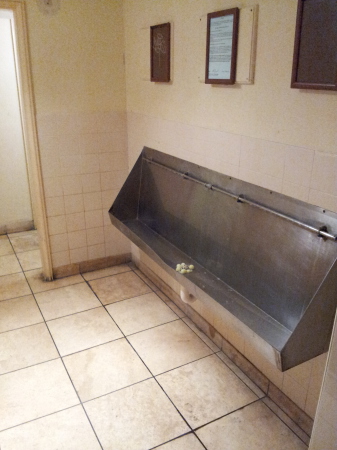
Many public toilets across Britain are extremely sturdy models made from stainless steel.
The first of these is in the Tron pub in Edinburgh, Scotland.
If you're walking along the Avon River path between Bristol and Bath and you want to use a public toilet rather than secluded bushes? The second of these is what you'll find.
See the Stainless Steel Toilet page for more of this metallic design.
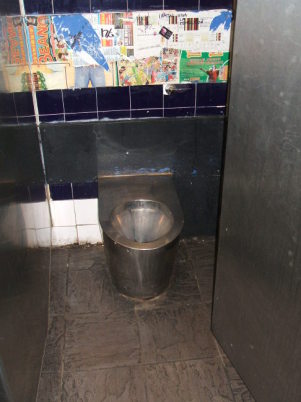
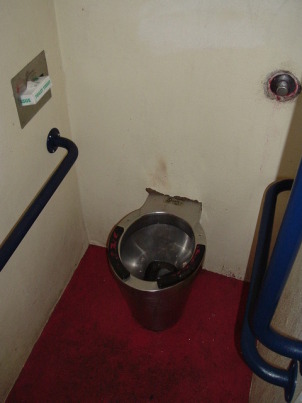
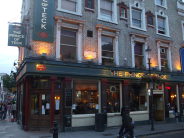
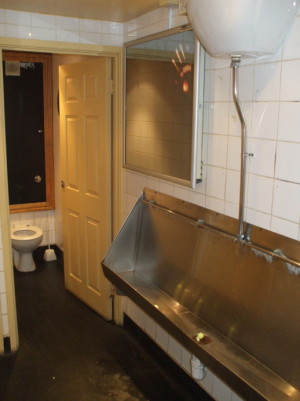
British pub toilets tend toward the large, steel, and utilitarian. The first of these is in the Prince of Teck pub in Earl's Court, London, the second is in another pub in that area.
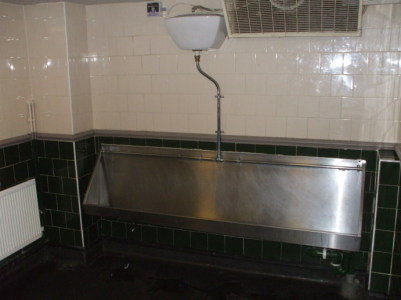
The John Snow Pub is named for the pioneering physician and epidemiologist who determined that the 1854 cholera outbreak in London was caused by sewage-contaminated water at a pump in Soho. The very pleasant pub named in his memory now has very clean ceramic sinks and a large urinal.
See the Cholera Pump page for more details on the cholera outbreak and Snow's valuable work, plus pictures of the pub's interior and more on its plumbing.
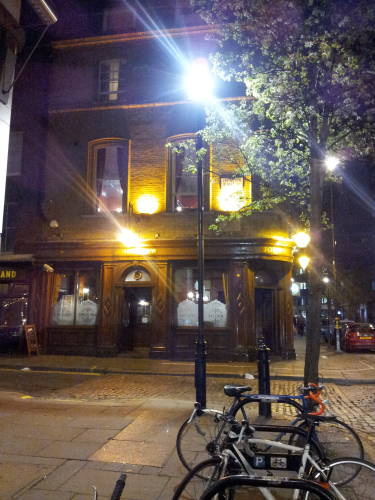
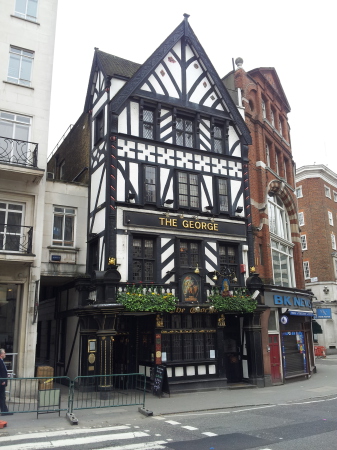
The George is a pub in The City, the old financial and judicial heart of old London.
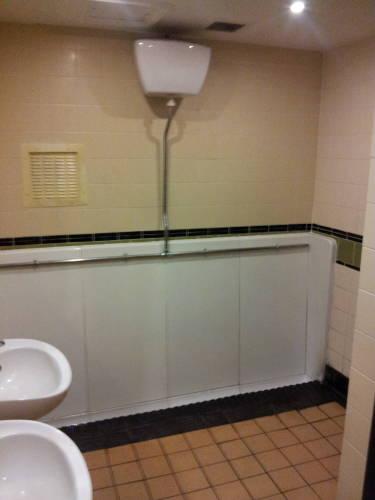
The urinal in the gents' room is a no-nonsense traditional stainless steel trough with the requisite naphthalene balls.
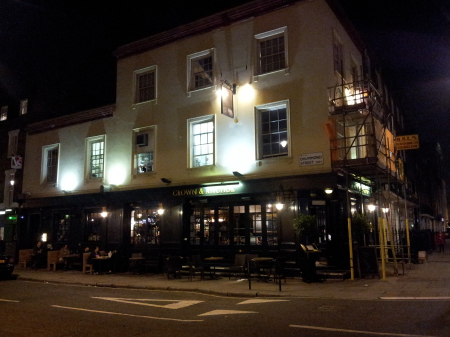
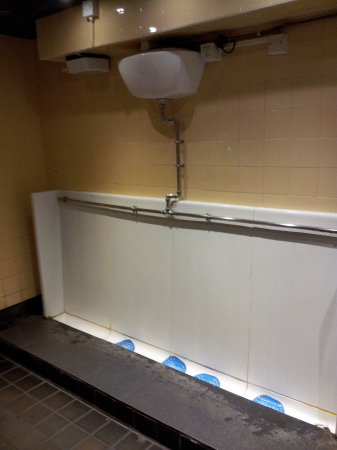
The Crown and Anchor pub is just a few blocks west of Euston Station in north-central London. Its gents' room has a large ceramic urinal with a high-mounted tank.
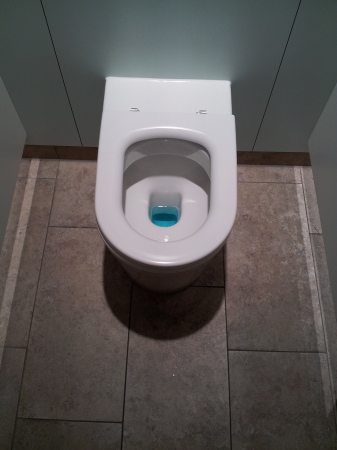
You may encounter one last distinctive British toilet on your way out of the country.
This squarish Euro-modern commode is at Terminal 4 of London Heathrow Airport.
As a U.S. visitor to Britain, I have noticed the modern design in the architecture of London and in fixtures and appliances. Not that everything is modern in Britain, but many things there are more modern than in the very young country of the United States.
This pub toilet in Dunfermline, Scotland, has an unusually sturdy latch and lock.
According to a correspondent, this is probably a rather old door, and an example of what once was common on public toilets. These doors had locks requiring an old-style Penny to unlock the door. This is the origin of the British euphemism "To spend a penny".
The use of the old Penny or Pence coin dates this door back to before the decimalisation of British coinage in 1971.
Back in the pre-decimal days of £sd,
the pound (£) was divided into 20 shillings (s)
of 12 pence (d) each:
£1 = 20s, 1s = 12d
The origins of this go back to Charlemagne's 8th century decree that the money of the Holy Roman Empire should be silver coins, so quantities could be determined by counting rather than weighing.
This in turn is based on the Roman Empire's 12 denarii being equal to one gold solidus, and 240 denarii being cut from one Roman libra of silver. The English name pound is a Germanic adaptation of the Latin libra pondo or "pound weight".
Many monetary systems based on a 240:12:1 ratio were used across medieval Europe. Just like the Babylonians and their base-60 mathematics and calendar, the 240:12:1 system supports many fractions: twelfths, tenths, eights, sixths, fourths, thirds, and halves. With the addition of the British Guinea of 21 shillings you could do even more.
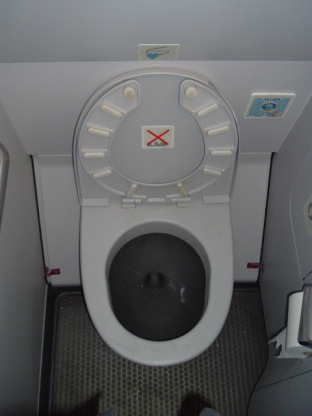
The toilet in a washroom on board an Airbus A330 en route from London to Detroit.
This is one of the toilets against the fuselage skin, not one of the only slightly more roomy center ones.
Why do your ears sometimes feel pressure changes when you flush an airline toilet? Because the vacuum flushing may cause the pressure altitude within the tiny toilet cabin to quickly jump 5 to 20 meters, say from about 2000m pressure altitude to 2015m.
For other odd A330 photographs, see my Gallery of Crash Dump Screens. The seatback entertainment systems run an embedded version of the Linux operating system. The OS is fairly stable, but the application is not.
|
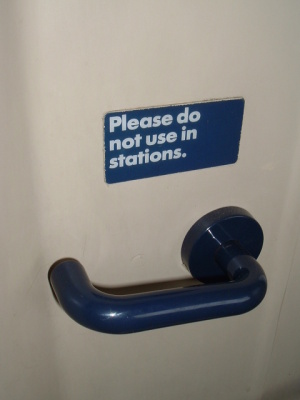
Please do not use in stations |
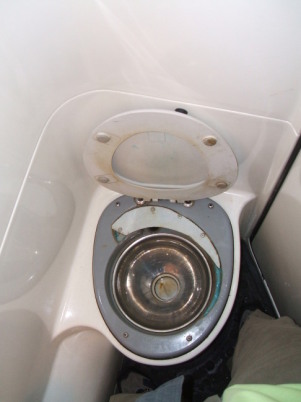
This toilet is on the Great Northern Railway train between London and Edinburgh, UK. Although it's a very nice and modern train, they still give the traditional advice regarding train toilets.
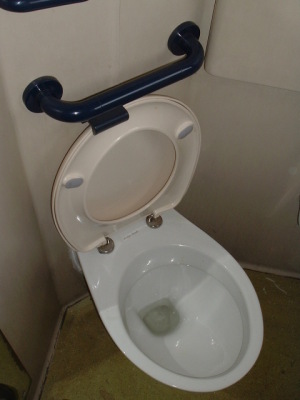
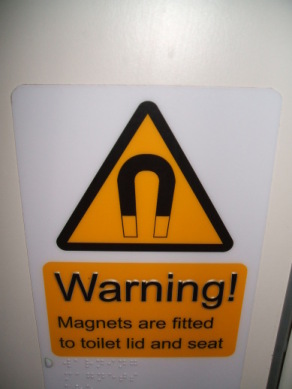
Magnets! MAGNETS!! LOOK OUT!!!
Some of the UK railways put magnets in their train toilet seats and lids.
They provide rather ominous warnings about it.
See the Toilet Sign page for more toilet signs.
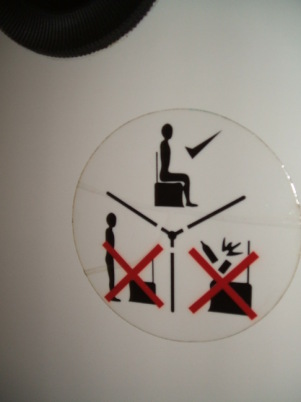
National Express buses in the U.K. also have on-board toilets. This is from an overnight bus from Edinburgh to London (about 7 hours).
Also notice the sign —
Do not even attempt to pee standing!
That also helps to keep things clean.
See the Toilet Sign page for more toilet signs.
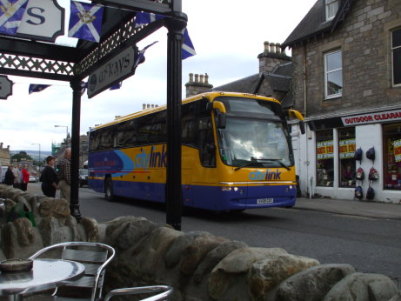
Citylink buses connect cities and towns within Scotland. As bus toilets go, these are the nicest that I have encountered. They are constructed about like aircraft toilets, and very clean.
Here we see a Citylink bus passing through Pitlochry on the route from Edinburgh to Inverness.
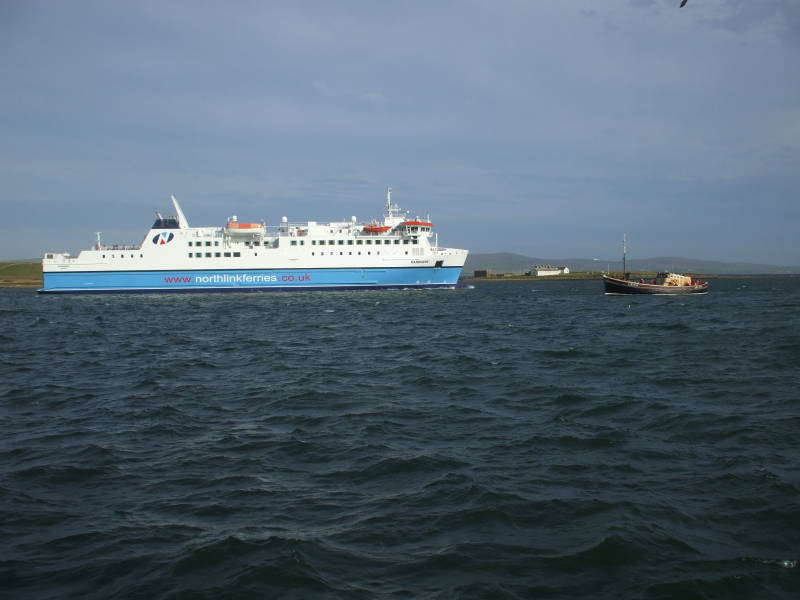
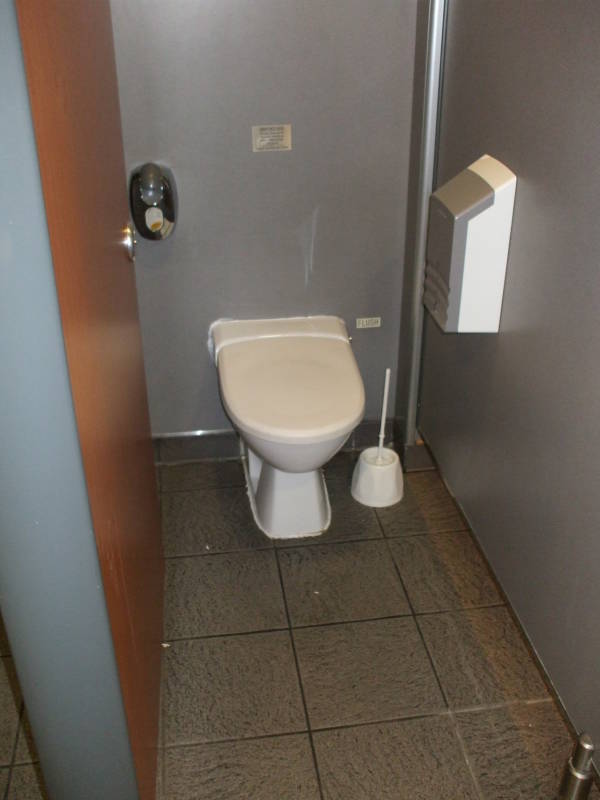
The M/V Hamnavoe ferry links the Orkney Islands with the north coast of Scotland.
There are several sailings a day, 90 minutes en route each direction.
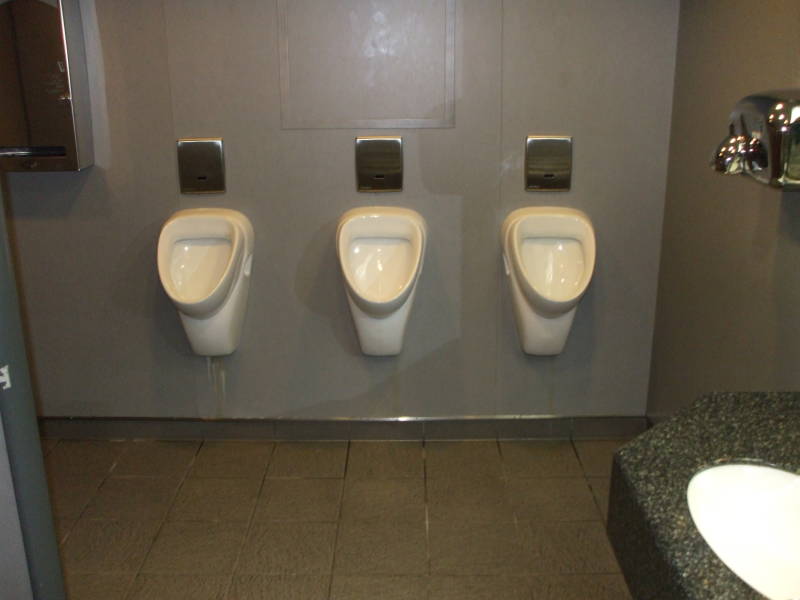
Here are the heads.
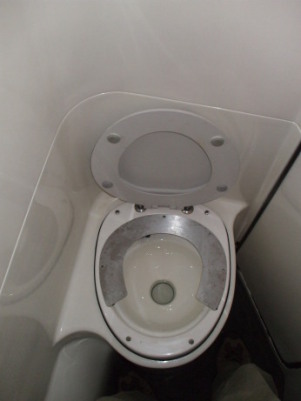
The M/V Isle of Mull is one of the many ferries connecting the Inner Hebrides islands with the west coast of Scotland.
Here is one of the heads as photographed during a trip from Oban to Craignure on the Isle of Mull.
See the Ship Toilet page for more toilets on ships.