
Squat or Sit?
Squat Toilets and Raised Commodes
This is the biggest toilet question in the minds of most
international travelers.
For some potential travelers, especially Americans,
it may be the biggest question of all
and a large part of what keeps them from traveling
out of their fear of the different and the unfamiliar:
When I visit that country,
what will the toilets be like?
Will they be squat toilets,
pans in the floor?
Or will they be raised
commodes, like porcelain chairs?
If I have a choice, should I squat or sit?
That is entirely up to you. It's your decision and we really don't need to hear all about it.
However, there are some people with very strong opinions about this. Some of them are very insistent. They're zealous evangelists of squatting. For some reason it only works one way, you never find a complete stranger telling you at length how you absolutely must sit on a raised porcelain commode.
This series of pictures shows one author's five-step process for getting into the correct position:
- Knees higher than hips. Use that little stool!
- Lean forward and put your elbows on your knees.
- Bulge out your abdomen.
- Straighten your spine.
- GO!
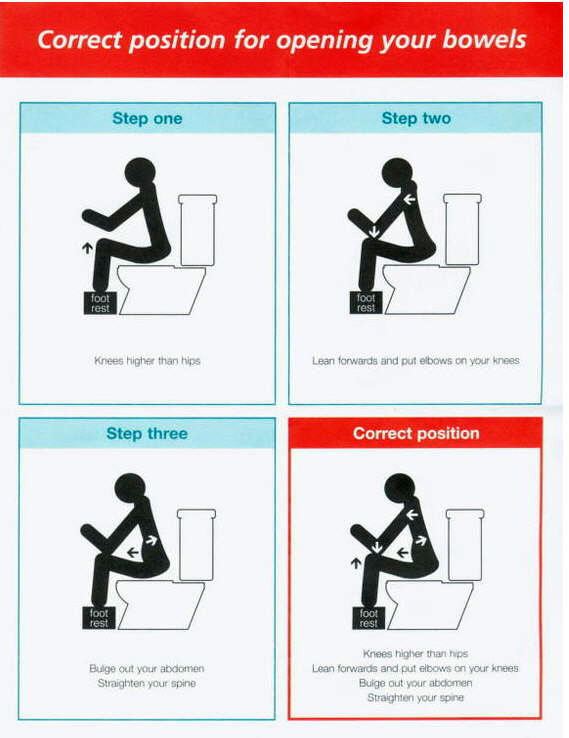
Some people use a small stool to elevate their feet while seated on a raised commode. This mimics the anatomical pose of squatting. These stools can be made from metal, white plastic, or even bamboo.

Amazon B07HD7JVLB

Amazon B00ESKVN7W
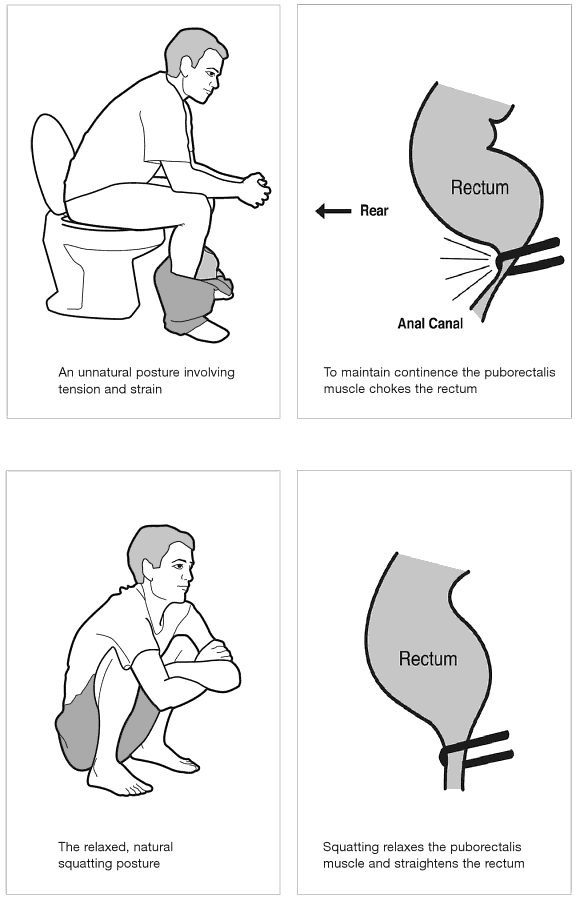
Others insist that your puborectalis muscle is going to choke your rectum and you must squat.
Quiz: What vital step has this squatting man forgotten?
That is correct, he has neglected to remove or at least drop his trousers! His oh-so-natural relaxed straightened rectum is going to fill his pants.
As I said, some of these people get awfully zealous. It isn't long before their enthusiasm for getting everyone to defecate a certain way expands to include various exotic enema regimens.
Maybe you should get a full-height Poop Stool and do it correctly.
For absolutely everything I have on the topic of toilets, arranged on a country by country basis, see my collection of international toilets. But allow me to attempt to summarize the distributions of squatters and commodes, of pans and thrones:
North America
You'll find nothing but raised porcelain commodes in this part of the world. Yes, some U.S. or Canadian state or provincial or national park probably has a squat toilet somewhere, and there are probably some squat toilets in Quebec, but I don't remember seeing any and I certainly don't have any pictures. Not yet, anyway, but I'm always looking to document new examples.
Or so I wrote, before receiving this corrective from Jean Gould of Québec:
		I protest about your words on squad toilet in Quebec.
		It a misunderstanding of the history of British Empire and
		of North American economic trends and specially the building
		industry.
		Quebec was a French province 250 years ago when aristocrats
		were peeing on walls corners in Versailles.
		After 1759, English rulers came.
		Middle Class brought ... English toilet in 19th century.
		With 20th century, the American way of life came up.
		Since this time "American Standard" rules in architectural
		design, including public restroom and private bathroom.
		Is so true than Canada, which have adopted metric system
		since 30 years used yet British units for all buildings
		matters including plumbing.
		So squad toilet is exotic for all Canadians including
		French Canadians, may be more for them because they
		travel more extensively in France.
		However, squad toilet is more common in south of France,
		and in North Africa.
		Squad Toilet is a mix of home made building and industrial
		production, like shower, people buy a square cement slab
		with little walls (3-4 inches) and build walls on the spot
		and put ceramic on its.
As a somewhat extreme example of the North American insistence on raised thrones, see this pit toilet in the Boundary Waters Canoe Area Wilderness in north-eastern Minnesota.
We were on our third day of paddling, at a location you probably could reach in one long and hard day of paddling. We were on a small island near the border.
The location was marked as a camp site, as there was a nice cleared smooth area where you could pitch tents and sleep, and there was a stone fire ring.
And, back a path into the woods, there was a toilet!
Some poor ranger has to paddle around to dig new pit toilets and fill in the old ones.
Official Pit Toilet #17 is a conical fiberglass seat fastened to a frame of 2"x6" boards, placed over a pit that probably has some lime dumped down into it. The fiberglass cone serves to funnel the ammonia into the atmosphere.
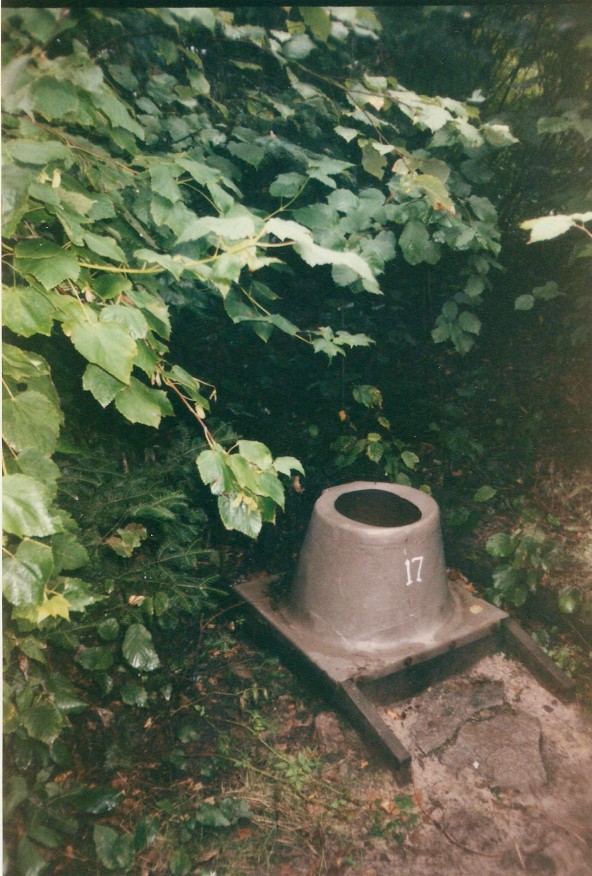
Pit toilet with fiberglass seat in the Boundary Waters Canoe Area Wilderness.
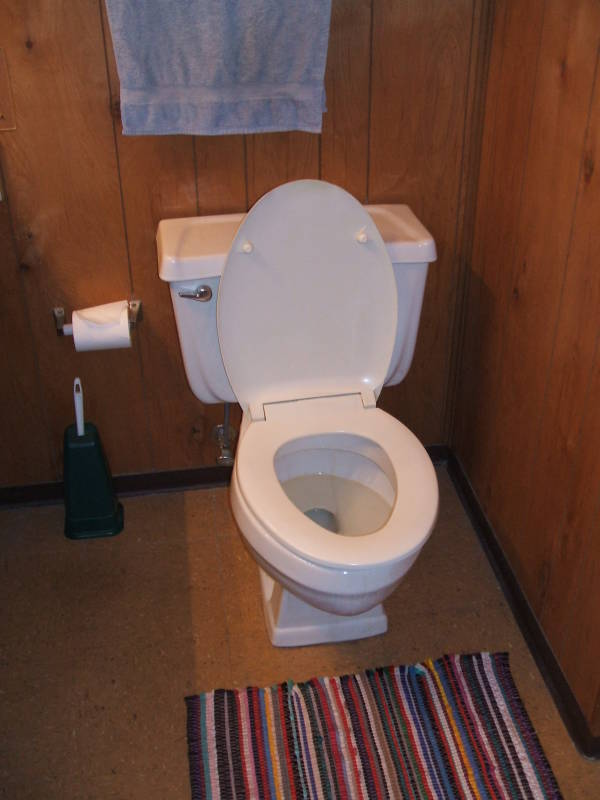
My North American toilet, a raised porcelain throne.
But for all practical purposes, all of the toilets you will find in the United States will be raised porcelain commodes like the one you see here.
This one is actually mine, so it's reasonably clean but I'm sure that you would find many others to be nicer.
Visit my page of American toilets to see more of the range from nasty to nice.
Mexico also has raised porcelain commodes, and has had them for quite some time.
Here you can see Leon Trotsky's toilet at his home in Mexico City. He was assassinated there with an ice ax in 1940.
Notice how high the tank is mounted on the wall. This would provide for a very powerful flush!
Trotsky was not a man who would trifle with a paltry dribble into his toilet.
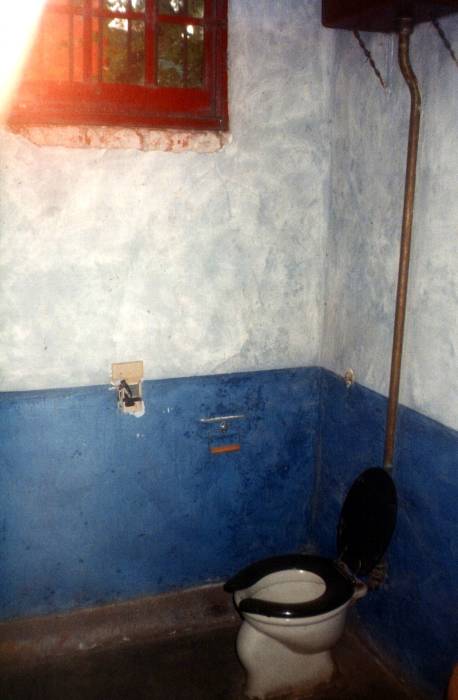
Leon Trotsky's toilet in Mexico.
Europe
In most of Europe you will largely find raised porcelain commodes, with some exceptions.
France has some squat toilets in restaurants and bars. A few public squat toilets remain, at least in smaller towns. The public squat toilets remaining in cities are being replaced with the high-tech automated toilet units that were first developed in France.
Ernest Hemingway wrote about squat toilets in 1920s Paris in A Moveable Feast. From "A Good Café on the Place Saint-Michel", its first chapter:
The Café des Amateurs was the cesspool of the Rue Mouffetard, that wonderful narrow crowded market street which led into the Place Contrescarpe. The squat toilets of the old apartment houses, one by the side of the stairs on each floor with the two cleated cement shoe-shaped elevations on each side of the aperture so a locataire would not slip, emptied into cesspools which were emptied by pumping into horse-drawn tank wagons at night. In the summer time, with all windows open, we would hear the pumping and the odor was very strong. The tank wagons were painted brown and saffron color and in the moonlight when they worked the rue Cardinal Lemoine their wheeled, horse-drawn cylinders looked like Braque paintings.
Then from the third chapter, "Shakespeare and Company":
At home in our two-room flat that had no hot water and no inside toilet facilities except an antiseptic portable container that was not uncomfortable to anyone who was used to a Michigan outhouse, but it was a cheerful gay flat with a fine view and good mattress and springs for a comfortable bed on the floor, well and tastefully covered, and pictures that we liked on the walls, I told my wife about the wonderful place I had found.
Some public toilets in Romania are squatters, especially at monasteries and other places not really catering to outside visitors.
Most public toilets in Greece are squatters. Many of them are very grim and some of them are truly awful.
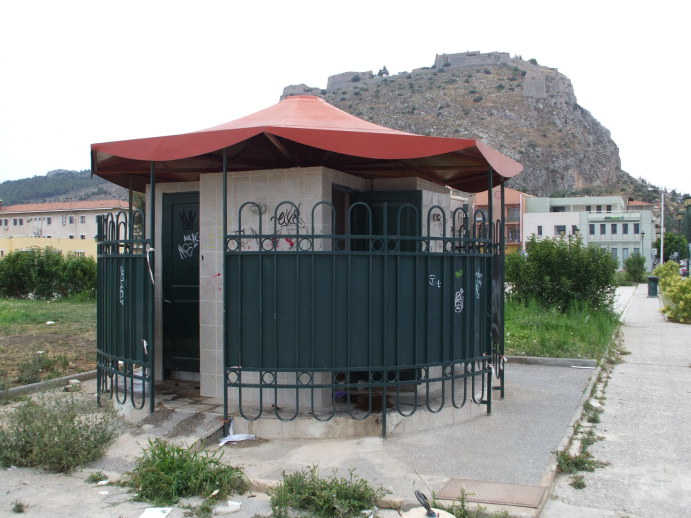
An awful toilet in Nafplio, Greece.
Further east, getting into the former Soviet Union, you get crossover designs. This Latvian train toilet was built in Russia during the days of the Soviet Union.
The footpads on the rim of the bowl let it be used as an elevated squatter.
While that would be the design generally preferred by the people of Soviet Central Asia (Turkmenistan, Uzbekistan, Kazakhstan, Kirghizstan, Tadjikistan), squatting might be preferred by anyone forced to use it after a long train journey had rendered the seat quite filthy.
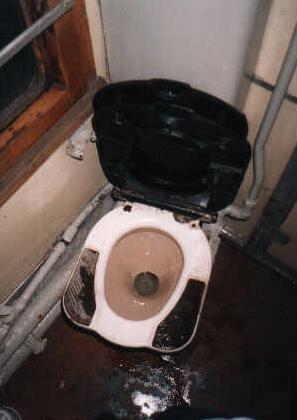
Latvian train toilet with footpads on the rim.

Maybe you could install your own squat toilet.
In Germany there is also the question of "Stand or Sit?" for the guys.
Well, it's not a question for most, the trend in Germany is for men to sit down to urinate. At least at home and the office, not at bars and clubs, mind you. But the sit-to-pee phenomenon has (of course) multi-syllable German terms: sitzpinklers, for those who sit, and stehpinklers for the rebels who insist on standing. You can even buy signs forbidding the stehpinklers.
"A Victory for the Right to Pee Standing Up"
The Atlantic
"Unthinkable? Having a sit down"
The Guardian
Middle East
As you leave Europe to the south-east, you leave the world of raised porcelain thrones. The toilets are mostly squatters.
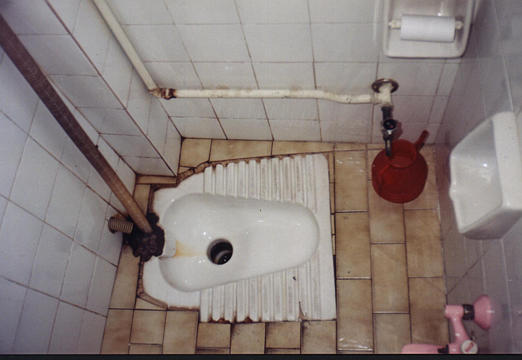
Squat toilet at the Mavi House guesthouse in the Sultanahmet district of İstanbul, Turkey.
There are exceptions in Turkey where most (but not all) Turkish trains and many hotels and guesthouses have raised porcelain commodes. Raised commodes are more common in hotels catering to foreign visitors, but they are also found in places catering mostly to Turks. For example, the hotels where I have stayed in Konya and Malatya, neither of them all that popular with foreign visitors, had raised porcelain commodes.
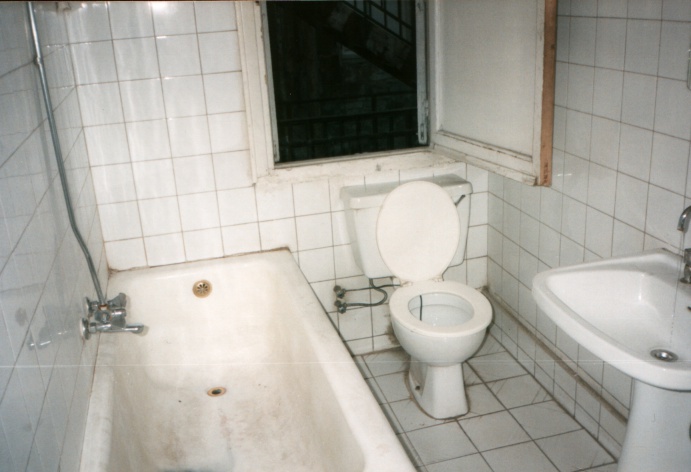
Raised toilet, tub, and sink at a hotel in Malatya, Turkey.
Further south, in Syria and Jordan, I saw very few raised porcelain commodes, and none at all in Egypt.
As for Israel, I haven't been there, but I've been told that in the non-Arab areas it's exclusively raised seats. As someone e-mailed me, "I've been to cities, Moshavim, Kibbutzim and towns, but everywhere I go — porcelain seats."
Clearly the seats-versus-squatters trend is a cultural one, not a strictly geographical one.
And, to judge by the former USAF members who spent a year or more at Incirlik Air Force Base in Turkey and later contacted me asking how they might install a squat toilet in their home in the U.S., it can be a personal one that changes away from the trend of both geography and native culture.
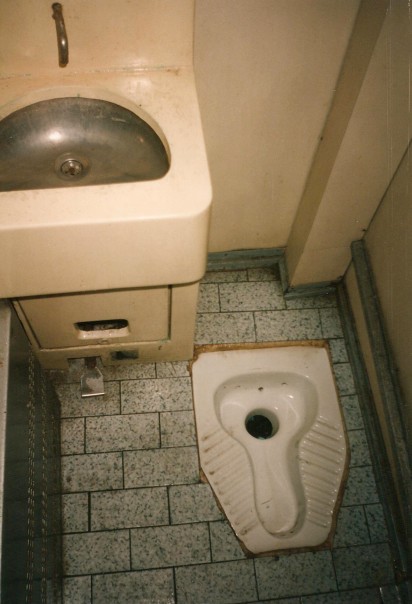
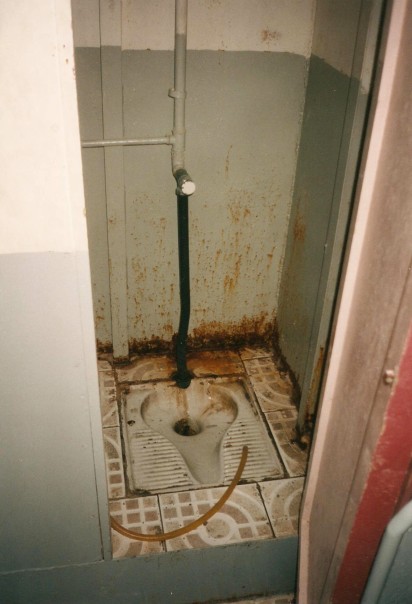
Here are two squat toilets on board Egyptian transportation.
The first is a squat toilet found on board the Egyptian passenger train on the Aswan-Luxor-Cairo route paralleling the Nile.
Although this was an express train and thus far superior to the conditions found on board local train service, there was something dreadfully wrong here.
No Egyptian train toilet is supposed to be this clean!
The second is a toilet on board a ferry between Aqaba, Jordan and Dahab on the Sinai peninsula. Don't be overly offended by this! You're seeing lots of rust, not a lack of cleaning.
Eastern Asia
Or at least what little I've seen of that huge and diverse continent, my travels so far being limited to parts of China and Japan.
Let's start with some squat toilets at the Temple of the Six Banyan Trees in Guangzhou, People's Republic of China. Notice the thick ceramic blocks where you place your feet.
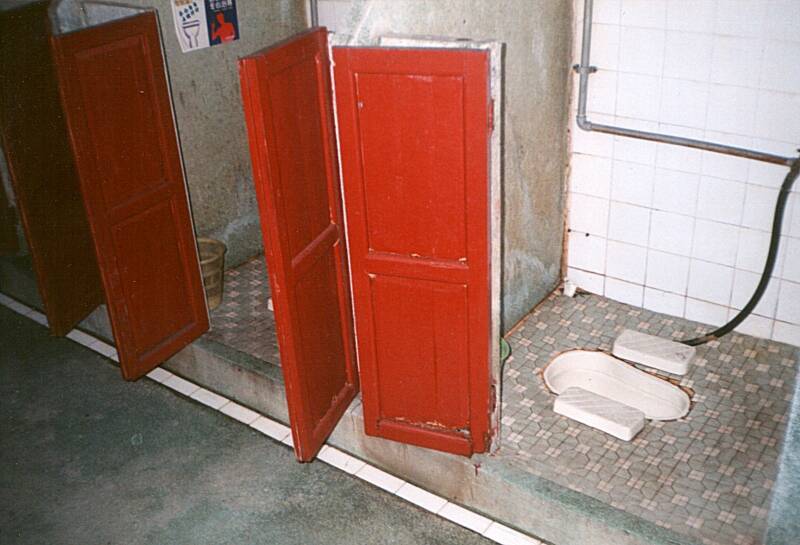
Squat toilets at the Temple of the Six Banyan Trees in Guangzhou, People's Republic of China.
Public toilets in east Asia are almost all squatters. Some hotels have raised porcelain throne toilets in the guest rooms, especially large Japanese hotels catering to Western business travelers, but many feature squat toilets.
The two squat toilets seen below are around Yangshou and Xingping in Guangxi Provence in southeastern China.
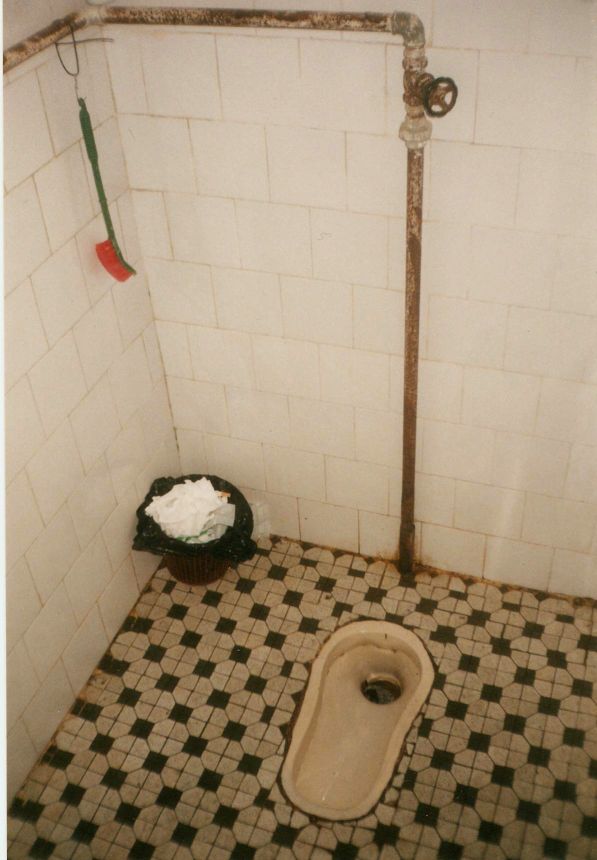
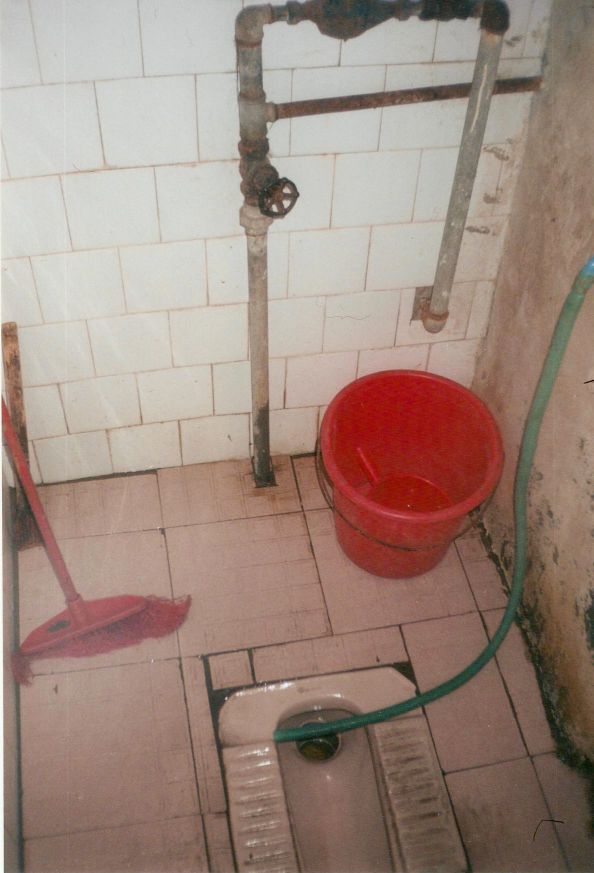
These are some public toilets in the Chungking Mansions, a large apartment block with many guesthouses and small restaurants in the Tsim Sha Tsui district in Hong Kong.
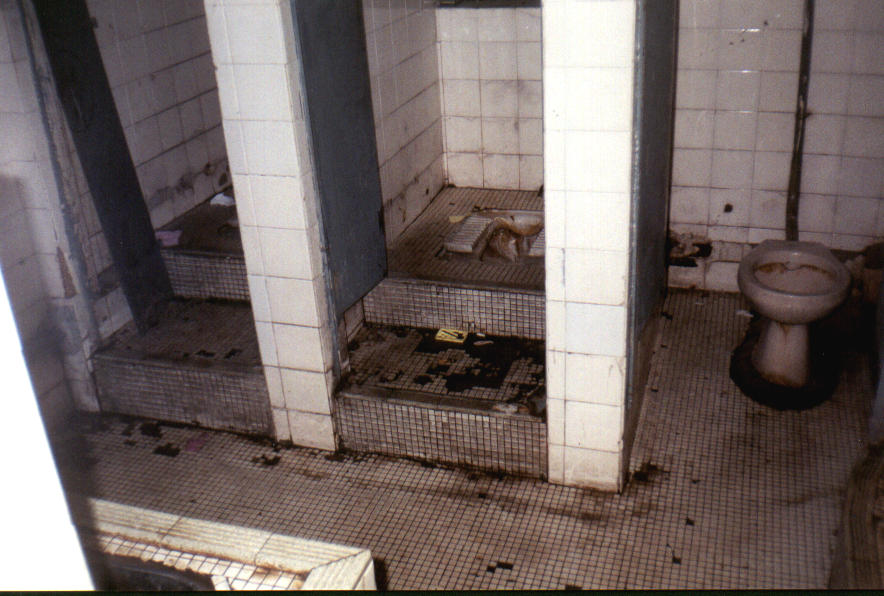
Public toilets in the Chungking Mansions in Hong Kong.
Here is a case where you are offered a choice of squat toilet and raised porcelain commode. Someone who usually has an aversion to squat toilets might find them preferable in some situations like this. For more on squatting versus sitting in China, see:
Seats, Squats, and Leaves: A Brief History of Chinese Toilets My Mission to Clean Up China’s Atrocious Public Toilets
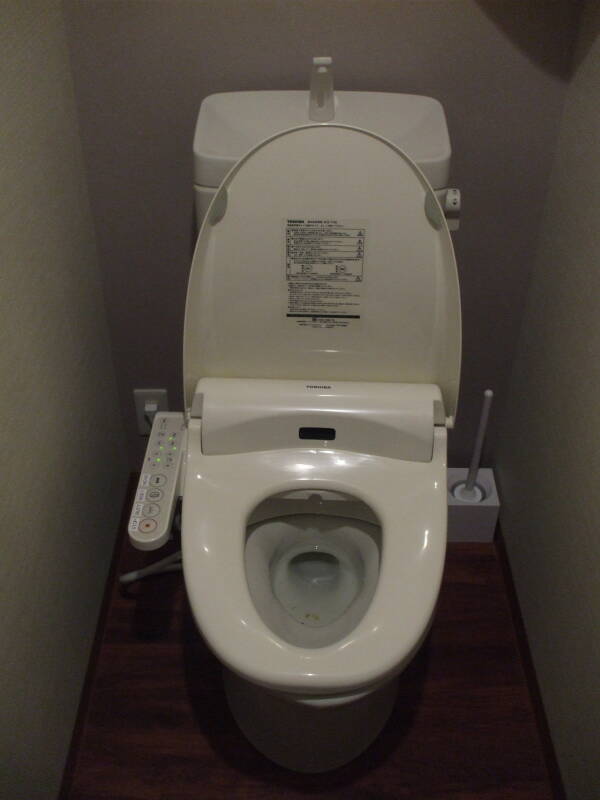
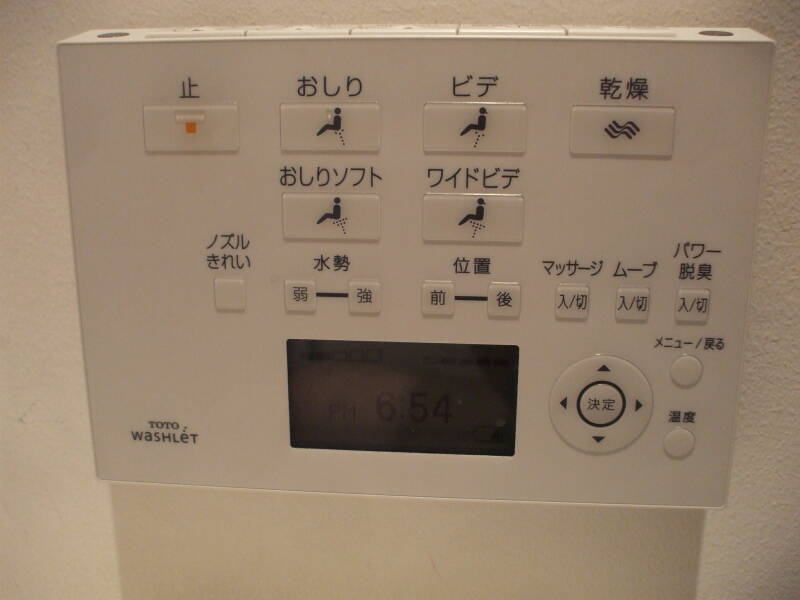
Japan used to be predominantly squat territory. But that was decades ago, before Japan started to lead the world in high-tech multi-function toilet design. Now raised commodes are very common, almost all of them with heated surfaces and built-in rear and front spray bidet functions, and on many of those you can adjust the water spray temperature and pressure. Some of them include air drying, and many include "cover noise" to obscure just what you're up to in the bathroom.
Here is a standard squat toilet at the Kosho-ji temple in Kyōto, a relatively simple raised commode with side-arm controls at the Khaosan World Asakusa Ryokan and Hostel in Tokyo, and a more complex wall-mounted control panel for a toilet at the Bunka Hostel in the Asakusa district of Tokyo.
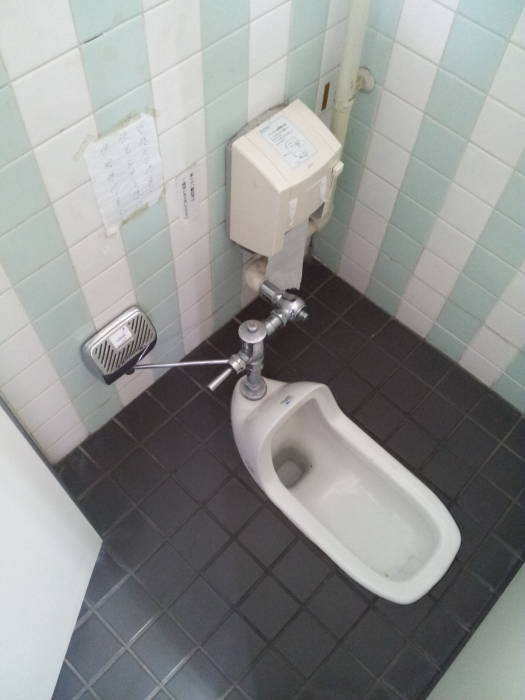
This leads us to...