
Aircraft Toilets
The Lavatories Are Now Available
Travelers have a lot of questions about
toilets on board aircraft.
If you're on a long flight, especially one crossing an ocean,
you will have to visit the lavatory.
Flights across the U.S. or Canada between the west coast
and east coast take five hours or more.
Between North America and Europe, it's at least eight hours.
Between North America and Asia, it's even longer.
You will visit the lavatory at least once.
But...
Why are they called "lavatories"?
How do airliner toilets work?
Have airliners always had toilets on board?
What is the mysterious blue liquid?
How much liquid is required per flush?
Why do your ears pop when you flush?
Keep reading to learn the answers to all these questions
and more!
Surprising Facts about Aircraft Lavatories
- They're called "lavatories." even though no one bathes in them. Regional airlines in the U.S. are doing away with water for the hand-washing basins. More here
- Airlines aren't required to provide them. More here
- Smoking is prohibited, but U.S. Government regulations require ashtrays. More here
- ... and razor blade disposal slots. More here
- The vacuum flush was patented in 1975. More here
- They do not simply dump the waste overboard. More here
- You can unlock them from outside. Just slide the knob under the "Lavatory" sign.
Aircraft Toilets
Toilets on board aircraft are known by the euphemistic term lavatories. That's an even more roundabout way of saying bathroom when no one really bathes in those little compartments.
| English | Latin |
| I wash. | Ego lava. |
| You wash. | Vos lava. |
| He washes. | Lauat. |
| We wash. | Nov lava. |
| They wash. | Lavant. |
The name lavatory comes from the Latin, meaning a room where people wash themselves. In English we say bathroom and washroom to avoid saying the dreaded word toilet. We might as well call it the ablutions chamber.
Meanwhile, many regional airlines in North America have found yet another way to cut costs and maximize their income: They no longer refill the potable water tanks supplying the hand-washing basins. That saves them money in two ways. First, a little less labor is required to service the plane between flights. Second, that's a little less weight to carry.
So, in these so-called "lavatories" you cannot wash yourself!
They provide disinfectant hand-wipes, or at least they do now. It's just a matter of time until they realize that they can leave them out, telling people to bring their own if they want to be at all clean.
Lavatories Aren't Required
Airlinerlavatory
misadventures
There is no requirement to provide facilities for passengers to wash themselves. There isn't even a requirement for toilets. But since the 1930s, airlines have realized that they would have to provide something.
Back in the 1930s, when passenger airline service was highly civilized, the Douglas Corporation's DC-3 was the state of the art. It was born as Douglas' Douglas Sleeper Transport project for American Airlines. The DST was a passenger aircraft with sleeping berths, it could carry 24 passengers in seats during the day, and 16 in sleeper accommodations overnight.
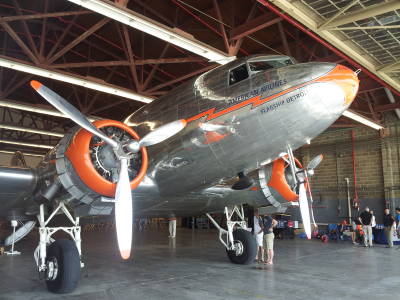
Seven DSTs were built and tested, and then the first DC-3 (a DST with 21 passenger seats instead of sleeping berths) came off the same production line and was delivered directly to American Airlines. American started DC-3 passenger service on June 26, 1936, with flights from Newark, New Jersey, and Chicago, Illinois.
This is the original American Airlines Flagship Detroit, which was the 34th plane built on the Santa Monica production line. Here we see it visiting the Purdue University airport in 2013.
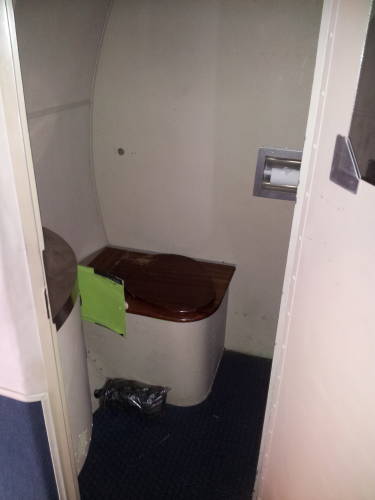
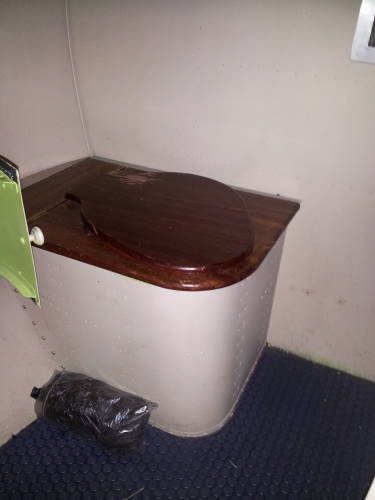
The DC-3 and DST led to a revolution in air travel in the U.S. An eastbound trip from the Pacific coast to the Atlantic coast took just 15 hours with three refueling stops. Westbound trips took 17½ hours because of the headwinds. Both these were significant improvements over competing aircraft designs. Trains began to be replaced for long-distance travel across the U.S.
Later in 1936, KLM Royal Dutch Airlines put their first DC-3 into service on the route between Amsterdam and Sydney via Jakarta (still called Batavia at the time). Amsterdam-Sydney was by far the longest scheduled airline route in the world at the time.
You need an on-board toilet for those long flight segments! Here is the lavatory on the Flagship Detroit. Notice the wooden seat and lid, and the spacious compartment.
It was a far more civilized time.
A total of 16,079 aircraft were built when all the variants are added up, 10,048 of these were the C-47 military version. Civilian DC-3s were built until 1942, military C-47s were built through the end of the war in 1945.
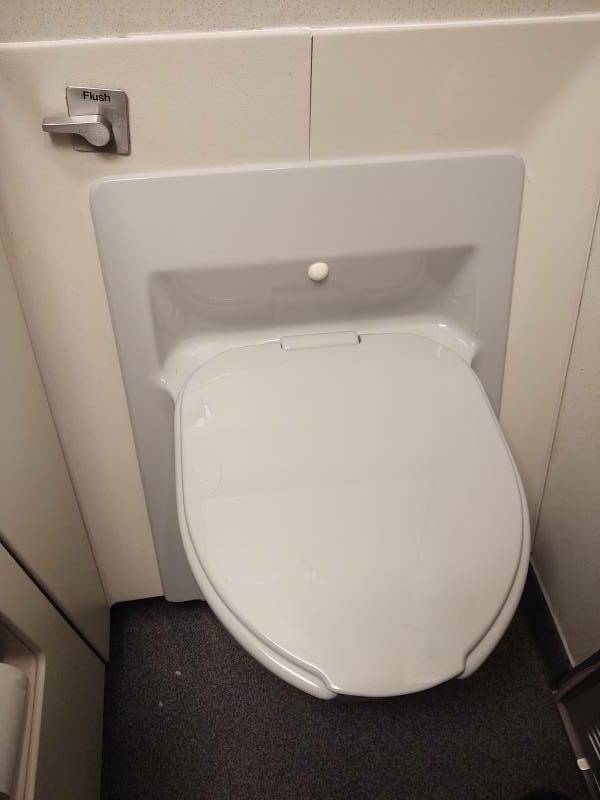
Aircraft lavatory design has changed through the years. Listen to the captain of your aircraft or vessel to know when it's safe to move around. Modern aviation is far better for toilet facilities than a few decades ago, similar to how toilets have improved on boats as well, making them safer to use when underway. The costs of owning a yacht, as well as an airplane, have gone up in recent years partly due to improvements in sanitation facilities. Here is the toilet in a lavatory on board a Northwest Airlines Airbus A330 en route from London to Detroit.
This is one of the toilets against the fuselage skin, not one of the only slightly more roomy center ones.
The A330 is a twin-engine wide-body aircraft that can haul up to 335 passengers over a range of up to 13,430 kilometers. Service ceiling is 41,100 feet or 12,527 meters, its two Rolls-Royce Trent 700 engines move it at a cruise speed of Mach 0.82, which is 470 knots or 871 kph at a cruise altitude of 36,000 feet or 11,000 meters.
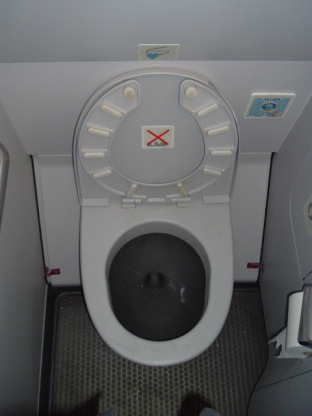
An April 2013 article in the Wall Street Journal reported that B/E Aerospace had beat out Zodiac Aerospace in a large contract to Boeing to supply lavatory assemblies, as they had shrunk the lavatory compartment even more and thereby airlines could squeeze a few more seats into an already packed fuselage. Delta announced that they would cram four more seats into their 737-900s.
Both B/E and Zodiac provide some information on their cabin interiors. Zodiac says that it's the market leader, with about 60,000 vacuum toilets or 75% of the total flying every day.
How Dirty Are The Lavatories?
Coffee, Tea, or Coliform? Dangerous Lavatory WaterIt's a tiny compartment containing a toilet that flushes with violent force. Fecal bacteria spread throughout the lavatory compartment in the mist caused by flushing. Studies find dangerous E. coli bacteria on and around the water taps.
Don't drink the water in the lavatory!
Why do your ears sometimes feel pressure changes when you flush an airline toilet?
Because the vacuum flushing may cause the pressure altitude within the tiny toilet cabin to quickly jump 5 to 20 meters or more, say from about 2000m pressure altitude to 2020m.
How do I know this?
All you have to do is take a barometric altimeter into an airliner lavatory and measure it for yourself.
The vacuum flush system provides adequate flushing of waste while minimizing the amount of heavy flush water they must carry on board. The system was patented in 1975. It's lighter and reduces odor. See US3922730 A, "Recirculating toilet system for use in aircraft or the like".
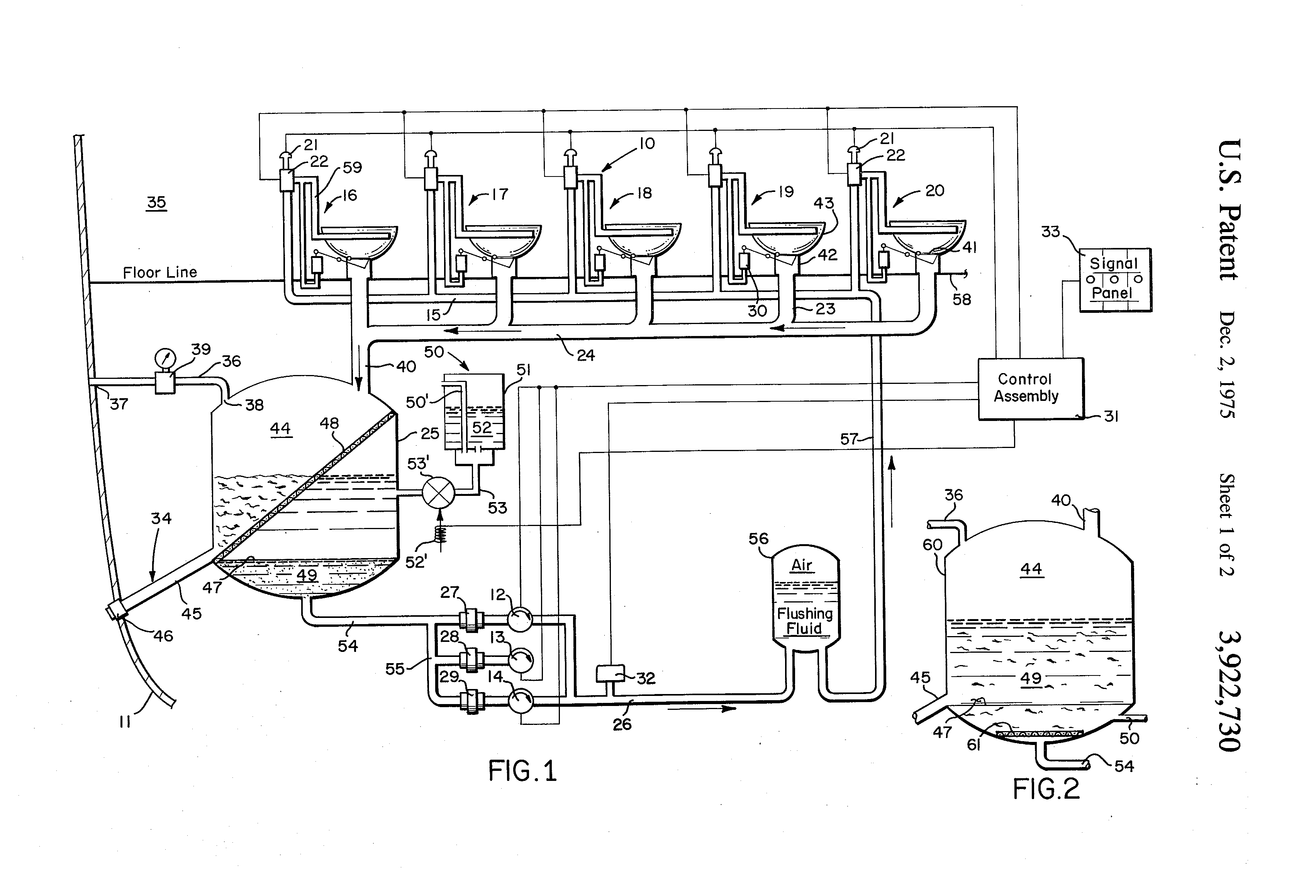
How much water does it take to flush an airline toilet?
JAMCOLavatories Vestergaard Lavatory
Service Trucks Iliff Aircraft
Service & Repair
It depends. There are several manufacturers, and they compete on measures including size, weight, and shape (to conform to the fuselage and to allow seats directly in front to slightly recline). And, on the amount of flushing fluid used per cycle.
B/E AerospaceVacuum Waste System B/E Aerospace
Lavatory Designs
This Wall Street Journal article "Zodiac, B/E Aerospace Compete to Improve Airplane Toilets" describes a new design by Zodiac and the Japanese lavatory maker Jamco Corporation that consumes "less water per flush than the standard six or eight ounces [0.18-0.24 liters] in other models".
Flushing fluid can be reduced by two factors. First, strong vacuum flushing. Second, low-friction, non-wetting surfaces, similar to Teflon. Boeing started installing vacuum toilets in 1982, according to a Gizmodo story.
The blue liquid, literally marketed as "Blue Juice" by some manufacturers, serves as a disinfectant, odor suppressor, corrosion prevention, and anti-freeze. The Society of Automotive Engineers has defined a series of standards for airplane lavatory flushing fluid.
SAE AMS 1476C (current) SAE AMS 1476 (historical) SAE AMS 1476A (historical) SAE AMS 1476B (historical)
Here is one toilet along the fuselage centerline on a Boeing 747 on a KLM flight from Amsterdam to Chicago.
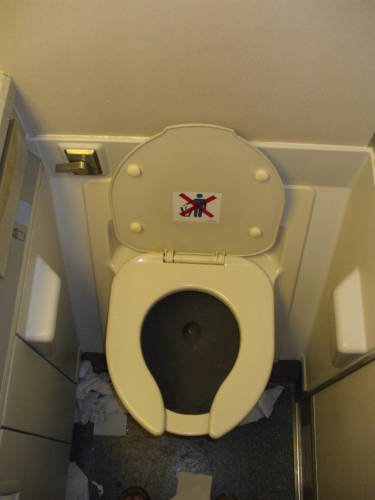
The Boeing 747 has been in commercial service since 1970. KLM flies the 747-400M Combi model, carrying 251 passengers in 45 rows of seats with cargo loaded on pallets through a large side cargo door into an aft compartment. It can cruise at Mach 0.85 (493 knots or 912 kph at 35,000 feet) with a maximum range of 13,450 kilometers or 7,260 nautical miles.
How and when are the lavatories cleaned?
There aren't any laws regulating how airlines maintain on-board lavatories, and in fact there is no requirement for having them at all.
On many airlines, technical operations employees disinfect the lavatories overnight using cleaning products containing bleach (or sodium hypochlorite). Between flights during the day, the cleaning crews empty the trash, restock supplies, and mop the lavatory floor. In flight, the flight attendants usually check the lavatories regularly, typically every 30 minutes, partly to make sure that paper products are still available but more to make sure that no one is hiding out indefinitely in the lavatory.
The airports are responsible for emptying the holding tanks. The Airbus A380 has four waste tanks holding 2100 liters. The waste tanks in the Boeing 747 hold less than half of that.
They do not simply dump the waste overboard
That's just a rumor. The waste is not dumped overboard to fall as "blue ice". This urban legend became so prevalent that the U.S. Federal Aviation Administration issued a press release, "Fact Sheet — It Came From the Sky: Human Waste, Blue Ice and Aviation".
Aircraft lavatory waste is contained in a holding tank which can only be accessed from the exterior of the plane. Pilots have no means of dumping a tank, the external access lever can only be operated by ground crews.
As the FAA attempts to patiently explain, reports of falling waste are highly correlated with the migration of geese. People insist that they were hit by smelly blue waste so it must have falled from a plane. But as the FAA says:
Bird migration also occurs during a time when fruit trees are ripening. As the fruit goes through a bird's digestive system it loses none of its color, which means if it was blue going in, it will be blue coming out.
Bus toilets, however, can be dumped by the driver. From the Chicago Tribune, March 10, 2005:
A driver for the Dave Matthews Band admitted Wednesday
that he emptied his bus' septic tank over the Chicago River
last summer, drenching passengers on an architectural
boat tour with 800 pounds of human waste.
In a court hearing Wednesday morning, Wohl admitted that
on the afternoon of Aug. 8, he discharged the septic tank
while the bus crossed the grated Kinzie Street Bridge
downtown, endangering about 100 sightseers riding the
open-deck tourist boat passing under the bridge.
Passengers on the tour boat, Chicago's Little Lady,
described a downpour of foul-smelling, brownish-yellow slurry
that ruined their clothes and made several of them sick.
And from USA Today, April 29, 2005:
CHICAGO (AP) — The Dave Matthews Band, settling a
lawsuit stemming from human waste dumped from a tour bus
onto people touring the Chicago River, has agreed to pay
$200,000 to an environmental fund and take measures
to avoid a repeat of the incident,
the Illinois attorney general said Friday.
[....]
The band agreed to record when and where its tour buses
empty septic tanks.
What about that blue fluid in airliner lavatories?
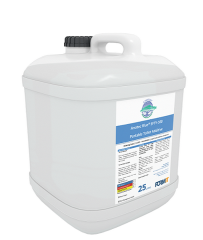
It's a disinfectant chemical added to the water used for flushing. Anotec, an Australian firm, is a prominent supplier. Their Anotec Blue SFTY-100 is commonly used in aircraft toilets. It comes in containers containing up to 1,000 liters. It combines straightforward disinfection with a catalytic process that breaks down waste solids. A surfactant helps to prevent clogging lines to allow for clean pump-out.
Earlier chemical toilet solutions used hazardous chemicals including formaldehyde and glutaraldehyde.
Anotec's literature describes Anotec Blue SFTY-100 liquid toilet additive as a fluid that boils at 102°C, with a vapor pressure of 15 mm of mercury at 25°C and a specific gravity of 1.07. Its pH is in the range 6.8 to 7.3. It comes in the classic blue and also clear formulations, and they offer up to ten different fragrances if you're buying in bulk.
As for dosing, let's say you have a 200 liter tank. Put in enough water to cover the bottom, and then pour just 100 milliliters of Anotec Blue into the tank. Then fill the tank with water. It looks like this is potent stuff!
The McDonnell Douglas MD-80 family of short to medium-range airliners are lengthened and updated versions of the DC-9. The MD-80 series entered commercial service in 1980, the precusor DC-9 first flew in 1965.
The MD-80 series included the MD-81, MD-82, MD-87 and MD-88. The lavatory shown below is in an MD-88 operated by Delta Airlines. This final MD-80 variant was introduced in January, 1986. It is very similar to the MD-82 and MD-83 with the exception of a "glass cockpit" (or electronic flight instrument system) and some updated cabin trim.
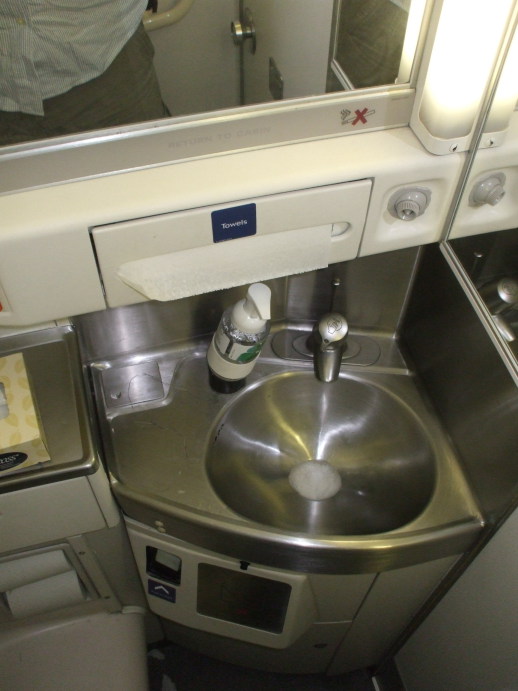
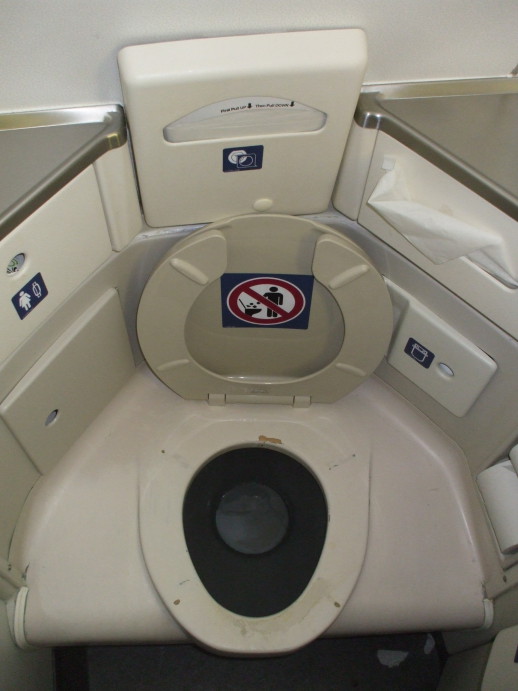
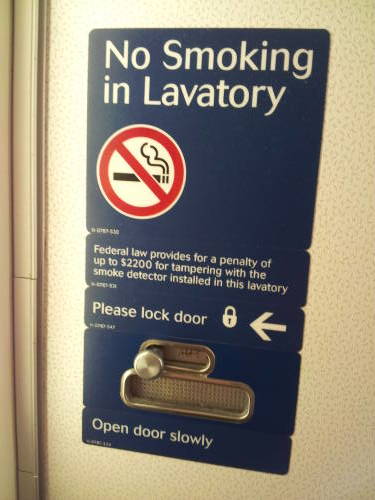
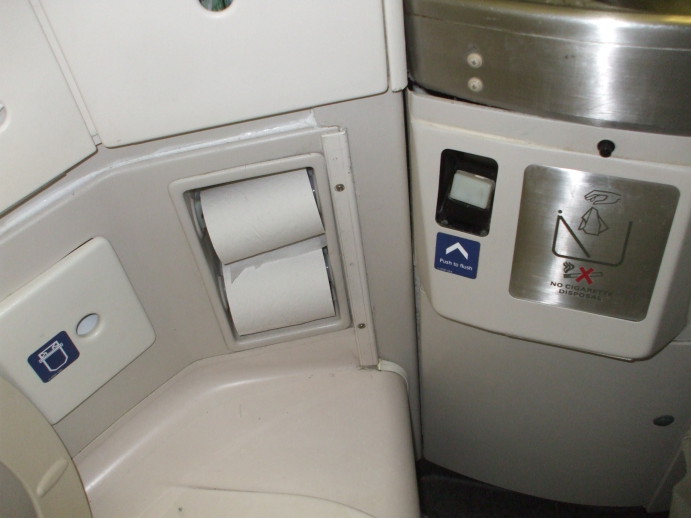
The MD-88 entered service with Delta in 1988, and this one was still in service in early 2012. In early 2018 Delta announced a plan to start replacing their MD-series aircraft.
The MD-90 series followed, with more fuel-efficient engines and a longer fuselage. This included the MD-90 and the MD-95, which was renamed the Boeing 717-200 in 1997 after Boeing merged with McDonnell Douglas, which itself was the successor to the Douglas Aircraft Company.
Current flights of:
MD80
MD82
MD88
MD90
MD-95 / B717-200
Boeing B767-300ER
Here is a toilet on board a Delta Boeing 767-300ER en route from Atlanta to Athens.
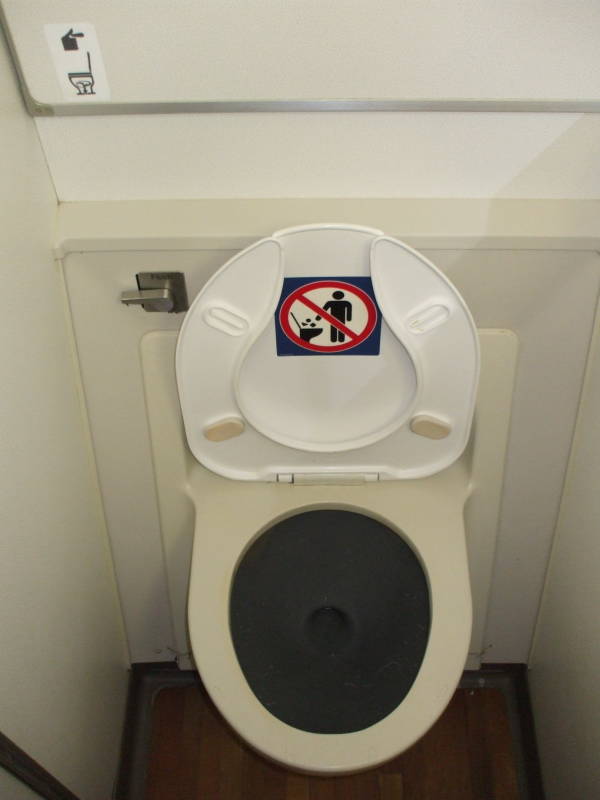
The Boeing 767 is a mid-sized wide-body airliner with two engines. It entered commercial service in 1982. In 1985 it became the first twin-engine airliner to be approved for extended overseas flights. Regulatory agencies including the U.S. Federal Aviation Administration for ETOPS-120, Extended Operations up to 120 minutes flying time from the nearest emergency diversion airport. In the 1990s the 767 became the most used airliner for transatlantic flights between Europe and North America. The 747 entered commercial service in 1970. Airlines are replacing them with earlier models. The 747 is still flying, but along with the 1970s DC-10, MD-10, and MD-11, these older passenger jets have mostly transitioned to cargo service today.
The 767-300ER entered service in 1988. It has become the most popular 767 variant, with airliners placing more orders for the 767-300ER than for all the other variants combined.
The 767-300ER has enough range for transpacific service. Its maximum range at maximum takeoff weight is 11,065 kilometers or 5,990 nautical miles. It can cruise at Mach 0.80, 470 knots or 851 kph, at a cruising altitude of 11,000 meters or 35,000 feet.
Here is the lavatory on board a B767-300ER operated by Delta flying from Atlanta, USA, to Santiago, Chile. This is one of the mid-cabin lavatories in Economy. But it's not as if First Class lavatories are really any nicer. This one was in pretty good shape, given that we were over 5 hours into a 9 hour flight.
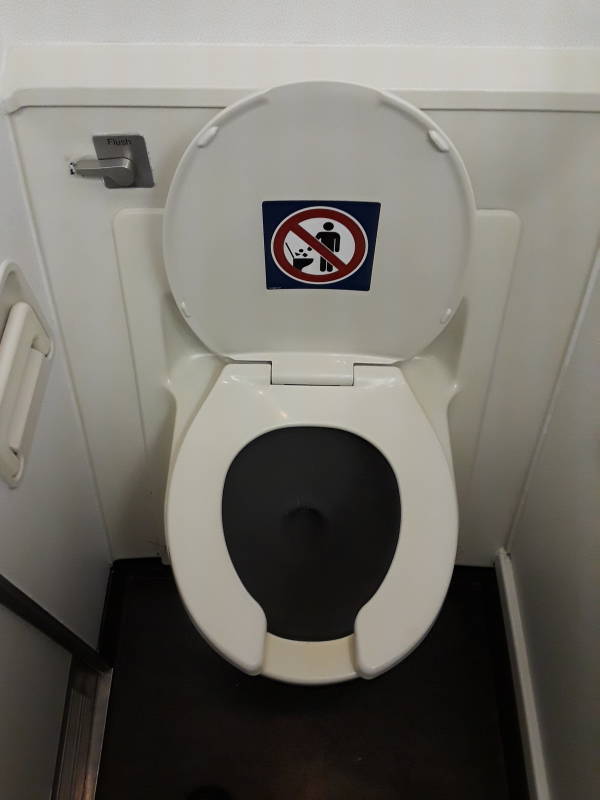
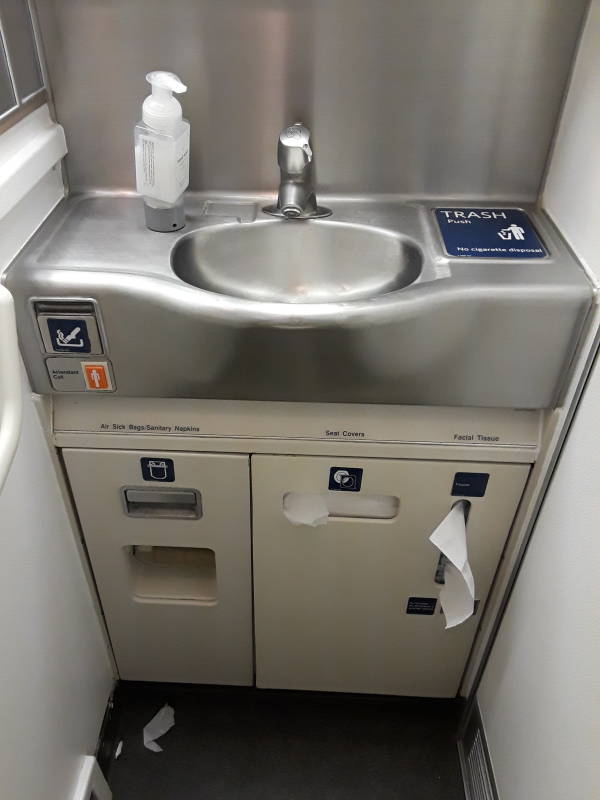
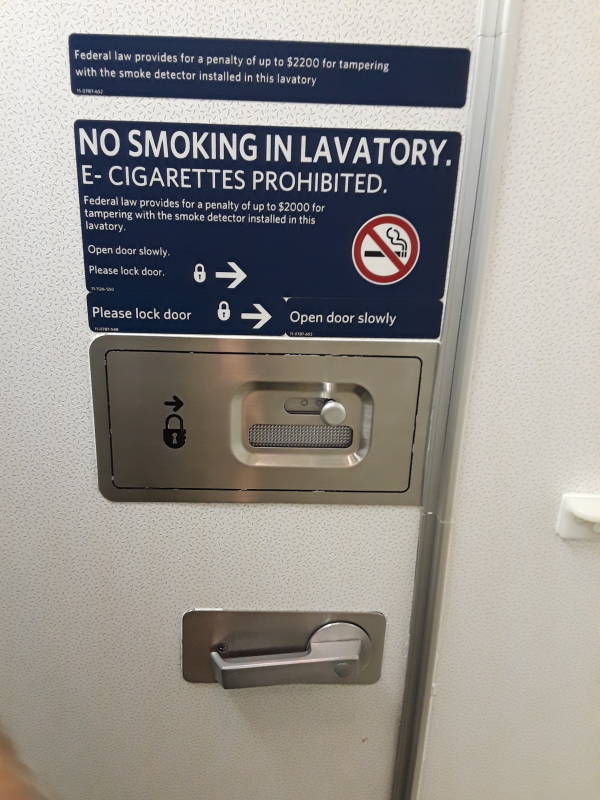
Aren't The Lavatories Tiny?
Yes, and they're getting smaller.
The Boeing 737 MAX went into service in May 2017. A group of American Airlines flight attendants soon complained about the lavatory design.
The cabin has about 12 more seats than older versions of the B737 series. The rear lavatories are between the rear passenger seats and the galley, so open lavatory doors block access to and from the galley.
They also complained that the sinks are so small that water splashes onto anyone trying to wash their hands.
Ashtrays and Razor Blades
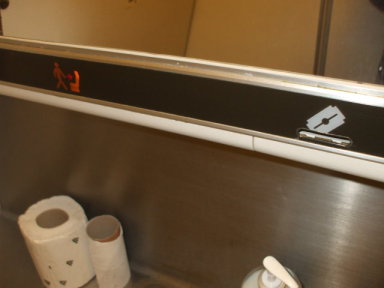
At left is part of the interior of a lavatory on a Boeing 767 operated by Alitalia, en route from Rome to Chicago. I don't know what the engineers at Boeing were thinking....
See the slot for disposing of your used razor blades?
How is that going to be useful?
It's probably somewhat like the ashtray on the inside of the lavatory door. Smoking has been banned on board flights in most of the world for several years now. However, the U.S. Federal Aviation Administration requires that lavatory doors have ashtrays. They realize that some people are going to smoke anyway, and without an ashtray they are likely to put their cigarette butts into the trash and start a fire. See the FAA's formal policy requiring lavatory door ashtrays.
People are still addicted to tobacco. But who shaves with disposable razor blades?
Iceland Air B767-300
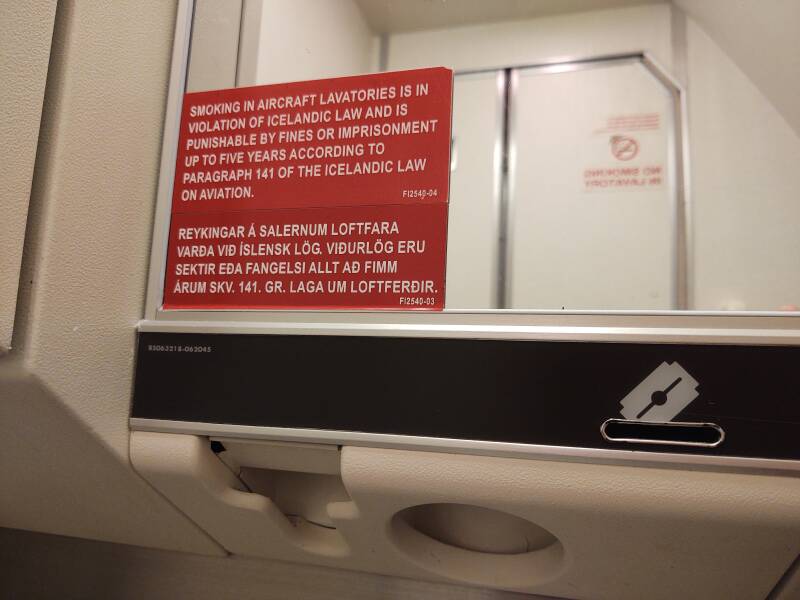
This is one of the rear lavatories on board an Iceland Air B767-300 en route from Keflavík to New York JFK.
Boeing keeps putting razor blade disposal slots in all their aircraft. Here's the Icelandic legal notice about smoking in the lavatory.
DC-7
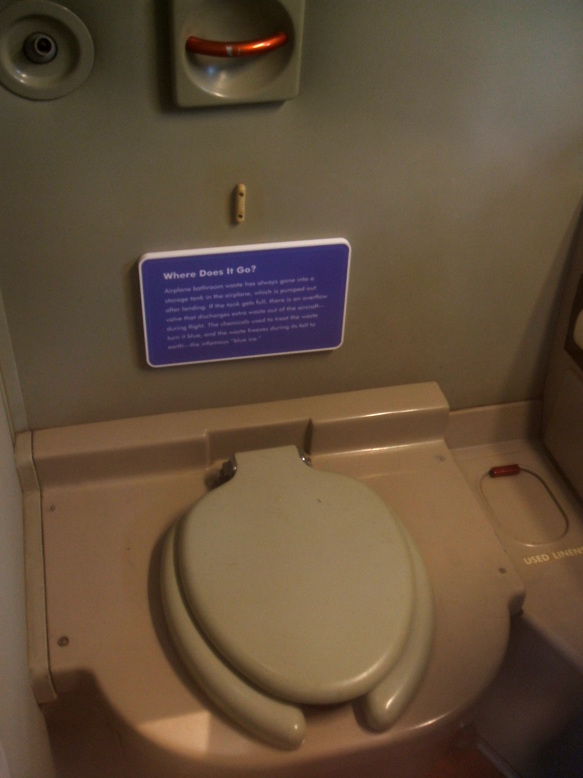
Here is the port lavatory in a Douglas DC-7, as seen at the Smithsonian's National Air and Space Museum in Washington DC, USA.
The DC-7 was the last major piston-engined transport made by Douglas, built from 1953 to 1958. 348 were built. The U.S. FAA aircraft registry showed in mid 2017 that there were 16 DC-7 aircraft still registered. Five of the original DC-7, six DC-7B, two DC-7BF, and three DC-7F. They're disappearing. In early 2013 the total was 11 original DC-7 models, 18 DC-7B, 2 DC-7BF, 20 DC-7C, and one DC-7CF.
Back in 1953, American Airlines charged $302 for a round-trip ticket — New York to Los Angeles and return. Adjusted for inflation, $302 in 1953 is equal to $2,788 in 2018.
Here is the starboard lavatory of the DC-7. Yes, both port and starboard lavatories.
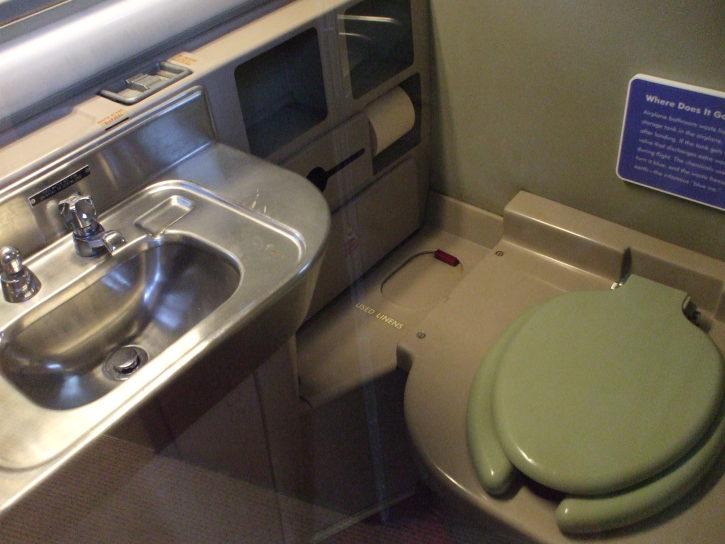
The added informative placards in blue above the seats say:
Airplane bathroom waste has always gone into a storage tank in the airplane, which is pumped out after landing. If the tank gets full, there is an overflow valve that discharges extra waste out of the aircraft—during flight. The chemicals used to treat the waste turn it blue, and the waste freezes during the fall to earth—the infamous "blue ice."
Well, that's partly true. Later commercial airliners have used waste holding tanks, but the earlier on-board toilet situation was different.
During World War II, large bomber aircraft like the American B-17 and the British Avro Lancaster had chemical toilets on board. They often malfunctioned and were difficult to use given the many layers of clothing worn against the intense cold of high altitude flight. Bomber crews preferred to urinate into bottles and defecate into cardboard boxes, which could be thrown from the aircraft.
The British Supermarine Stranraer was a flying boat used for anti-submarine and convoy escort patrols until March 1941. It was designed in the 1930s, the last of the RAF's biplane flying boat designs. Its on-board toilet had a waste pipe that opened to the exterior. When you lifted the toilet's lid in flight, the airflow past this waste pipe produced a whistling noise. Predictably, the entire aircraft became known as the Whistling Shithouse.
For more on the proper airflow of vented toilet waste pipes, and the problems caused when this fails, see the Train Toilet page.
U.S. Presidential Aircraft
U.S. Presidents Franklin Roosevelt through Eisenhower had personal aircraft, all of which were given distinctive names by their VIP users.
A USAF Boeing VC-137C, the military designation for the 707-320B, was built specifically for use by the President of the United States during the administration of John F. Kennedy. The aircraft had serial number 62-6000 and used callsign SAM 26000 (for "Special Air Mission") during routine flight, and Air Force One when the President was on board.
The Boss would be seated at the table seen here, with a personal lavatory through the narrow doorway behind it.
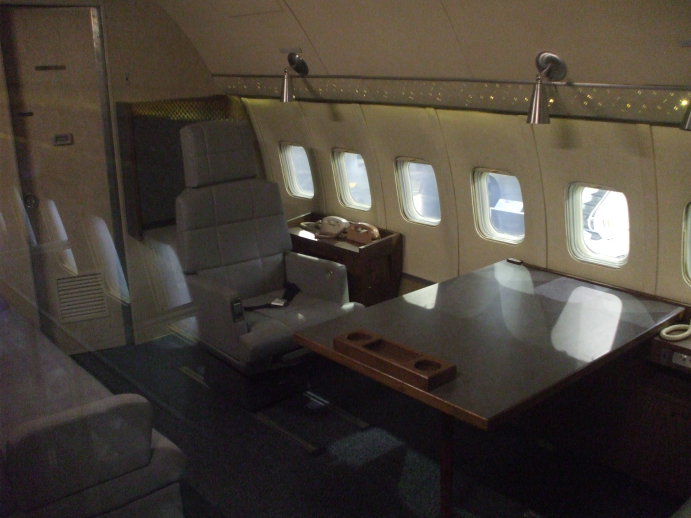
This aircraft carried Kennedy and all of the next seven Presidents: Johnson, Nixon, Ford, Carter, Reagan, George H.W. Bush, and Clinton. Today it is at the WPAFB museum.
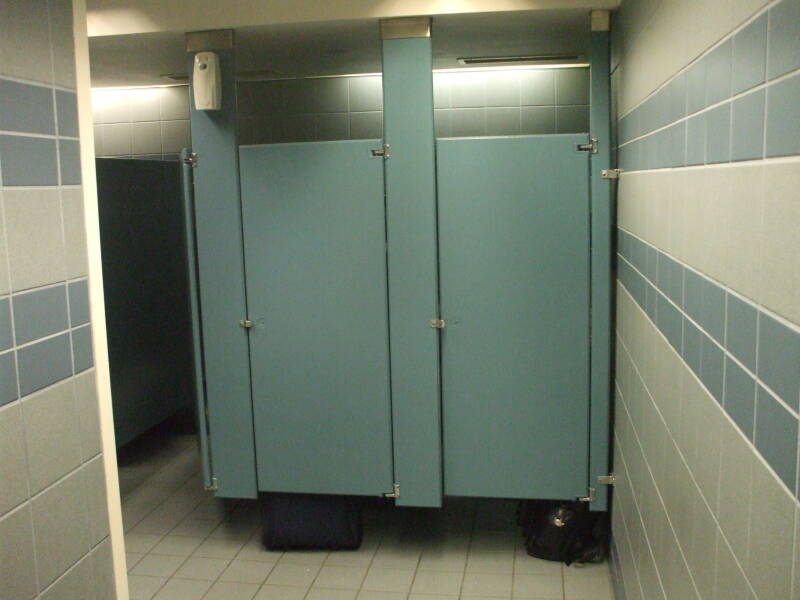
The stalls occupied by U.S. Larry Craig and the undercover police officer.
At left is the men's rooms at Minneapolis-St Paul International Airport where U.S. Senator Larry Craig was arrested for soliciting sexual acts.
The dedicated page shows the toilet itself, the entrance to the men's room and its location in the busy central concourse of the airport, and to read about the incident.
One airborne toilet that I have used and failed to photograph was the all-metal toilet on board a Syrian Arab Airlines Tupolev Tu-154m. Surely it was aluminum, although it had the look of stainless steel.
In February, 2011, the FAA issued Air Worthiness Directive 2011-04-09, ordering every U.S. airline to empty or remove the emergency oxygen tanks in all their aircraft lavatories. The change was kept secret from the public for a month.
The reason was security: the FAA said that oxygen generators in lavatories could be used by terrorists to take down airplanes by turning the canisters into explosive devices.
The FAA said that there had only been 12 incidents in the past ten years of pressure loss at cruising altitude. Just over one a year, they consider that a low enough risk for the flying public to run without being told about it.
In September, 2011, Boeing announced a number of the passenger improvements on board their 787 Dreamliner, as All Nippon Airways planned to start passenger operation of the new jet in October. These included larger windows, decreased pressure but increased humidity in the cabin air, and bidets with button control of various spray options.
Search for aviation incidents caused by toilet problemsThe Aviation Herald maintains a searchable database of aviation incidents. These include flights cancelled, delayed, or diverted en route due to problems with the lavatories. Use the button at right to search for recent ones!
In March, 2016, Boeing unveiled a prototype self-cleaning lavatory which uses ultraviolet light to kill 99.99% of germs with just a 3-second blast after a person exits. It also includes hands-free faucet, soap dispenser, trash flap, toilet lid, toilet seat, and hand dryer. A hands-free door latch is also under study.
Yes, the airship Goodyear purchased from the Zeppelin corporation has a toilet on board, passengers and crew are no longer stuck on board for a six-hour flight without one. No picture here, I haven't seen it myself.